What is 'primal panic' and is that what she's been feeling?
6 min read
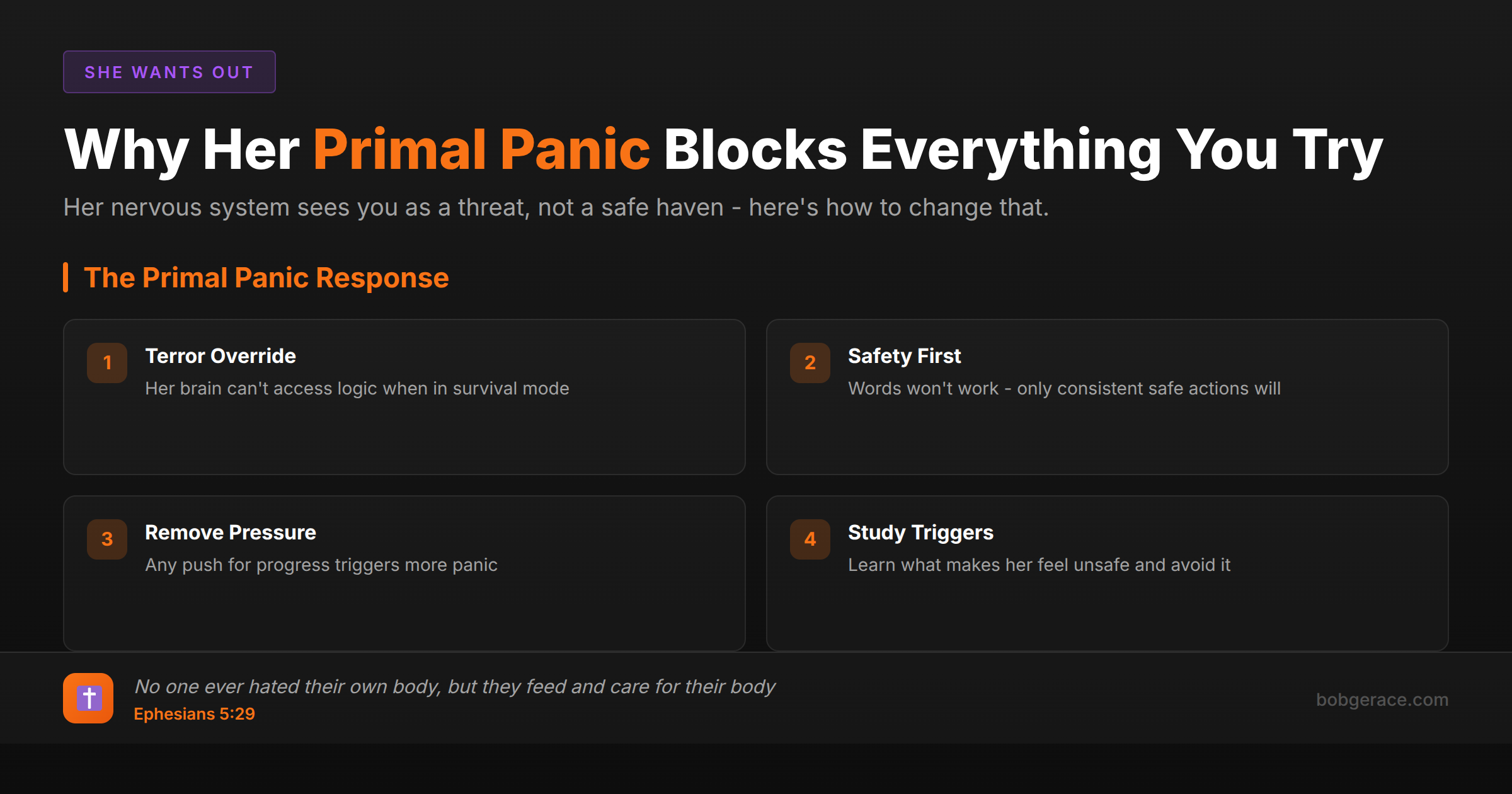
Primal panic is the deepest level of attachment terror - it's what happens when your wife's nervous system perceives you as a threat rather than a safe haven. This isn't regular anxiety or frustration. It's a biological alarm system screaming that her primary attachment bond is in danger. When she's in primal panic, her brain literally can't access logic or reason. She's operating from pure survival mode, which is why your attempts to talk through things or make promises fall flat. Her nervous system has decided you're dangerous, and until that changes at a biological level, nothing else matters. This is likely what's been driving her withdrawal, her seeming inability to forgive, and her desperate need for distance.
The Full Picture
Primal panic happens when repeated attachment injuries create a fundamental shift in how your wife's nervous system perceives you. Instead of seeing you as her safe person, her brain now categorizes you as a threat.
This typically develops through patterns like: • Chronic emotional unavailability - she reaches for connection and repeatedly finds emptiness • Betrayals of trust - promises broken, lies told, or emotional affairs • Feeling unheard or dismissed - her concerns minimized or explained away • Emotional volatility - walking on eggshells around your moods or reactions
What makes this so devastating is that marriage is supposed to be her primary source of safety. When that becomes her primary source of danger, her entire world turns upside down.
The panic isn't just emotional - it's physiological. Her heart races when you walk in the room. She has trouble sleeping beside you. Physical intimacy feels impossible because her body is in protection mode. This isn't a choice she's making - it's a biological response to perceived threat.
Most men make the mistake of trying to logic their way out of this. They explain, defend, or make promises. But you can't think your way out of primal panic. The nervous system doesn't speak in words - it speaks in consistent, safe experiences over time.
The good news? This can be healed, but it requires you to understand what safety actually looks like to her wounded nervous system.
What's Really Happening
From a clinical perspective, primal panic represents what we call disorganized attachment - when the person who should provide safety becomes the source of threat. This creates a neurological double-bind that's incredibly distressing.
Research from the Gottman Institute shows that when someone's nervous system is chronically activated by their partner, they develop what's called diffuse physiological arousal (DPA). Their baseline heart rate increases, stress hormones remain elevated, and they lose the ability to self-soothe in the relationship.
Sue Johnson's work on Emotionally Focused Therapy identifies this as an 'attachment injury' - a moment or pattern where one partner fails the other during a critical time of need. When these injuries accumulate, they create what I call 'attachment trauma' within the marriage.
The amygdala - our brain's alarm system - begins firing whenever the injured partner encounters triggers associated with their spouse. This happens below the level of conscious thought. They might not even understand why they feel panicked, but their body knows.
Neuroplasticity research gives us hope here. The brain can rewire itself when provided with consistent, predictable safety cues over time. But this process can't be rushed. The nervous system needs hundreds of micro-experiences of safety to begin trusting again.
This is why traditional couples counseling often fails when primal panic is present. You can't negotiate with a dysregulated nervous system. Safety must be established first, then communication and problem-solving can follow.
What Scripture Says
Scripture speaks clearly about our responsibility to create safety in marriage. Ephesians 5:28-29 says, 'Husbands ought to love their wives as their own bodies. He who loves his wife loves himself. After all, no one ever hated their own body, but they feed and care for their body.' The word 'care' here means to provide warmth and comfort - exactly what a panicked nervous system needs.
1 Peter 3:7 instructs husbands to 'be considerate as you live with your wives, and treat them with respect as the weaker partner and as heirs with you of the gracious gift of life.' This isn't about physical weakness - it's about emotional vulnerability and the husband's role as protector.
When David cries out in Psalm 55:4-5, 'My heart is in anguish within me; the terrors of death have fallen on me. Fear and trembling have beset me; horror has overwhelmed me,' he's describing something remarkably similar to primal panic - that overwhelming sense of threat and terror.
Isaiah 41:10 offers God's response to such fear: 'So do not fear, for I am with you; do not be dismayed, for I am your God. I will strengthen you and help you; I will uphold you with my righteous right hand.' As husbands, we're called to reflect God's character - to be a source of strength and safety, not fear.
Proverbs 18:21 reminds us that 'the tongue has the power of life and death.' Our words and actions either feed her panic or speak life into her wounded spirit. The choice is ours.
What To Do Right Now
-
1
Stop trying to convince her with words - focus entirely on demonstrating safety through consistent, small actions
-
2
Acknowledge that her panic is real without defending yourself or explaining your intentions
-
3
Remove all pressure for reconciliation, intimacy, or relationship progress - let her nervous system rest
-
4
Study her specific triggers and actively avoid them while she heals
-
5
Seek individual therapy to understand how you contributed to her feeling unsafe
-
6
Pray for her healing and ask God to show you how to be a source of peace rather than panic
Related Questions
- What is 'attachment injury' and did I cause one?
- Why does one event seem to define our whole marriage to her?
- How does unaddressed attachment pain accumulate?
- What does 'emotional starvation' look like in a wife?
- What are 'failed bids for connection' and how many did I miss?
- What is 'deactivation' and has she done it?
- What are 'attachment injuries' and how many did I cause?
- What does chronic stress do to her capacity for connection?
- What is anxious attachment and am I doing it right now?
- Why do I feel like I'm going to die if she leaves?
Also find Bob on
Subscribe for weekly videos on Christian marriage.
Your Marriage Needs More Than Theory
Understanding primal panic doesn't fix it. A coach who knows your specific history can show you what safety looks like in your actual marriage, not just in general.
Talk to Bob →