What is 'attachment injury' and did I cause one?
6 min read
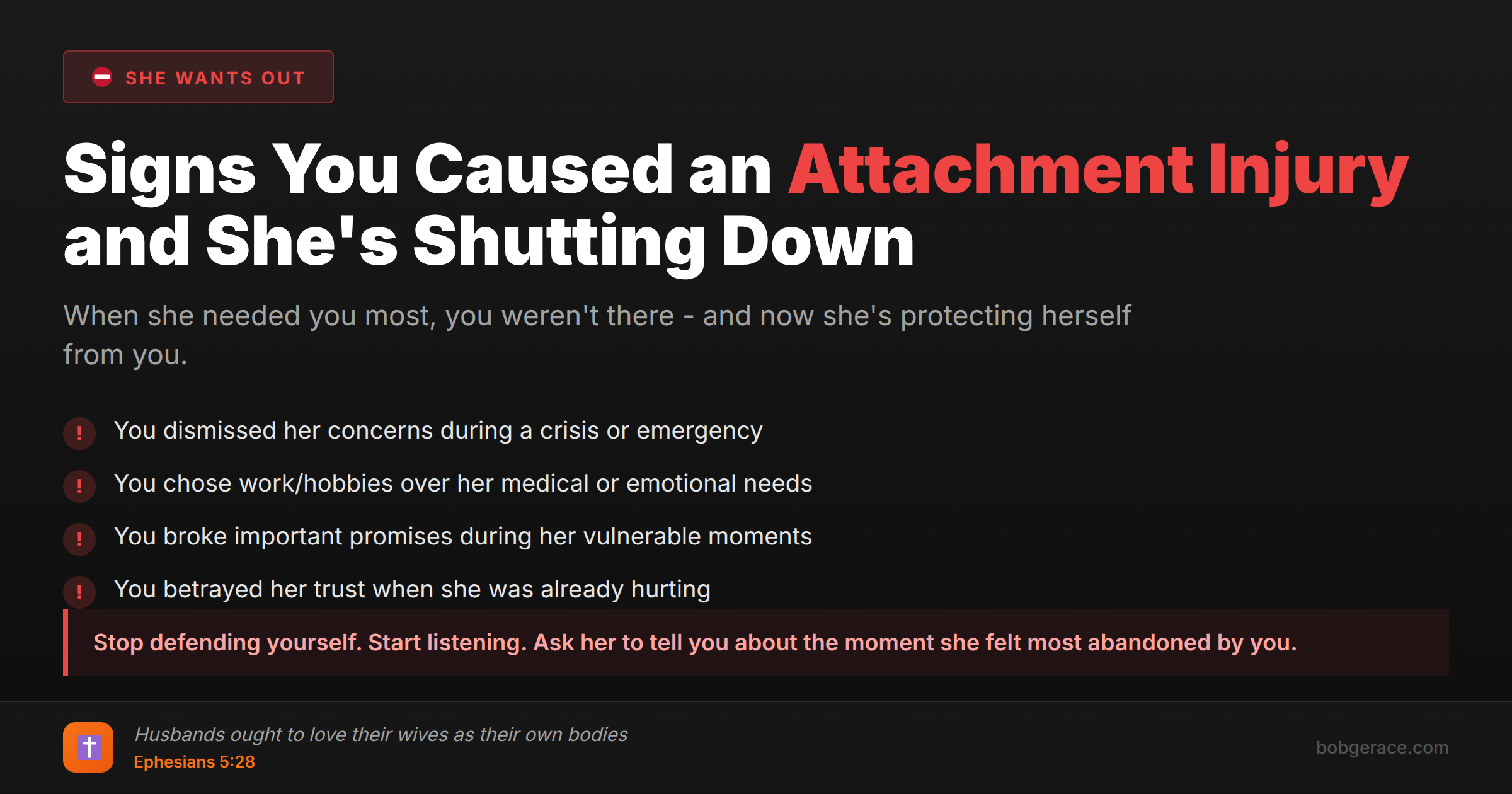
An attachment injury is a deep emotional wound that happens when your spouse feels abandoned, betrayed, or let down by you during a moment of extreme vulnerability or need. It's not just any argument or disappointment - it's a specific incident where she reached out for connection, safety, or support, and you weren't there or actively caused harm instead. Yes, you likely caused one if your wife is pulling away or has shut down emotionally. Common examples include dismissing her concerns during a crisis, choosing work over her medical emergency, breaking promises during vulnerable moments, or betraying her trust when she needed you most. The injury isn't just about what you did - it's about the message it sent: 'I can't count on you when I need you most.' This creates a protective withdrawal that can feel impossible to penetrate.
The Full Picture
Think of attachment injury like a physical wound that never properly healed. When your wife needed you most - maybe during a family crisis, health scare, job loss, or emotional breakdown - something happened that made her feel completely alone despite being married to you.
Common attachment injuries include: • Dismissing her fears or concerns during a vulnerable moment • Choosing work, friends, or hobbies over her during a crisis • Breaking important promises when she was counting on you • Being emotionally unavailable during grief or trauma • Minimizing her pain when she opened up to you • Taking someone else's side against her in front of others • Betraying her trust or confidence when she was at her lowest
The injury isn't just about the incident itself - it's about the story it created in her mind: 'He won't be there when I need him.' This story becomes the lens through which she views your relationship, making her hyper-vigilant to any sign that confirms her worst fears.
Here's what makes this so devastating: she didn't just lose trust in you during that moment - she lost trust in the relationship itself as a safe haven. Every subsequent attempt at connection gets filtered through this wound. Your efforts to fix things may feel threatening to her because getting close means risking being hurt again.
Most men focus on defending their actions or explaining their perspective. This misses the point entirely. The injury isn't about whether your behavior was justified - it's about the impact it had on someone who was supposed to be able to count on you unconditionally.
What's Really Happening
Attachment injuries represent violations of what researchers call the 'attachment bond' - the deep emotional connection that provides safety and security in intimate relationships. Dr. Sue Johnson's work on Emotionally Focused Therapy identifies these injuries as moments when the attachment system is activated (your partner needs comfort, protection, or connection) but instead of receiving care, they experience abandonment or betrayal.
Neurologically, attachment injuries create lasting changes in the brain's threat detection system. The injured partner's amygdala becomes hyperactive when attachment cues are present, triggering fight-or-flight responses even during seemingly normal interactions. This explains why your wife may seem to overreact to situations that appear minor to you - her brain is responding to the original wound, not just the current moment.
Research shows that unhealed attachment injuries create what we call 'negative sentiment override' - a state where positive interactions are interpreted through a negative lens. Even genuine attempts at repair can be viewed with suspicion because the injured partner's nervous system remains in a protective state.
The healing process requires more than apologies or behavior change. It demands what we term 'injury resolution work' - a structured process where the injured partner can express the full impact of the wound while the injuring partner demonstrates genuine understanding and accountability. This isn't about blame but about creating new neural pathways that allow the attachment system to feel safe again.
Without proper resolution, attachment injuries often lead to emotional withdrawal, affair vulnerability, or relationship dissolution. However, when properly addressed, couples can actually emerge stronger than before the injury occurred.
What Scripture Says
Scripture calls husbands to be protectors and nourishers of their wives. Ephesians 5:28-29 says, 'Husbands ought to love their wives as their own bodies. He who loves his wife loves himself. After all, no one ever hated their own body, but they feed and care for their body, just as Christ does the church.' When we fail to care for our wives during their most vulnerable moments, we violate this sacred calling.
1 Peter 3:7 instructs us to 'live with your wives in an understanding way, showing honor to the woman as the weaker vessel, since they are heirs with you of the grace of life, so that your prayers may not be hindered.' Notice the warning - when we fail to understand and honor our wives, it affects our relationship with God himself.
The concept of covenant love means being present during both good times and bad. 1 Corinthians 13:7 reminds us that love 'bears all things, believes all things, hopes all things, endures all things.' This doesn't mean enabling unhealthy behavior, but it does mean showing up consistently, especially when your spouse is struggling.
Jesus himself models what it means to be present during crisis. In Matthew 26:38, He tells His disciples, 'My soul is overwhelmed with sorrow to the point of death. Stay here and keep watch with me.' He didn't ask them to fix His problem - He asked them to simply be present during His darkest hour.
Galatians 6:2 calls us to 'carry each other's burdens, and in this way you will fulfill the law of Christ.' When we abandon our wives during their heaviest burdens, we miss the opportunity to reflect Christ's love and create wounds that require intentional healing through confession, repentance, and restored faithfulness.
What To Do Right Now
-
1
Stop defending yourself and start listening - ask her to tell you about the moment(s) when she felt most abandoned or betrayed by you
-
2
Acknowledge the injury without explaining your side - say 'I can see how my actions hurt you deeply and I take full responsibility'
-
3
Write down the specific incident(s) and how your actions impacted her, then read it back to her for accuracy
-
4
Ask what she needed from you in that moment and what it felt like when you weren't there for her
-
5
Make a specific commitment about how you'll respond differently in similar situations going forward
-
6
Give her permission to remind you of this commitment without getting defensive when future triggers arise
Related Questions
- What are 'failed bids for connection' and how many did I miss?
- Why does one event seem to define our whole marriage to her?
- What is 'primal panic' and is that what she's been feeling?
- How does unaddressed attachment pain accumulate?
- What does 'emotional starvation' look like in a wife?
- Is her leaving connected to past trauma?
- What are 'attachment injuries' and how many did I cause?
- How does unaddressed hurt compound?
- What attachment injuries did I experience?
Also find Bob on
Subscribe for weekly videos on Christian marriage.
This Work Needs a Human in Your Corner
Healing an attachment injury in your specific marriage isn't something you figure out alone. A coach who knows your story can help you navigate what to say, when to push, when to wait.
Talk to Bob →