What does Hosea model about forgiveness?
6 min read
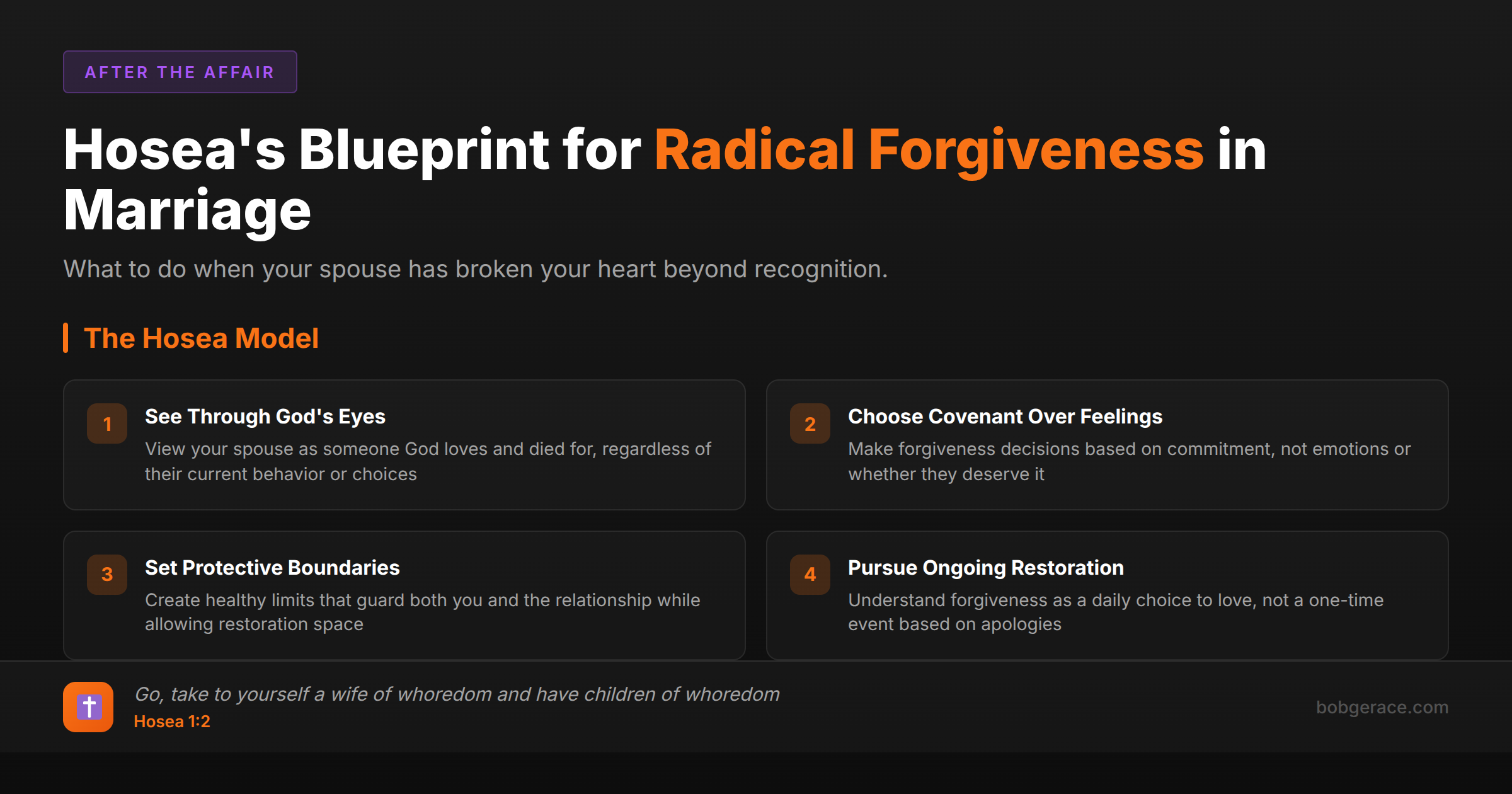
Hosea models the most radical form of forgiveness imaginable - pursuing and restoring a spouse who has repeatedly been unfaithful. God commanded Hosea to marry Gomer, a prostitute, knowing she would be unfaithful, then to buy her back from slavery and restore their marriage. This wasn't just forgiveness after an apology - this was covenant love that pursued restoration despite ongoing betrayal. Hosea's story shows us that biblical forgiveness isn't about feelings or fairness - it's about covenant commitment that mirrors God's relentless love for His people. Hosea chose to love Gomer not because she deserved it, but because his love reflected God's character. This model challenges us to see forgiveness not as a one-time event, but as an ongoing choice to pursue restoration even when it costs us everything.
The Full Picture
The book of Hosea presents one of the most challenging and beautiful pictures of forgiveness in all of Scripture. God specifically chose Hosea to live out a painful metaphor - his marriage would represent God's relationship with unfaithful Israel. But this wasn't just theological symbolism; it was Hosea's real life, real pain, and real choice to forgive.
The Pattern of Betrayal and Pursuit
Gomer didn't just have one affair - she lived a pattern of unfaithfulness. She left Hosea repeatedly, had children with other men, and eventually ended up enslaved, likely sold because of debts from her lifestyle. Most people would have written her off. Society certainly did. But Hosea kept pursuing.
The Cost of Covenant Love
When God told Hosea to buy Gomer back from slavery, it cost him financially, emotionally, and socially. He paid fifteen shekels of silver and some barley - likely everything he had. This wasn't cheap grace or easy forgiveness. Hosea's forgiveness required sacrifice, humility, and a willingness to be seen as a fool by everyone around him.
Beyond Human Capacity
What Hosea modeled goes beyond normal human capacity for forgiveness. This level of love - pursuing someone who has hurt you repeatedly, paying a price to restore them, and choosing covenant commitment over self-protection - only makes sense when we understand it flows from God's heart. Hosea could love this way because he understood how God loves us.
The Restoration Process
Notice that Hosea didn't just take Gomer back and pretend nothing happened. He established boundaries (Hosea 3:3), required a period of faithfulness, and rebuilt trust gradually. Biblical forgiveness doesn't mean naive trust - it means choosing love while wisdom guides the process of restoration.
What's Really Happening
From a psychological perspective, Hosea's model of forgiveness demonstrates several crucial principles that modern research supports. First, he understood that forgiveness is fundamentally a choice, not a feeling. Neuroimaging studies show that choosing forgiveness activates the prefrontal cortex - our decision-making center - rather than just our emotional centers.
Hosea also demonstrates what we call 'decisional forgiveness' versus 'emotional forgiveness.' He made the decision to pursue //blog.bobgerace.com/soul-restoration-marriage-leading-her-back/:restoration before his emotions caught up. This aligns with current trauma research showing that healing often requires behavioral choices that precede emotional healing.
Critically, Hosea's approach included healthy boundaries during restoration. When he brought Gomer home, he didn't immediately return to full intimacy. He established a period of rebuilding trust. This shows sophisticated emotional intelligence - true forgiveness doesn't mean removing all consequences or ignoring the need for behavioral change.
The most remarkable aspect psychologically is Hosea's ability to separate Gomer's behavior from her identity. He saw her through God's eyes - as someone worthy of love despite destructive choices. This perspective prevented the bitterness and resentment that typically destroy both the forgiver and the relationship.
Modern attachment theory helps us understand why this was possible: Hosea's primary attachment was to God, not to Gomer's approval or faithfulness. This secure foundation allowed him to love from a place of strength rather than neediness, making genuine forgiveness possible even in the face of repeated betrayal.
What Scripture Says
Scripture reveals God's heart through Hosea's obedience to an impossible calling. The biblical framework shows us forgiveness as covenant love in action.
God's Initial Command *"Go, take to yourself a wife of whoredom and have children of whoredom, for the land commits great whoredom by forsaking the Lord."* (Hosea 1:2)
God didn't ask Hosea to do something He wouldn't do Himself. This command reveals that God knowingly enters relationship with unfaithful people, choosing love despite certain heartbreak.
The Call to Restoration *"And the Lord said to me, 'Go again, love a woman who is loved by another man and is an adulteress, even as the Lord loves the children of Israel, though they turn to other gods.'"* (Hosea 3:1)
The word 'again' is crucial - this wasn't first-time forgiveness but repeated restoration. God's love pursues us not just after our first failure, but after our hundredth.
The Price of Redemption *"So I bought her for fifteen shekels of silver and a homer and a lethech of barley."* (Hosea 3:2)
Forgiveness required payment. Hosea paid everything he had to redeem Gomer from slavery, foreshadowing Christ's ultimate payment for our redemption.
Boundaries in Restoration *"You must dwell as mine for many days. You shall not play the whore, or belong to another man; so will I also be to you."* (Hosea 3:3)
Forgiveness included clear expectations and mutual commitment. Grace doesn't eliminate boundaries; it establishes them in love.
God's Heart Revealed *"How can I give you up, O Ephraim? How can I hand you over, O Israel?... My heart recoils within me; my compassion grows warm and tender."* (Hosea 11:8)
This passage reveals why Hosea could forgive so radically - he understood God's relentless love for His people.
What To Do Right Now
-
1
Ask God to help you see your spouse through His eyes - as someone He loves and died for, regardless of their current behavior or choices
-
2
Make a clear decision to forgive based on covenant commitment, not on your feelings or your spouse's worthiness in the moment
-
3
Establish healthy boundaries that protect both you and the relationship while allowing space for genuine restoration to occur
-
4
Seek wise counsel from mature believers who understand both grace and wisdom in walking out forgiveness practically
-
5
Invest in your own relationship with God so your identity and security come from Him, not from your spouse's faithfulness
-
6
Consider the cost of restoration honestly - forgiveness may require sacrifice, time, and the willingness to be misunderstood by others
Related Questions
- What does biblical forgiveness require of me?
- Can I forgive without trusting?
- What's the difference between forgiveness and reconciliation?
- How do I forgive when she hasn't fully repented?
- What does 'seventy times seven' mean practically?
- How do I model grace without enabling?
- What does 'love your wife as Christ loves the church' mean?
- What does 'dying for your wife' mean practically?
- How long did Hosea wait for Gomer?
- What does faithfulness require when she won't reciprocate?
Also find Bob on
Subscribe for weekly videos on Christian marriage.
Forgiveness This Hard Needs a Coach
You can't walk out Hosea-level forgiveness by reading about it. A coach who knows your marriage helps you calibrate grace and boundaries in real time.
Talk to Bob →