How does unaddressed attachment pain accumulate?
5 min read
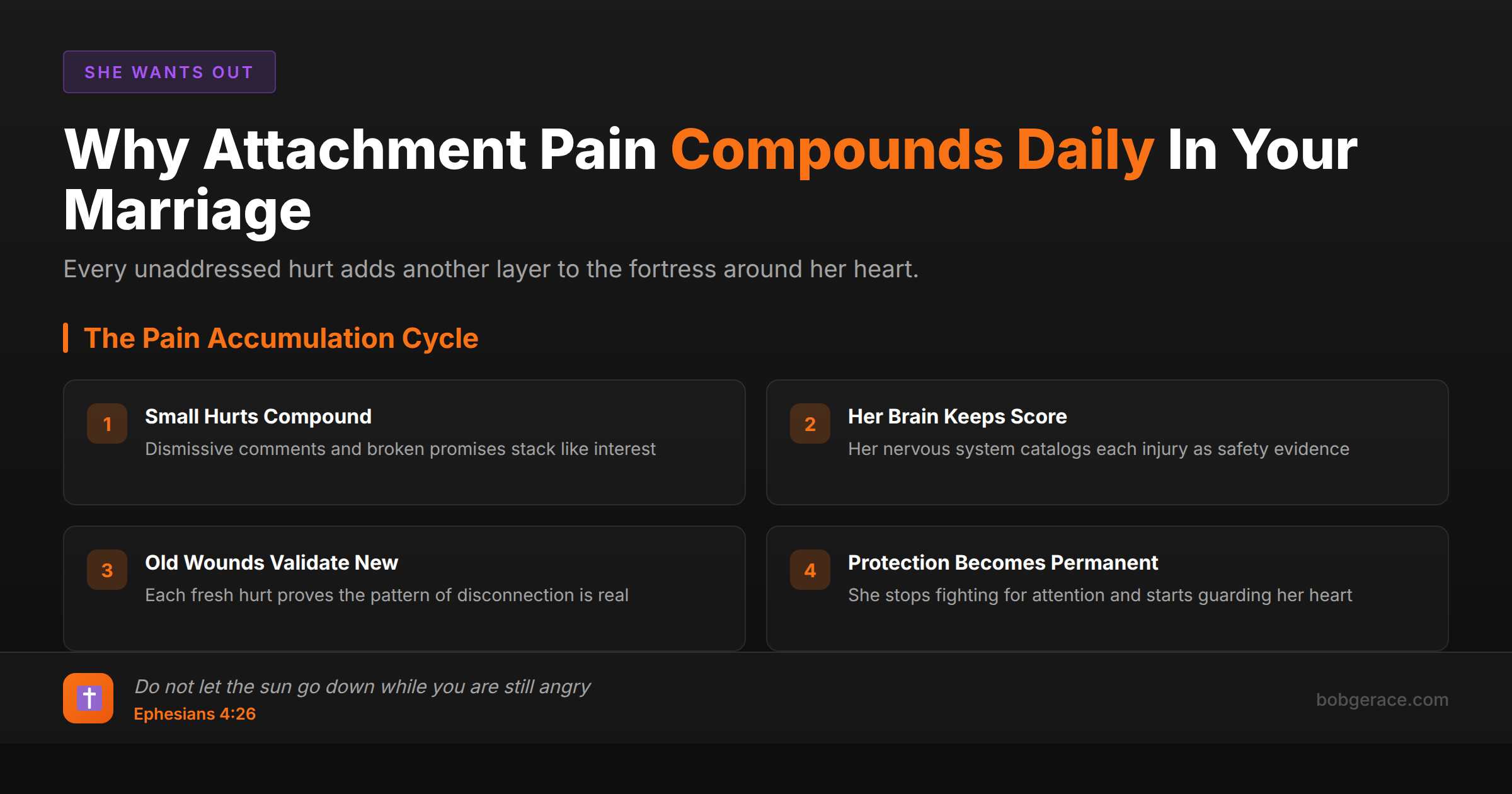
Unaddressed attachment pain works like compound interest - but in reverse. Every time she reaches for connection and you're not fully present, every dismissive comment, every broken promise adds another layer to the wound. What starts as small disappointments becomes a fortress of protection around her heart. Here's what most men don't understand: she's not keeping score to punish you. Her nervous system is literally cataloging each injury as evidence of whether you're safe or unsafe. When pain goes unaddressed, it doesn't fade - it accumulates. Each new hurt validates the old ones, creating a pattern of disconnection that feels increasingly permanent to her. The woman who once fought for your attention is now protecting herself from expecting it.
The Full Picture
Think of attachment pain like sediment in a river. Each unaddressed hurt settles at the bottom, layer by layer, until it changes the entire landscape of your relationship. What started as a clear, flowing connection becomes murky and obstructed.
The accumulation process happens in predictable stages:
• Initial injury - She expresses a need, you miss it or dismiss it • Protest - She tries harder to get through to you, often appearing "emotional" or "needy" • Despair - She begins to shut down, protecting herself from further disappointment • Detachment - She stops bringing her needs to you entirely
The cruel irony is that most men feel relief when she stops "complaining" or being "emotional." What they don't realize is that her silence isn't peace - it's resignation. She's not less hurt; she's just stopped believing you'll respond differently.
Common ways attachment pain accumulates:
• Consistently choosing work, hobbies, or phone over her presence • Minimizing her emotional experiences ("you're overreacting") • Making promises you don't keep, even small ones • Being physically present but emotionally absent • Responding to her bids for connection with irritation or indifference
Each incident might seem minor in isolation, but together they create a narrative in her mind: "I'm not important to him." Once this story takes root, even your positive actions get filtered through the lens of accumulated pain.
What's Really Happening
From a clinical perspective, unaddressed attachment injuries create what we call "negative sentiment override" - a state where the accumulated pain becomes the dominant lens through which all interactions are interpreted. Dr. John Gottman's research shows that when couples reach this state, even neutral or positive behaviors are perceived negatively.
The neurobiological reality is that repeated attachment injuries literally rewire the brain. The amygdala - our threat detection system - becomes hypervigilant to signs of emotional danger from the very person who should feel safest. This isn't conscious or intentional; it's a protective adaptation.
Attachment theory, developed by John Bowlby, explains that we're biologically wired to seek safety and connection with our primary attachment figure - in marriage, that's your spouse. When this system is repeatedly activated without resolution, it creates what researchers call "chronic attachment anxiety" or "attachment avoidance."
The accumulation follows a predictable pattern: hyperactivation (protest behaviors like criticism or emotional outbursts), followed by deactivation (emotional withdrawal and self-protection). By the time most couples seek help, they're deep in the deactivation phase.
Trauma research shows us that emotional injuries can be just as damaging as physical ones. Dr. Sue Johnson's work in Emotionally Focused Therapy demonstrates that attachment injuries must be specifically addressed and processed - they don't heal simply with the passage of time or general relationship improvements. The pain remains stored in both explicit memory (conscious recollection) and implicit memory (body sensations and emotional responses).
What Scripture Says
Scripture gives us profound insight into how pain accumulates and the importance of addressing wounds quickly. Ephesians 4:26-27 warns us: "In your anger do not sin: Do not let the sun go down while you are still angry, and do not give the devil a foothold." This isn't just about managing anger - it's about preventing pain from taking root and growing.
The principle of immediate reconciliation appears throughout Scripture. Matthew 5:23-24 tells us: "Therefore, if you are offering your gift at the altar and there remember that your brother or sister has something against you, leave your gift there in front of the altar. First go and be reconciled to them; then come and offer your gift." God prioritizes relational healing over religious activity.
Proverbs 18:19 reveals the danger of accumulated hurt: "A brother wronged is more unyielding than a fortified city; disputes are like the barred gates of a citadel." When we fail to address injuries, they become fortress walls that separate us from those we love most.
1 Peter 3:7 specifically addresses husbands: "Husbands, in the same way be considerate as you live with your wives, and treat them with respect as the weaker partner and as heirs with you of the gracious gift of life, so that nothing will hinder your prayers." Our relationship with God is directly connected to how we handle the tender heart He's entrusted to our care.
The healing process requires what James 5:16 prescribes: "Therefore confess your sins to each other and pray for each other so that you may be healed." Accumulated pain demands intentional confession, not general apologies. Psalm 147:3 promises that "He heals the brokenhearted and binds up their wounds" - but healing requires bringing those wounds into the light.
What To Do Right Now
-
1
Write down every unaddressed conflict or hurt you can remember from the past year - don't justify or defend, just acknowledge
-
2
Ask her specifically: 'What are the times I've hurt you that we never fully resolved?' Then listen without defending
-
3
Identify your top three patterns that contribute to her pain (dismissiveness, distraction, broken promises, etc.)
-
4
Address one specific injury per conversation - go deep on individual wounds rather than surface-level general apologies
-
5
Validate the accumulation itself: 'I can see how all these individual hurts have built up into something much bigger'
-
6
Create a daily practice of checking in: 'How did I do today at making you feel emotionally safe with me?'
Related Questions
- What is 'attachment injury' and did I cause one?
- Why does one event seem to define our whole marriage to her?
- What is 'primal panic' and is that what she's been feeling?
- What does 'emotional starvation' look like in a wife?
- Why didn't she tell me sooner how bad it was?
- What are 'failed bids for connection' and how many did I miss?
- What are 'attachment injuries' and how many did I cause?
- She brings up things from years ago
- What is 'accumulated resentment'?
- How does unaddressed hurt compound?
Also find Bob on
Subscribe for weekly videos on Christian marriage.
Stop Guessing What She Needs to Hear
You know the pattern is real. A coach who knows your marriage can help you address the specific hurts—not just the concept. You don't have to figure out her catalog alone.
Talk to Bob →