How does unaddressed hurt compound?
6 min read
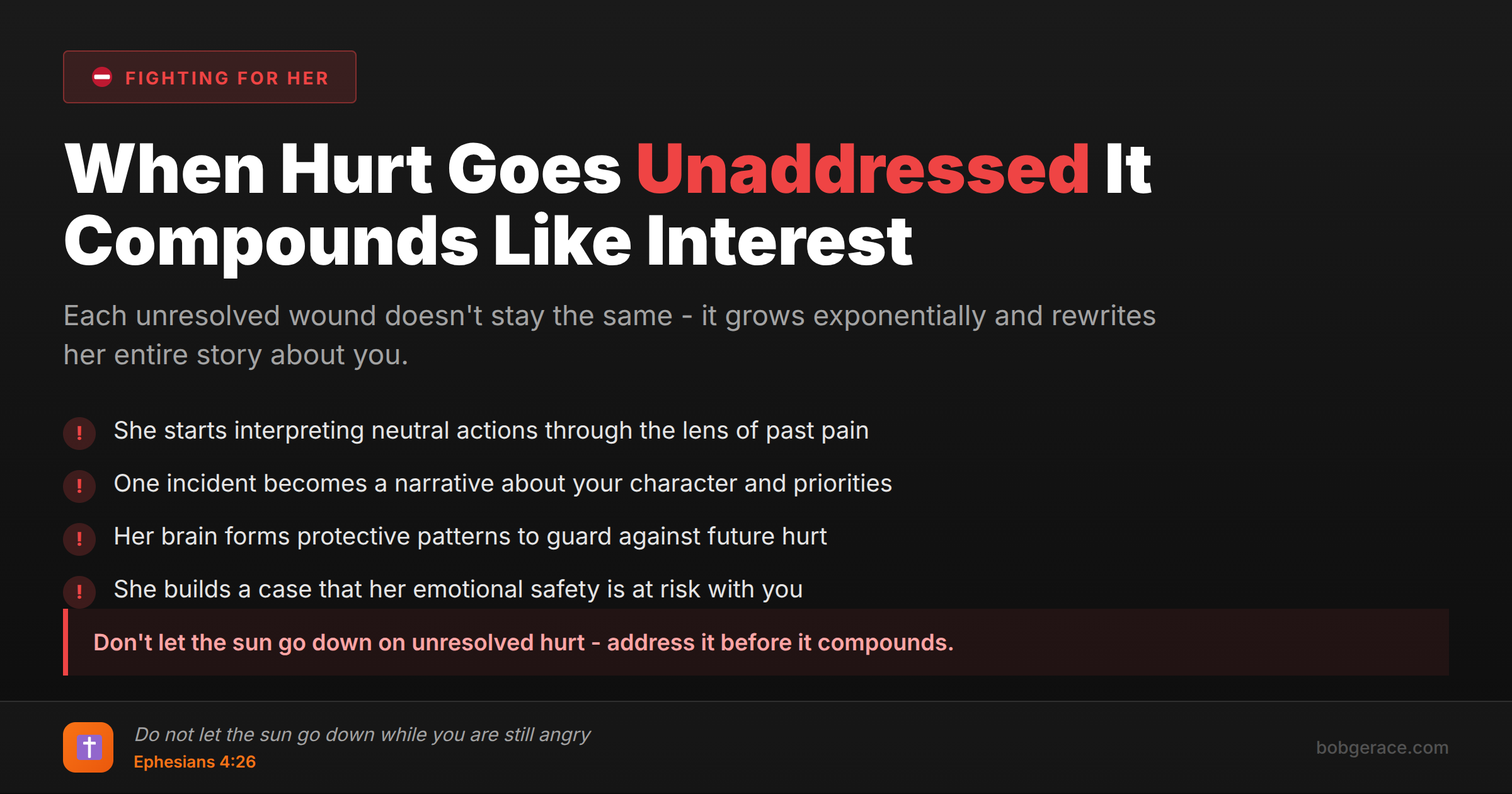
Unaddressed hurt in marriage works like compound interest - it grows exponentially over time. Each unresolved incident doesn't just remain static; it gains emotional "interest" through repeated exposure, rumination, and new triggers that remind your wife of the original wound. When hurt goes unaddressed, your wife's brain begins to form protective patterns. She starts interpreting neutral actions through the lens of past pain, building a case that proves her emotional safety is at risk. What began as disappointment over one incident becomes a narrative about your character, your priorities, and whether she can trust you with her heart. This isn't dramatic overreaction - it's normal psychological self-preservation.
The Full Picture
Think of unaddressed hurt like a physical wound that never heals properly. When you get a cut and don't clean it, it doesn't just stay the same size - it gets infected, spreads, and creates deeper problems. Emotional wounds work similarly, but with one crucial difference: they have memory.
Every time your wife experiences a new hurt that reminds her of the unaddressed one, her brain doesn't process it as a separate incident. Instead, it adds the new pain to the existing pile. A forgotten anniversary becomes part of the same emotional file as the time you dismissed her concerns six months ago. Your brain sees separate events; her brain sees a pattern of being undervalued.
The Compounding Process
The compounding happens in three distinct phases:
Phase 1: The Original Hurt - Something happens that genuinely wounds her. Maybe you prioritized work over an important conversation, made a dismissive comment, or broke a promise. At this stage, she's still open to resolution.
Phase 2: The Waiting Period - She gives you opportunities to address it. She might bring it up directly, hint at it, or wait for you to notice her emotional shift. When these opportunities pass unrecognized, the hurt begins to ferment.
Phase 3: The Protective Shift - Her brain concludes that you either don't care enough to notice or don't value her feelings enough to address them. The original hurt transforms into something deeper: a belief about who you are and what she means to you.
This is when the real damage begins. Now every interaction gets filtered through this new belief system. Your innocent comment gets interpreted as criticism. Your busy schedule becomes evidence of misplaced priorities. Your attempt at humor lands as insensitivity. She's not trying to be difficult - her brain is trying to protect her from further harm by staying alert to danger signals.
The cruelest part? The longer this goes unaddressed, the harder it becomes for her to believe your eventual efforts are genuine. By the time you notice something's wrong, she may have already grieved the loss of feeling truly seen and valued by you.
What's Really Happening
From a neurological perspective, unaddressed hurt creates what we call "negative sentiment override" in the brain. This occurs when the emotional processing centers become hypersensitive to perceived threats from the partner who caused the original wound.
The brain's primary job is survival, and emotional safety is just as important as physical safety. When hurt goes unaddressed, the amygdala (our alarm system) begins tagging the spouse as a potential emotional threat. This isn't conscious or intentional - it's automatic brain protection.
Research shows that once negative sentiment override is established, it takes approximately five positive interactions to counterbalance one negative perception. But here's the challenging part: when someone is in this state, they're more likely to interpret neutral interactions as negative, making it extremely difficult to reach that 5:1 ratio.
The compounding effect also involves what psychologists call "confirmation bias." The hurt spouse's brain actively looks for evidence that confirms their growing belief that they're not valued or safe. This isn't manipulation - it's the brain trying to make sense of the emotional data it's receiving.
We also see changes in attachment behavior. A wife who once felt securely attached may shift toward anxious or avoidant patterns as a protective mechanism. She might become hypervigilant about signs of further hurt (anxious) or begin emotionally withdrawing to minimize vulnerability (avoidant).
The good news is that brains are plastic and relationships can heal. But it requires the offending partner to first understand that they're not just dealing with the original hurt anymore - they're dealing with a complex emotional system that has been trying to protect itself. Healing requires patience, consistency, and often professional guidance to rebuild the neural pathways of trust and safety.
What Scripture Says
Scripture gives us profound insight into how unaddressed hurt compounds and why immediate attention to wounds in relationships is crucial.
Ephesians 4:26-27 warns us: "In your anger do not sin: Do not let the sun go down while you are still angry, and do not give the devil a foothold." This isn't just about managing anger - it's about preventing hurt from taking root and growing into something more destructive. When we let hurt linger unaddressed, we literally give the enemy of our marriages a foothold to cause greater damage.
Hebrews 12:15 provides another crucial warning: "See to it that no one falls short of the grace of God and that no bitter root grows up to cause trouble and defile many." Notice the progression - what starts as falling short of grace becomes a root, then grows up to cause trouble that affects multiple people. This perfectly describes how unaddressed hurt compounds and spreads.
The biblical principle of immediate attention to relational wounds is seen in Matthew 5:23-24: "Therefore, if you are offering your gift at the altar and there remember that your brother or sister has something against you, leave your gift there in front of the altar. First go and be reconciled to them; then come and offer your gift." God considers unresolved hurt so serious that He tells us to pause our worship to address it.
Proverbs 27:5-6 reminds us that "Better is open rebuke than hidden love. Wounds from a friend can be trusted, but an enemy multiplies kisses." When we fail to address hurt openly and honestly, we're actually being more harmful than helpful to our marriages.
God designed marriage as a //blog.bobgerace.com/christian-marriage-covenant-masculinity-unbreakable-standard/:covenant relationship that reflects His love for the church (Ephesians 5:25-33). Just as God doesn't leave our hurts unaddressed but pursues us with healing and restoration, we're called to pursue our wives' hearts when they're wounded. The compounding of hurt happens when we fail to reflect God's character of immediate, pursuing love in our marriages.
What To Do Right Now
-
1
Stop trying to minimize or rationalize past hurts - acknowledge that unaddressed pain grows regardless of your original intentions
-
2
Ask your wife specifically: 'What hurts have I left unaddressed that are still affecting you?' Then listen without defending
-
3
Apologize for the compounding effect, not just the original incident - say 'I'm sorry for letting this hurt grow by not addressing it sooner'
-
4
Identify the patterns that led to avoidance - fear of conflict, pride, busyness - and commit to changing these patterns
-
5
Create a 'repair ritual' where you both commit to addressing hurts within 24 hours before they can compound
-
6
Consider professional counseling if resentment has built to the point where she struggles to believe your efforts are genuine
Related Questions
- What is 'accumulated resentment'?
- What happens when small wounds never heal?
- What is 'marital debt' and how do I pay it down?
- Why does she remember everything I forgot?
- What are 'attachment injuries' and how many did I cause?
- Why does one wound matter more than a hundred good days?
- What is 'negative sentiment override' and does she have it?
- What is the 'distance and isolation cascade'?
- What does 'emotional starvation' look like in a wife?
- How does unaddressed attachment pain accumulate?
Also find Bob on
Subscribe for weekly videos on Christian marriage.
This Needs a Human Who Knows Your Marriage
If hurt's been compounding for months or years, generic advice won't cut it. Bob coaches men through exactly this—stopping the damage before it calcifies into permanent distance.
Talk to Bob →