What is 'resentment inventory' and does she have one?
6 min read
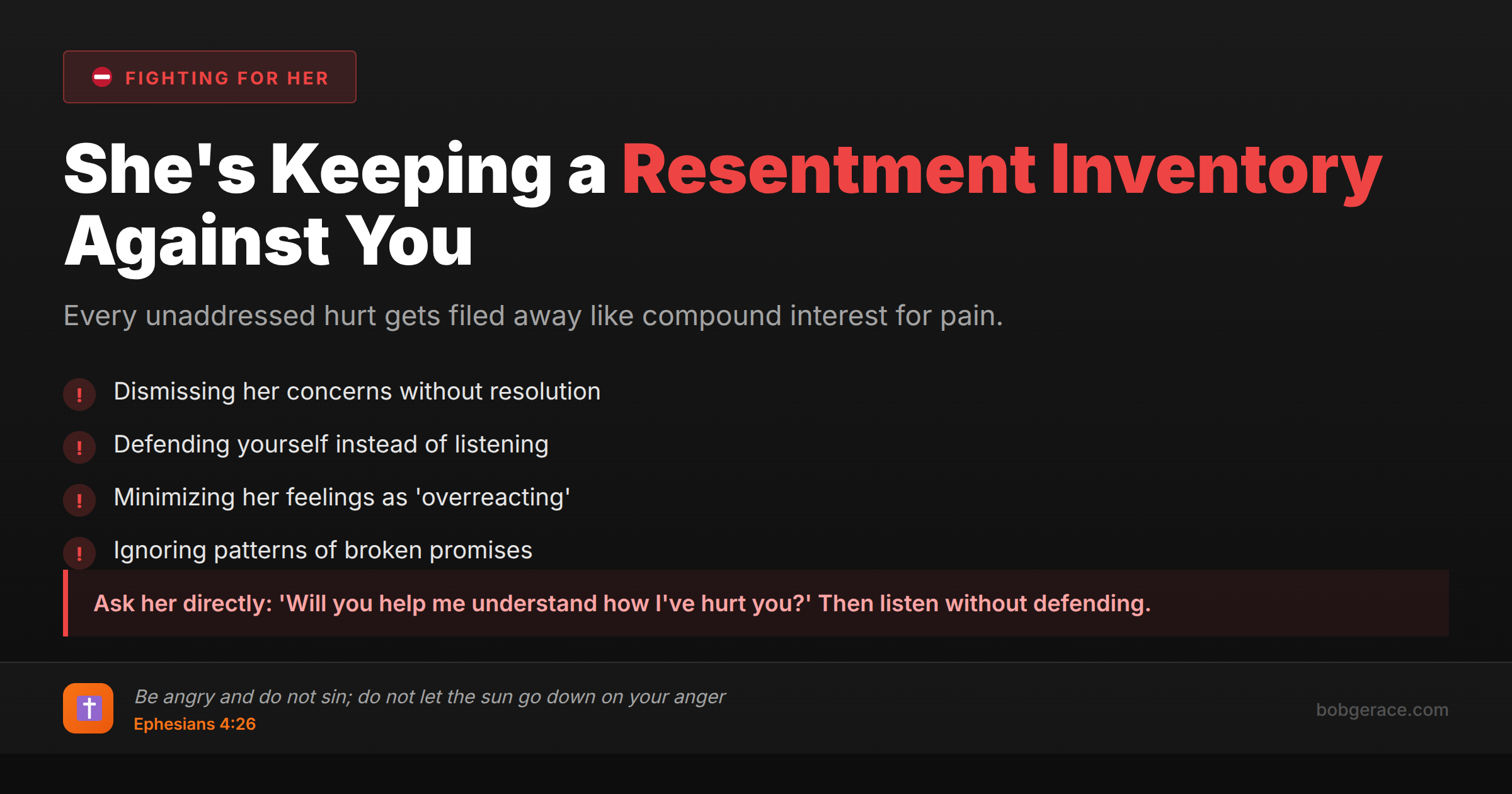
A resentment inventory is essentially a mental catalog of grievances, disappointments, and unresolved hurts that accumulate over time. Yes, if your wife has emotionally checked out, she likely has developed one - a detailed internal list of every time she felt dismissed, unheard, unloved, or betrayed. This isn't necessarily conscious or malicious; it's often an automatic psychological defense mechanism. Think of it like compound interest, but for pain. Small unaddressed issues don't just disappear - they accumulate with emotional weight attached. Each incident gets filed away: the time you forgot her birthday, dismissed her concerns, chose work over family, or failed to follow through on promises. When wives reach the point of emotional withdrawal, this inventory often feels overwhelming and insurmountable to them.
The Full Picture
Understanding resentment inventory requires grasping how the female brain processes relational wounds differently than the male brain. Women tend to be more relationally oriented and have stronger emotional memory networks. This means they naturally remember relational experiences with greater detail and emotional intensity.
How Resentment Inventory Develops:
It starts small - maybe she mentions feeling lonely when you work late, but you brush it off as nagging. She brings up wanting more emotional connection, but you think providing financially is enough. She asks for help with household responsibilities, but you promise "later" repeatedly. Each unaddressed concern gets catalogued.
The dangerous part isn't the individual incidents - it's the pattern recognition. Her brain starts connecting dots: "He consistently chooses other things over me." "My feelings don't matter to him." "He promises but doesn't follow through." These conclusions become the framework through which she interprets future interactions.
The Compound Effect:
Like financial debt, resentment compounds. A forgotten anniversary isn't just about that day - it confirms the pattern of feeling unimportant. A dismissive response to her concerns isn't just about that conversation - it reinforces feeling unheard. Each new incident carries the weight of all previous ones.
By the time most husbands recognize something's seriously wrong, the inventory is extensive. She's not just hurt about recent events - she's carrying years of accumulated pain. This explains why your wife might seem to overreact to small things or why bringing up past issues feels like reopening old wounds.
The Protection Mechanism:
Eventually, this inventory becomes a protective barrier. Instead of continuing to hope and be disappointed, she uses past experience to predict future pain. This is when emotional checkout begins - it's not punishment, it's self-preservation.
What's Really Happening
From a clinical perspective, resentment inventory represents a trauma response within the attachment system. When repeated relational injuries occur without repair, the brain's threat detection system becomes hypervigilant to protect against future harm.
Neurologically, women's brains show stronger activation in areas associated with emotional processing and memory consolidation. The hippocampus, which processes emotional memories, works differently under chronic stress. Unresolved marital conflict creates a state of chronic activation, where the brain literally cannot forget these emotional wounds.
The Attachment Injury Cycle:
Attachment theory explains this phenomenon clearly. When a spouse feels consistently unseen, unheard, or unimportant, attachment injuries accumulate. Unlike individual grievances, these injuries threaten the fundamental security of the relationship bond. The brain interprets this as existential threat to the relationship's survival.
What makes this particularly challenging is that men and women often have different thresholds for what constitutes an attachment injury. Men might view forgotten conversations as minor oversights, while women experience them as relational disconnection. Neither perspective is wrong - they reflect different attachment needs and communication styles.
The Protective Shutdown:
When the inventory becomes overwhelming, the nervous system shifts into protective mode. This isn't conscious choice - it's neurobiological self-preservation. The brain essentially decides that emotional investment equals vulnerability to pain, so it shuts down emotional availability.
The challenging reality is that by the time most couples seek help, years of unaddressed inventory exists. However, the brain's neuroplasticity means these patterns can change with consistent, intentional repair efforts. The key is understanding that addressing recent issues won't automatically resolve historical ones.
What Scripture Says
Scripture addresses both the reality of resentment and God's //blog.bobgerace.com/female-orgasm-christian-marriage-sacred-design/:design for handling grievances within marriage. The Bible doesn't pretend that hurt doesn't happen - instead, it provides clear guidance for preventing resentment inventory from destroying relationships.
God's Design for Addressing Grievances:
*"Therefore each of you must put off falsehood and speak truthfully to your neighbor, for we are all members of one body. 'In your anger do not sin': Do not let the sun go down while you are still angry."* (Ephesians 4:25-26) This passage establishes the principle of immediate address rather than accumulation of grievances.
*"If your brother or sister sins, go and point out their fault, just between the two of you. If they listen to you, you have won them over."* (Matthew 18:15) Jesus provides a framework for direct, loving confrontation rather than silent inventory building.
The Danger of Unaddressed Resentment:
*"See to it that no one falls short of the grace of God and that no bitter root grows up to cause trouble and defile many."* (Hebrews 12:15) This perfectly describes resentment inventory - bitter roots that grow over time and eventually poison the entire relationship.
*"Above all else, guard your heart, for everything you do flows from it."* (Proverbs 4:23) When resentment inventory takes root in the heart, it affects every aspect of the relationship.
God's Call for Forgiveness and Restoration:
*"Be kind and compassionate to one another, forgiving each other, just as in Christ God forgave you."* (Ephesians 4:32) While this doesn't minimize hurt, it provides the pathway forward.
*"Husbands, love your wives as Christ loved the church and gave himself up for her."* (Ephesians 5:25) This sacrificial love model directly addresses the patterns that create resentment inventory in the first place.
What To Do Right Now
-
1
Acknowledge the inventory exists - Don't minimize or defend. Ask her directly: 'I know I've hurt you in ways that have built up over time. Will you help me understand?'
-
2
Listen without defending - When she shares her grievances, resist the urge to justify, explain, or minimize. Your goal is understanding, not winning.
-
3
Identify patterns, not just incidents - Ask yourself: 'What themes do I hear? How have I consistently failed to meet her needs or address her concerns?'
-
4
Take full responsibility - Own your role completely. Avoid phrases like 'I'm sorry you felt...' Instead say 'I was wrong when I...'
-
5
Address current behavior immediately - Stop adding to the inventory. If she brings up a concern, address it that day, not when convenient for you.
-
6
Seek professional help - Years of accumulated resentment requires professional guidance. Don't try to navigate this alone - get qualified marriage coaching or counseling.
Related Questions
- What is 'accumulated resentment'?
- How does unaddressed hurt compound?
- She brings up things from years ago
- What is 'marital debt' and how do I pay it down?
- Why does she remember everything I forgot?
- What are 'attachment injuries' and how many did I cause?
- What is 'negative sentiment override' and does she have it?
- Why does she seem to attach to everyone but me?
- What role does resentment play in sexual shutdown?
Also find Bob on
Subscribe for weekly videos on Christian marriage.
Your Marriage Has a Specific History
Her resentment inventory is built from YOUR specific moments—what you said, what you didn't do, what she stopped believing. A coach who knows your story can help you address the actual grievances, not just the concept.
Talk to Bob →