Why does one event seem to define our whole marriage to her?
6 min read
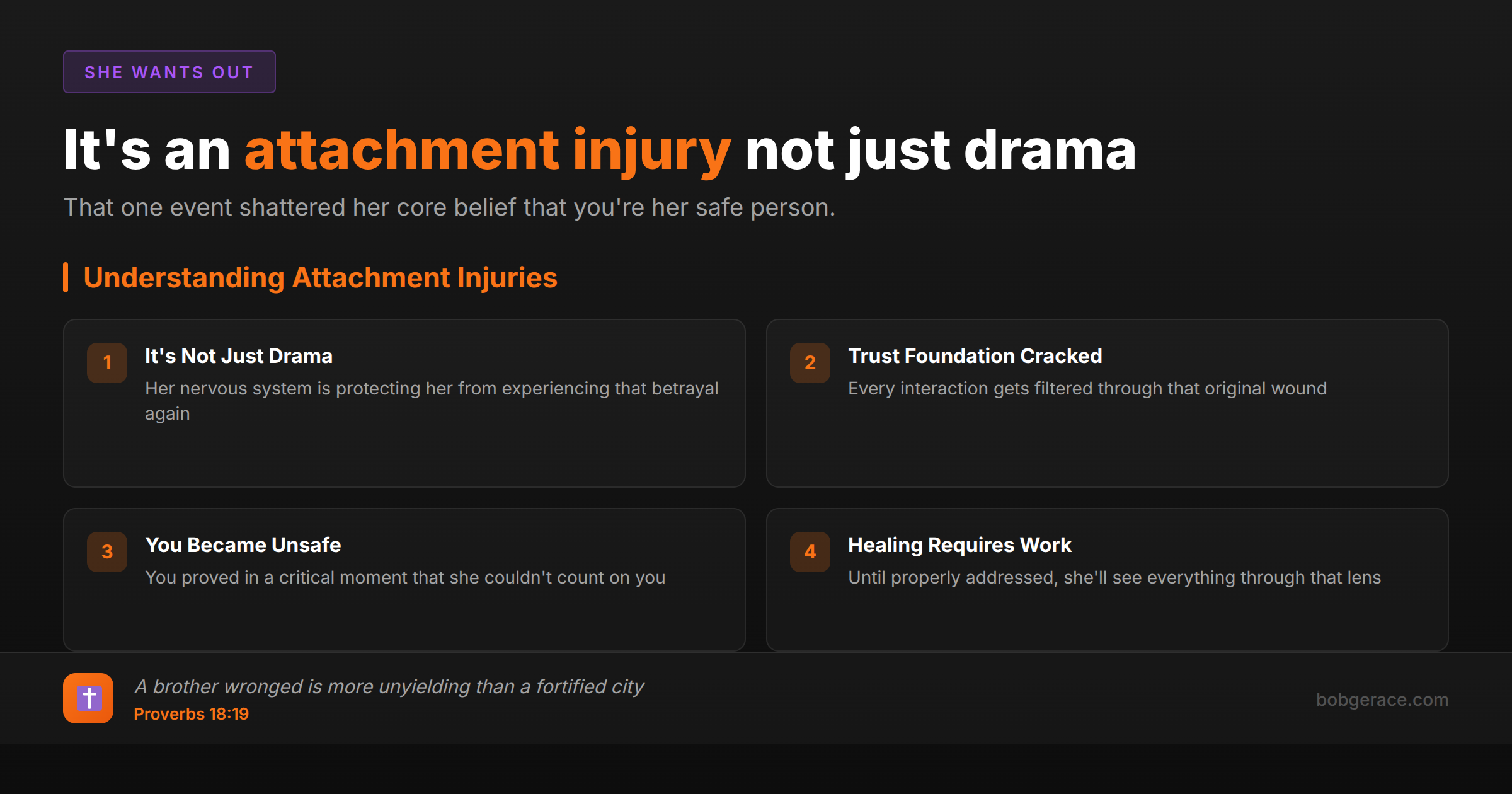
That one event isn't just an event to her - it's an attachment injury that fundamentally changed how she sees you and your marriage. When you betrayed her trust, dismissed her pain, or failed her in a critical moment, it didn't just hurt her feelings. It shattered her core belief that she could count on you as her safe person. Attachment injuries are like emotional earthquakes. They crack the foundation of trust so deeply that every interaction afterward gets filtered through that original wound. She's not being dramatic or holding grudges - her nervous system is literally protecting her from experiencing that level of betrayal again. Until this injury is properly addressed and healed, she'll keep seeing your entire relationship through the lens of that moment when you proved you couldn't be trusted.
The Full Picture
Most men don't understand the difference between a regular hurt and an attachment injury. A regular hurt is when you forget her birthday or say something thoughtless. An attachment injury happens when you fail her at a moment of critical need - when she's vulnerable and desperately needs you to show up as her protector and advocate.
Common attachment injuries include: • Choosing someone else over her when she needed your loyalty (your mother, your job, another woman) • Minimizing or dismissing her pain during a crisis (miscarriage, family death, health scare) • Breaking trust through deception about finances, relationships, or major decisions • Failing to defend her when she was being attacked or criticized by others • Abandoning her emotionally during her darkest moments
Here's what makes it worse: most men try to logic their way out of attachment injuries. You explain your reasoning, point out all the good things you've done since, or get frustrated that she "won't just get over it." This actually deepens the injury because it proves you still don't understand the magnitude of what happened.
The reason this one event defines everything is because it revealed something terrifying to her: the person she trusted most in the world isn't safe. Every kind gesture since then feels like it could be withdrawn. Every promise feels conditional. Every moment of vulnerability feels dangerous.
She's not choosing to see your marriage this way - her brain is protecting her from further harm by staying hypervigilant to signs that you might fail her again.
What's Really Happening
From a clinical perspective, attachment injuries create what we call "negative sentiment override" - a state where the injured partner's nervous system becomes primed to interpret neutral or even positive behaviors as potentially threatening. Research by Dr. Sue Johnson shows that these injuries don't heal with time alone; they require specific therapeutic intervention.
The neuroscience is clear: when someone experiences betrayal by their primary attachment figure, it activates the same brain regions associated with physical pain. The anterior cingulate cortex and right ventral prefrontal cortex light up exactly as they would if she were experiencing actual physical injury. This isn't melodrama - it's measurable brain trauma.
What's particularly challenging is that attachment injuries create trauma responses that bypass rational thinking. Her amygdala (fear center) becomes hyperactive around relationship threats, while her prefrontal cortex (rational thinking) goes offline. This is why logical explanations don't work - you're literally speaking to the wrong part of her brain.
The injury becomes definitional because it violates what attachment theorists call the "secure base" - the fundamental belief that your partner will be accessible, responsive, and emotionally engaged when you need them most. Once this secure base is damaged, every interaction gets filtered through the lens of "Can I really trust this person to be there for me?"
Healing requires what we call "Hold Me Tight" conversations - structured dialogues where the injured partner can express their pain while the injuring partner demonstrates genuine understanding, accountability, and commitment to change. Simply apologizing isn't enough; the apology must address the specific attachment fears that were triggered.
What Scripture Says
Scripture speaks directly to the sacred nature of marriage trust and our responsibility to handle each other's hearts with extreme care. Ephesians 5:29 reminds us, "After all, no one ever hated their own body, but they feed and care for their body, just as Christ does the church." When you injure your wife's ability to trust, you're damaging part of yourself.
Proverbs 18:19 warns us, "A brother wronged is more unyielding than a fortified city; disputes are like the barred gates of a citadel." This isn't just about siblings - it's about the reality that deep betrayal creates walls that require intentional, sustained effort to tear down. God understands that some hurts cut deeper than others.
Luke 17:1-2 shows Jesus taking betrayal seriously: "Things that cause people to stumble are bound to come, but woe to anyone through whom they come. It would be better for them to be thrown into the sea with a millstone tied around their neck than to cause one of these little ones to stumble." Your wife trusted you completely - that's what made your failure so devastating.
But there's hope in Isaiah 61:3 - God promises to give "a crown of beauty instead of ashes, the oil of joy instead of mourning, and a garment of praise instead of a spirit of despair." Attachment injuries can be healed, but it requires you to stop defending yourself and start binding up her wounds with the same intentionality Christ shows us.
1 Peter 3:7 calls husbands to "be considerate as you live with your wives, and treat them with respect as the weaker partner and as heirs with you of the gracious gift of life, so that nothing will hinder your prayers." When we fail to honor the sacred trust our wives place in us, it affects our relationship with God himself.
What To Do Right Now
-
1
Stop defending yourself and start listening to understand the depth of her pain
-
2
Write down exactly what you did that injured her, including how it made her feel unsafe
-
3
Acknowledge the attachment injury specifically - don't minimize it as just another argument
-
4
Take full responsibility without explaining your reasoning or justifying your actions
-
5
Ask her what she needs to feel safe with you again, then follow through consistently
-
6
Get professional help from a therapist trained in attachment injuries - this is too big to fix alone
Related Questions
- What is 'attachment injury' and did I cause one?
- Why does she remember everything differently than I do?
- What are 'failed bids for connection' and how many did I miss?
- What is 'negative sentiment override' and does she have it?
- How does unaddressed attachment pain accumulate?
- What is 'primal panic' and is that what she's been feeling?
- What are 'attachment injuries' and how many did I cause?
- Why does one wound matter more than a hundred good days?
- What is an 'apology' vs. 'repair' vs. 'attunement'?
- What does she need to hear that I haven't said?
Also find Bob on
Subscribe for weekly videos on Christian marriage.
This Injury Won't Heal on Its Own
Attachment injuries need precise repair work calibrated to your specific marriage. A coach who knows your story can show you what to do in the next 30 days.
Talk to Bob →