How do I open up without falling apart?
6 min read
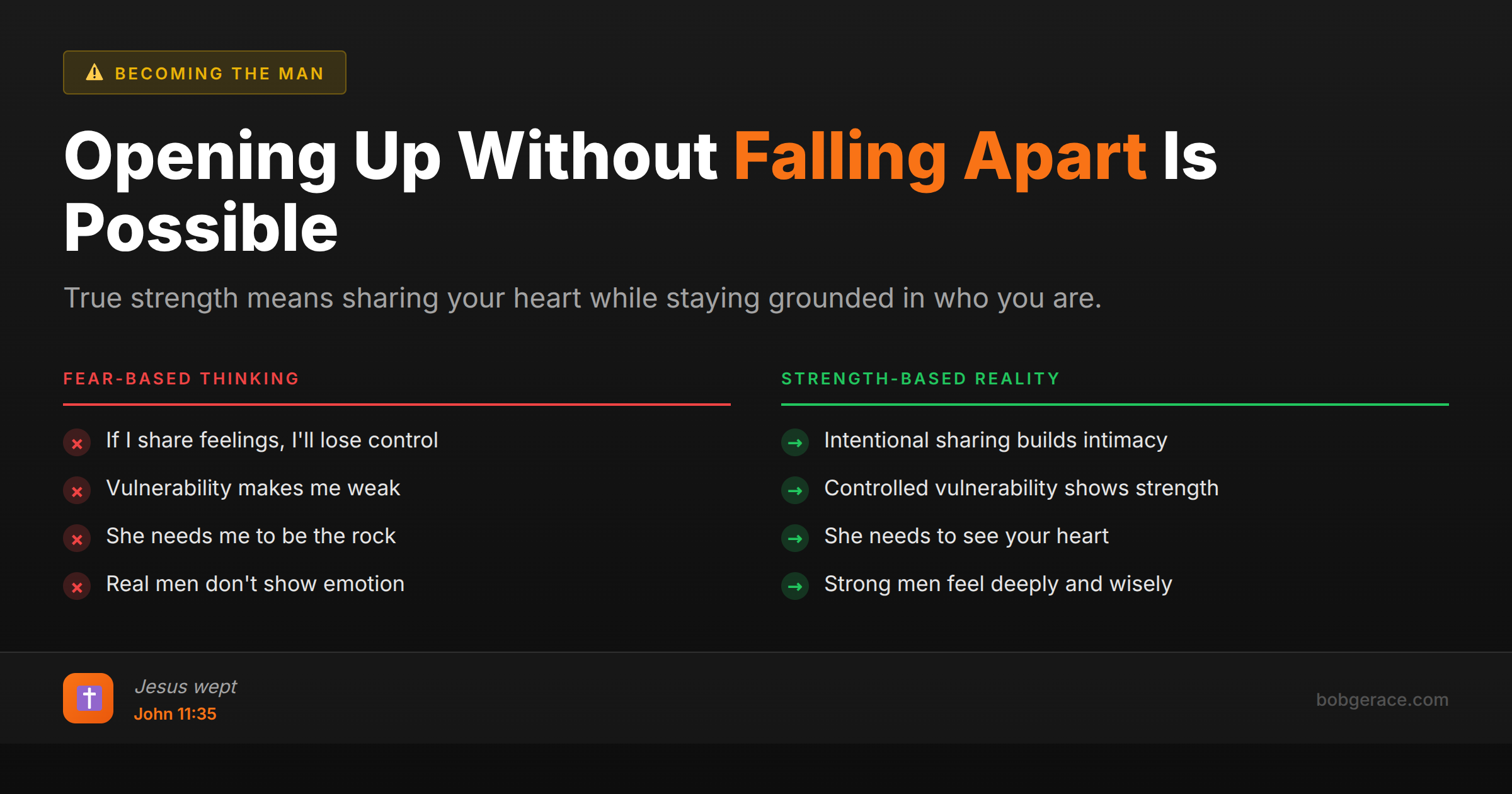
Opening up emotionally doesn't mean losing control—it means sharing your inner world with intentionality and wisdom. The fear of falling apart often keeps men locked in emotional isolation, but true strength comes from learning to be vulnerable while staying grounded in your identity as a man and husband. Start small with low-stakes emotions and build your capacity gradually. Practice naming what you feel before sharing it, and remember that your wife needs to see your heart, not your emotional chaos. When you approach vulnerability as a skill to develop rather than a dam to break, you can create deep intimacy without losing yourself in the process.
The Full Picture
Most men live with a fundamental misunderstanding about emotional vulnerability. We've been taught that opening up means unleashing everything at once—every fear, hurt, and insecurity in one overwhelming flood. No wonder we're terrified of falling apart.
The real issue isn't that you have emotions—it's that you haven't learned to regulate and share them skillfully. Your wife doesn't need to see your emotional chaos; she needs to see your heart. There's a massive difference.
Think of emotional vulnerability like physical strength training. You wouldn't walk into a gym and immediately attempt to deadlift 400 pounds. You'd start with manageable weight and progressively build your capacity. The same principle applies to emotional openness.
The fear of falling apart often stems from two places: First, you've never learned healthy emotional regulation skills, so sharing feels dangerous. Second, you're carrying years of unexpressed emotions that feel too heavy to unpack safely.
But here's what I've learned from working with hundreds of men: *The anticipation of falling apart is almost always worse than the reality.* When you approach vulnerability strategically—starting small, building trust, and staying grounded in your identity—you discover that opening up actually makes you stronger, not weaker.
Your marriage needs your emotional presence, not your emotional perfection. The goal isn't to become an emotional fountain, but to become a man who can share his inner world without losing himself in it. This is how you build the kind of intimacy that transforms marriage from mere partnership into deep, soul-level connection.
What's Really Happening
From a clinical perspective, the fear of 'falling apart' when opening up is rooted in what we call emotional dysregulation—the inability to manage intense emotions effectively. Many men experience this because they've spent years suppressing emotions rather than learning to process them.
When emotions are consistently suppressed, they don't disappear—they accumulate. This creates what I call 'emotional pressure,' where any attempt to open up feels like it might trigger an uncontrollable release. The brain interprets vulnerability as a threat to your emotional stability.
Neurologically, men often process emotions differently than women. The male brain tends to route emotional information through problem-solving centers first, which can create a delay between feeling and understanding. This delay makes emotions feel more unpredictable and threatening.
The key to healthy emotional expression is developing what we call 'distress tolerance'—the ability to experience difficult emotions without being overwhelmed by them. This involves learning to observe your emotions rather than being consumed by them. When you can name what you're feeling and understand why you're feeling it, you can share it without losing control.
Gradual exposure is crucial. Just as we treat phobias by gradually exposing people to their fears in safe environments, men can build emotional resilience by practicing vulnerability in low-stakes situations first. This builds neural pathways that support emotional regulation while maintaining a sense of safety and control.
What Scripture Says
Scripture provides a powerful framework for understanding emotional vulnerability as an expression of strength, not weakness. God created us as emotional beings, and He models emotional expression throughout His Word.
Jesus himself demonstrates that emotional openness and strength coexist beautifully. *"Jesus wept"* (John 11:35) at Lazarus's death, showing us that feeling deeply doesn't diminish masculine strength. In the Garden of Gethsemane, Christ openly shared His distress: *"My soul is overwhelmed with sorrow to the point of death"* (Matthew 26:38), yet He remained grounded in His purpose and identity.
The Psalms offer incredible examples of emotional honesty before God. David regularly expressed fear, anger, joy, and desperation: *"Why, my soul, are you downcast? Why so disturbed within me? Put your hope in God, for I will yet praise him"* (Psalm 42:11). Notice how David acknowledges his emotions while anchoring himself in truth.
Scripture calls us to emotional authenticity in relationships: *"Therefore each of you must put off falsehood and speak truthfully to your neighbor, for we are all members of one body"* (Ephesians 4:25). This includes emotional truthfulness with your wife.
**The key is being *"quick to listen, slow to speak and slow to become angry"* (James 1:19).** This verse teaches emotional regulation—processing before expressing, choosing your words carefully, and maintaining self-control even in vulnerability.
God promises to be our anchor when emotions feel overwhelming: *"Cast all your anxiety on him because he cares for you"* (1 Peter 5:7). When you're grounded in God's love and truth, you can risk vulnerability knowing that your identity and worth remain secure in Him.
What To Do Right Now
-
1
Start with the 'emotion pause'—before sharing anything emotional, take 30 seconds to identify what you're actually feeling and why
-
2
Practice the 'emotional headline' technique—share the main emotion first ('I'm feeling frustrated about work') before diving into details
-
3
Begin with low-stakes emotions—share positive feelings or minor concerns before tackling deeper issues
-
4
Use 'I feel' statements instead of 'you make me feel' to maintain ownership of your emotions
-
5
Set a time limit for emotional conversations—start with 10-15 minutes to prevent overwhelming yourself or your wife
-
6
Create a daily check-in routine where you share one emotion from your day, building the habit gradually
Related Questions
Ready to Build Real Emotional Strength?
Learning to open up without falling apart is a skill that transforms both you and your marriage. Let's work together to build your emotional resilience.
Work With Me →