What does it mean to 'hold space'?
6 min read
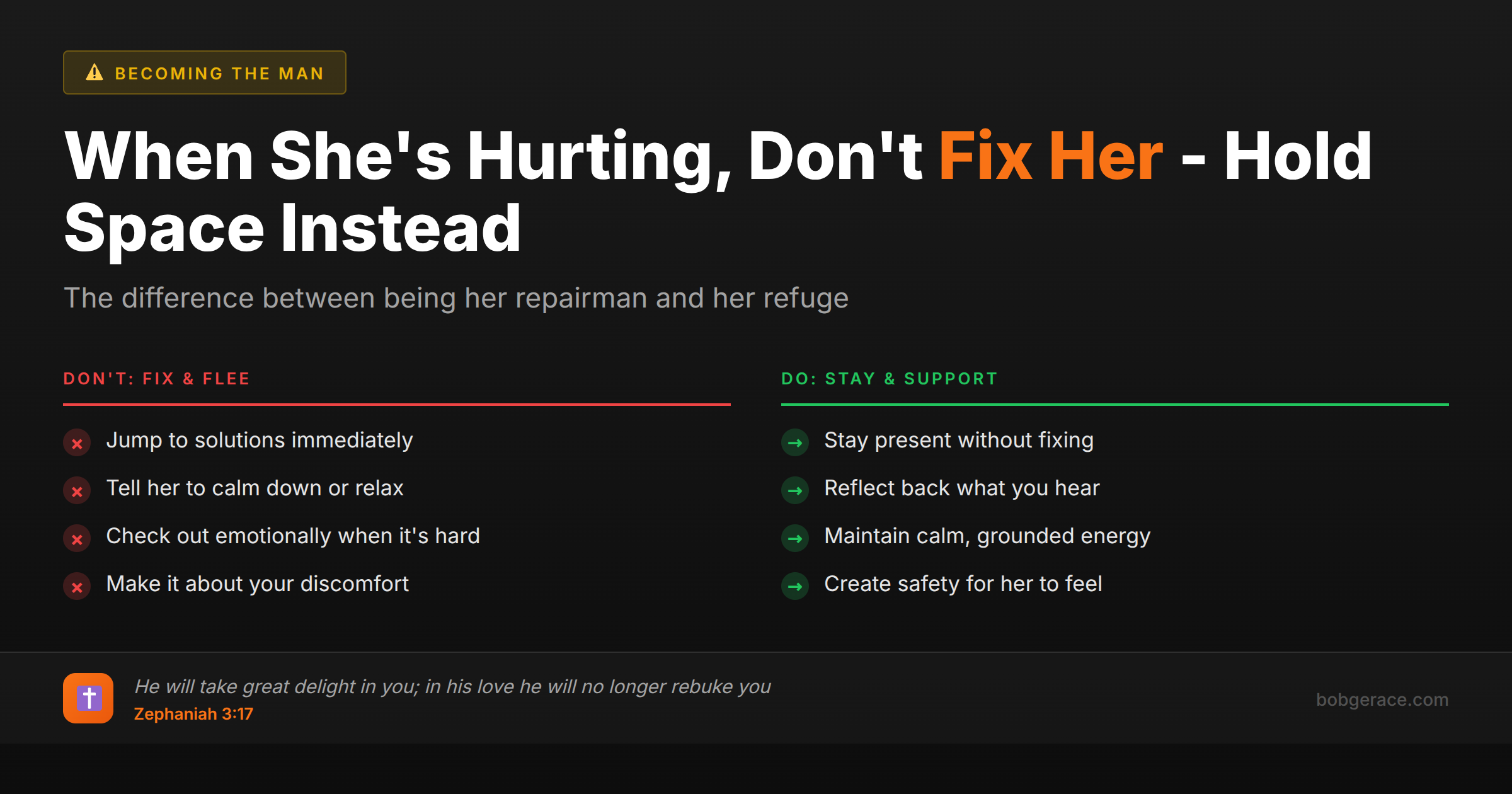
Holding space means being fully present with your wife during difficult emotions without trying to fix, judge, or abandon her. It's the masculine ability to remain calm, grounded, and emotionally available when she's struggling - like being a steady lighthouse in her storm. This isn't passive listening or checking out emotionally. It's active presence - staying connected to her heart while maintaining your own emotional stability. You're not absorbing her emotions or trying to change them. You're simply creating a safe container where she can feel and process without fear of your reaction. It's one of the most powerful gifts a man can offer his wife.
The Full Picture
Most men completely misunderstand what their wives need during emotional moments. We default to fixing mode - offering solutions, minimizing feelings, or trying to logic our way out of the situation. Or we go to the opposite extreme and emotionally check out because we feel overwhelmed or helpless.
Holding space is the third option that most men never learn. It's about being WITH her rather than doing something TO her situation. Think of it like this: when your wife is in emotional turbulence, she doesn't need you to be the rescue helicopter trying to pull her out. She needs you to be the steady ground she can land on safely.
This requires several key elements: Emotional regulation - you stay calm even when she's not. Non-reactive presence - you don't take her emotions personally or get triggered. Active listening - you're genuinely engaged, not just waiting for your turn to talk. Physical availability - your body language communicates safety and openness.
Here's what it's NOT: It's not agreeing with everything she says. It's not becoming her emotional dumping ground. It's not losing yourself in her feelings. You maintain your own center while creating space for hers.
The result is profound. When a woman feels truly held in this way, something shifts. She feels seen, heard, and safe. This allows her nervous system to regulate, her emotions to move through naturally, and her trust in you to deepen. She stops feeling like she has to manage your reaction to her feelings.
Most marriages lack this kind of emotional safety. Men either become reactive (getting angry, defensive, or overwhelmed) or they disconnect (going cold, offering quick fixes, or leaving the room). Both responses communicate the same message: "Your emotions are too much for me to handle."
Holding space communicates the opposite: "I can handle all of you. Your emotions don't threaten me. You're safe here."
What's Really Happening
From a neurological perspective, holding space activates the co-regulation system between partners. When one person maintains calm presence during another's emotional activation, it literally helps regulate the distressed person's nervous system through mirror neurons and parasympathetic activation.
Women's brains are typically more interconnected between emotional and verbal processing centers. When she's expressing emotions, she's often processing and integrating experiences, not necessarily seeking solutions. The masculine tendency to jump to problem-solving actually interrupts this natural processing cycle.
Research shows that feeling emotionally held and understood releases oxytocin and reduces cortisol levels. This creates the neurochemical foundation for deeper intimacy and trust. However, when men become reactive or dismissive during emotional moments, it triggers the woman's attachment system, often leading to pursuit-withdraw cycles.
The ability to hold space requires what we call 'differentiation' - maintaining your own emotional center while staying connected to your partner. This is a learned skill that involves developing distress tolerance, emotional awareness, and secure attachment behaviors. Men who master this skill report significantly higher relationship satisfaction and sexual intimacy.
What's particularly important is that holding space doesn't mean becoming passive or losing your masculine edge. It's actually a demonstration of emotional strength and leadership - showing that you're solid enough to handle whatever she brings without being knocked off your center.
What Scripture Says
Scripture gives us a beautiful picture of what it means to hold space, starting with how God relates to us in our distress.
"The Lord your God is with you, the Mighty Warrior who saves. He will take great delight in you; in his love he will no longer rebuke you, but will rejoice over you with singing." - Zephaniah 3:17. Notice God doesn't minimize our struggles or immediately fix everything. He remains present, delighted in us, and offers His stable presence.
"Rejoice with those who rejoice; mourn with those who mourn." - Romans 12:15. This is holding space in action - entering into someone's emotional experience without trying to change it or rush them through it.
"Bear one another's burdens, and so fulfill the law of Christ." - Galatians 6:2. Bearing doesn't mean fixing or carrying the burden yourself. It means coming alongside to provide support and presence during the carrying.
"Be completely humble and gentle; be patient, bearing with one another in love." - Ephesians 4:2. The phrase "bearing with" implies staying present through difficulty, not escaping or becoming reactive.
"Above all, love each other deeply, because love covers over a multitude of sins." - 1 Peter 4:8. Deep love creates a safe covering where imperfection and struggle can exist without fear of rejection.
"A man's heart plans his way, but the Lord directs his steps." - Proverbs 16:9. Just as God allows us to process and plan while gently guiding, we can hold space for our wives' emotional processing while trusting God with the outcomes.
Christ himself demonstrates this perfectly - present with us in our struggles, interceding for us, never condemning, always understanding our frame and remembering we are dust.
What To Do Right Now
-
1
Practice the STOP technique - When she becomes emotional, Stop talking, Take a breath, Observe her without judgment, and stay Present instead of reacting or fixing.
-
2
Master your body language - Sit or stand facing her, uncross your arms, maintain soft eye contact, and keep your posture open and relaxed to communicate safety.
-
3
Use reflection instead of solutions - Say things like 'That sounds really hard' or 'Help me understand more about that' instead of jumping to advice or minimizing.
-
4
Regulate your own nervous system - Practice deep breathing, ground your feet, and remind yourself that her emotions are not an emergency you need to fix.
-
5
Ask permission before problem-solving - When she seems ready, ask 'Would it help to brainstorm some solutions, or do you need me to just listen right now?'
-
6
Follow up later - After the emotional moment passes, check in with simple presence: 'How are you feeling now?' without bringing up solutions or analysis.
Related Questions
- What does masculine leadership look like?
- How do I lead without controlling?
- How do I be strong and gentle?
- What does emotional attunement look like?
- How do I become a safe emotional presence?
- How do I listen without fixing?
- What does 'holding space' while 'holding boundary' look like?
- How do I stay connected while enforcing boundaries?
- What does 'holding space' actually mean?
- How do I become a safe person again?
Also find Bob on
Subscribe for weekly videos on Christian marriage.
You Don't Have to Figure This Out Alone
Holding space in your marriage — with your wife's specific patterns, your history, your triggers — is different than the concept. A coach who knows your story can help you get this right.
Talk to Bob →