What does masculine leadership look like?
6 min read
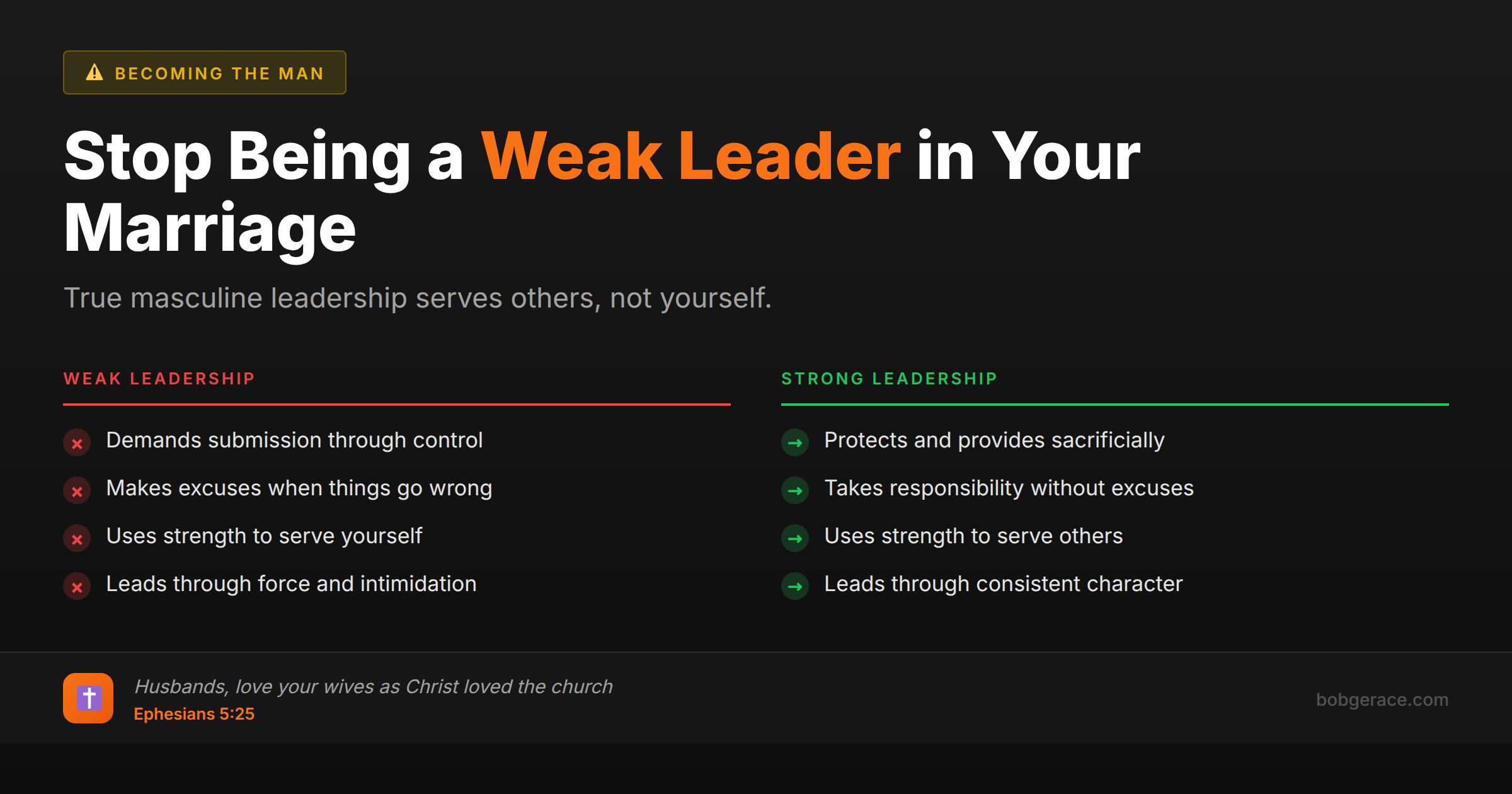
True masculine leadership isn't about being the loudest voice in the room or demanding submission. It's about servant leadership that protects, provides, and leads by example. A masculine leader takes responsibility without making excuses, makes decisions with his family's best interests at heart, and creates safety through consistent character. He leads with strength that serves others, not strength that serves himself. This means owning your mistakes, having the hard conversations, and being the kind of man your wife and children can depend on completely. It's leadership that draws people toward you because they trust your character, not leadership that pushes people away through force or control.
The Full Picture
Masculine leadership has been hijacked by two extremes - either the passive man who leads nothing, or the domineering man who crushes everything in his path. Both are failures of true masculinity.
Real masculine leadership is servant leadership with backbone. It's Jesus washing the disciples' feet, then overturning tables in the temple. It's having the strength to be gentle and the courage to be firm when the situation demands it.
Here's what it actually looks like:
You lead by going first. When there's a difficult conversation to be had, you initiate it. When there's a hard decision to make, you don't punt it to your wife. When there's conflict to resolve, you step into it rather than avoiding it.
You create safety through consistency. Your family knows what to expect from you because your character is predictable. You don't blow up over small things, but you also don't ignore big things. You're the steady presence they can count on.
You protect without being possessive. You shield your family from harm, whether that's financial stress, outside pressures, or even your own bad moods. But you don't control or micromanage - you create space for them to flourish.
You provide more than money. Yes, you work hard to meet physical needs, but you also provide emotional stability, spiritual direction, and your presence. You show up fully, not just financially.
You admit when you're wrong. Masculine leadership isn't about being perfect - it's about being accountable. When you mess up, you own it quickly and make it right. This builds trust, not weakness.
The goal isn't to be the king of your castle. It's to be the kind of leader who serves others so well that they want to follow your lead.
What's Really Happening
From a psychological perspective, healthy masculine leadership creates what we call 'secure attachment' in families. When a man leads with consistent, servant-hearted strength, he becomes a secure base from which his wife and children can explore the world confidently.
Research shows that children with fathers who demonstrate this kind of leadership - firm but warm, present but not controlling - develop better emotional regulation, higher self-esteem, and stronger relationship skills. Wives married to men who lead this way report higher marital satisfaction and lower anxiety levels.
The key psychological principle here is 'differentiated leadership' - the ability to stay connected to your family while maintaining your own sense of self and direction. This means you can make decisions that might be unpopular in the moment but are best for the family long-term, while still remaining emotionally available and responsive.
Many men struggle with this balance because they either become overly rigid (authoritarian) or overly flexible (permissive). Healthy masculine leadership requires what psychologists call 'flexible strength' - being adaptable in your approach while remaining consistent in your core values and commitment to your family's wellbeing.
When men lead this way, it actually reduces decision fatigue for the entire family. Instead of every choice being a negotiation or power struggle, there's a trusted leader who can make decisions efficiently while considering everyone's needs. This creates a sense of security and reduces family stress significantly.
What Scripture Says
Scripture gives us a clear picture of masculine leadership that's radically different from worldly leadership:
"Husbands, love your wives as Christ loved the church and gave himself up for her." (Ephesians 5:25) - This is the foundation. Christ's leadership was sacrificial, not selfish. He didn't use His position for His own benefit but gave His life for others.
"But whoever wants to become great among you must be your servant, and whoever wants to be first must be slave of all." (Mark 10:43-44) - Jesus redefined leadership entirely. The greatest leaders are those who serve others most faithfully.
"The husband is the head of the wife as Christ is the head of the church, his body, of which he is the Savior." (Ephesians 5:23) - Headship isn't about superiority but about responsibility. Christ leads the church by protecting, providing for, and laying down His life for it.
"Fathers, do not provoke your children to anger, but bring them up in the discipline and instruction of the Lord." (Ephesians 6:4) - Masculine leadership creates growth, not frustration. It disciplines with purpose, not anger.
"Above all else, guard your heart, for everything you do flows from it." (Proverbs 4:23) - A masculine leader starts by leading himself well. You can't give what you don't have.
"Be watchful, stand firm in the faith, act like men, be strong. Let all that you do be done in love." (1 Corinthians 16:13-14) - Biblical masculinity combines strength with love, courage with compassion.
This isn't about being perfect - it's about being faithful. Leading like Christ means serving others' best interests, even when it costs you something.
What To Do Right Now
-
1
Take inventory of where you're currently leading well and where you're dropping the ball - be brutally honest about both
-
2
Start making decisions instead of defaulting everything to your wife - begin with small daily choices and build up
-
3
Have a conversation with your wife about how she experiences your leadership - listen without defending
-
4
Identify one area where your family needs protection or provision that you've been avoiding
-
5
Establish one consistent practice that demonstrates servant leadership (family devotions, weekly date planning, etc.)
-
6
Find an older man who leads his family well and ask him to mentor you in this area
Related Questions
Ready to Lead Your Family Well?
Don't navigate this alone. Get the tools and support you need to become the leader your family needs.
Get Help Now →