What's the difference between leading and dominating?
6 min read
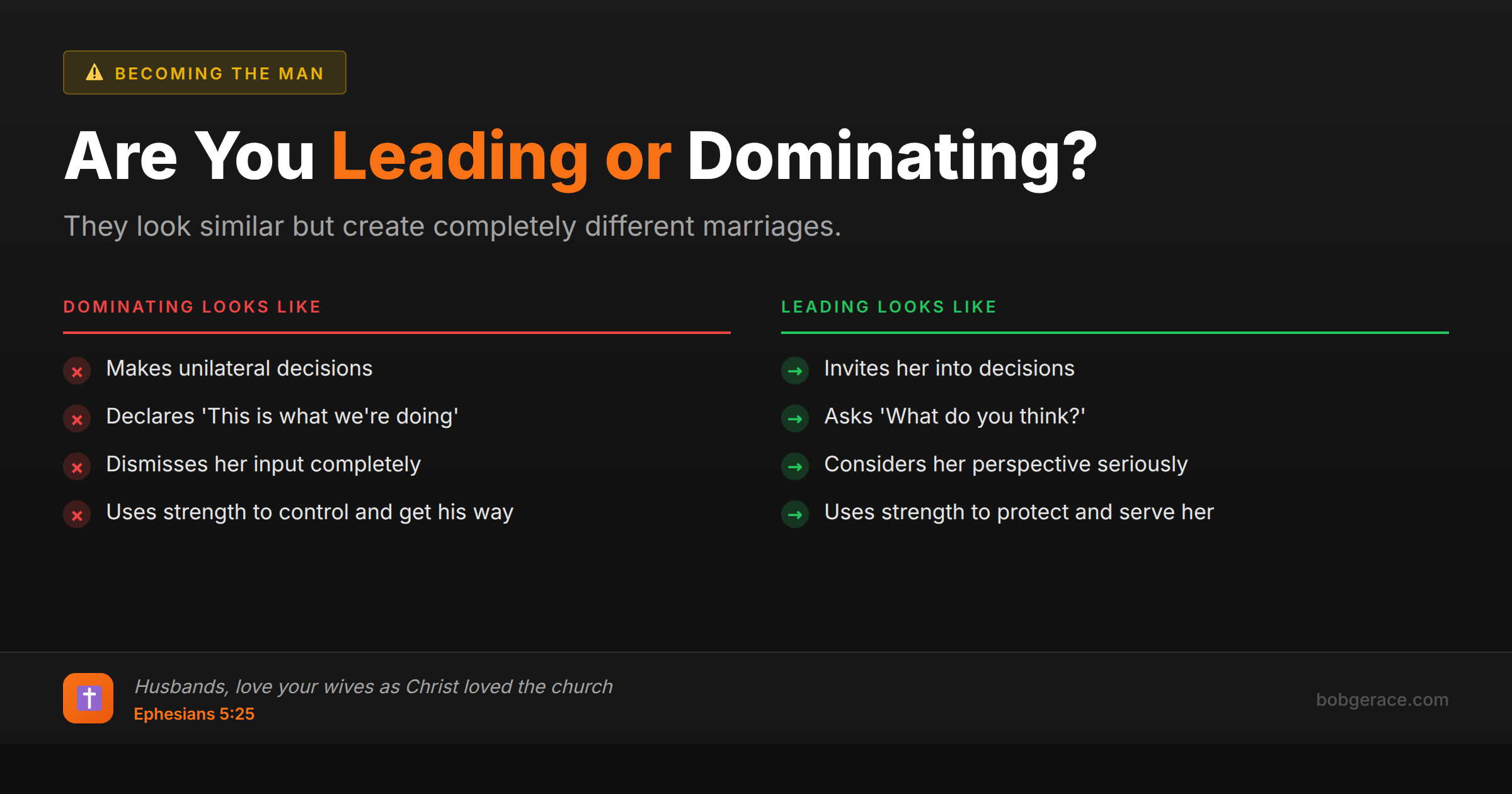
Leading and dominating are opposites masquerading as the same thing. A man who leads invites his wife into decisions, considers her perspective, and uses his strength to protect and serve her needs. A man who dominates makes unilateral decisions, dismisses her input, and uses his strength to control and get his way. The leader asks 'What do you think?' The dominator declares 'This is what we're doing.' The leader builds up his wife's confidence and capabilities. The dominator tears them down to maintain his position. True leadership in marriage requires more strength, not less—it takes real courage to listen, adapt, and sometimes admit you're wrong.
The Full Picture
Here's what most men don't understand: domination is actually the weaker response. It's what happens when a man feels threatened, insecure, or out of control. So he compensates by grabbing more control, making more demands, and shutting down opposition.
Leadership, on the other hand, comes from a place of security and strength. A leading man doesn't need to control his wife because he's not threatened by her strength, opinions, or capabilities. In fact, he actively develops them because he knows a stronger wife makes for a stronger marriage.
## The Dominator's Playbook
Dominating men operate from fear. They: - Make decisions without input - Use their physical size or voice to intimidate - Punish disagreement or pushback - Keep their wives financially or emotionally dependent - View their wife's strength as competition - Lead through threats and consequences
## The Leader's Approach
Leading men operate from love. They: - Seek input before major decisions - Use their strength to protect, not control - Welcome healthy disagreement and discussion - Encourage their wife's growth and independence - View their wife's strength as an asset - Lead through vision and invitation
The irony? Wives naturally want to follow a man who leads well. But they'll resist—and should resist—a man who dominates. When you try to force submission, you actually destroy it. When you earn it through loving leadership, it flows naturally.
This isn't about becoming soft or passive. It's about becoming the kind of man who's strong enough to listen, secure enough to be challenged, and confident enough to admit when he's wrong.
What's Really Happening
From a psychological perspective, the difference between leading and dominating lies in the underlying motivation and emotional regulation. Dominating behaviors typically stem from insecure attachment patterns, often rooted in childhood experiences of powerlessness or inconsistent caregiving.
When a man dominates, his nervous system is actually in a state of perceived threat. The brain's amygdala has hijacked rational thinking, leading to controlling behaviors as a survival mechanism. This creates a cycle: the more he controls, the more his wife withdraws or resists, which triggers more controlling behavior.
Healthy leadership, however, emerges from secure attachment and emotional regulation. These men can tolerate uncertainty, handle disagreement without feeling personally attacked, and remain calm when challenged. Their prefrontal cortex stays online, allowing for collaborative decision-making.
Neurologically, dominating men show increased activity in areas associated with threat detection and decreased activity in regions responsible for empathy and perspective-taking. This literally makes it harder for them to consider their wife's viewpoint.
The good news? These patterns can change through awareness and practice. When men learn to recognize their threat responses and develop emotional regulation skills, they naturally shift from dominating to leading. The brain's neuroplasticity allows for new patterns of connection and collaboration to develop, creating the secure attachment that both partners crave.
What Scripture Says
Scripture gives us the clearest picture of the difference between leading and dominating. Look at how Christ leads the church—this is our model for marriage leadership.
Ephesians 5:25-28 - "Husbands, love your wives, just as Christ loved the church and gave himself up for her... In this same way, husbands ought to love their wives as their own bodies." Christ doesn't dominate the church; He sacrificially serves it. He gave up His life, not demanded submission through force.
1 Peter 3:7 - "Husbands, in the same way be considerate as you live with your wives, and treat them with respect as the weaker partner and as heirs with you of the gracious gift of life." The word "considerate" here means to live with understanding and knowledge. You can't dominate someone you're trying to understand.
Mark 10:42-44 - Jesus directly addresses domination: "You know that those who are regarded as rulers of the Gentiles lord it over them, and their high officials exercise authority over them. Not so with you. Instead, whoever wants to become great among you must be your servant." Jesus explicitly rejects the domination model.
Ephesians 5:21 - "Submit to one another out of reverence for Christ." This verse comes before the instruction to wives. Biblical leadership involves mutual submission and consideration.
The biblical model is clear: leadership that mirrors Christ is sacrificial, serving, and seeks the other's growth and flourishing. It's leadership that empowers rather than controls, that builds up rather than tears down.
Domination, by contrast, reflects the fallen world's approach to power—using strength for selfish gain rather than sacrificial love.
What To Do Right Now
-
1
Audit your decision-making - For the next week, notice when you make unilateral decisions. Before announcing what 'we're' doing, ask 'What do you think about this?'
-
2
Practice the pause - When you feel the urge to control or override your wife's input, take three deep breaths and ask yourself: 'Am I leading or dominating right now?'
-
3
Ask for her perspective - On three current issues or decisions, genuinely seek your wife's input. Don't just ask—actually listen and incorporate her wisdom.
-
4
Admit when you're wrong - Find one recent situation where you were dominating instead of leading, and apologize specifically for that behavior.
-
5
Build her up publicly - This week, compliment your wife's wisdom, strength, or capabilities in front of others. Show you're not threatened by her gifts.
-
6
Create space for pushback - Tell your wife explicitly that you want her honest feedback on your leadership style, and promise not to get defensive when she shares it.
Related Questions
- What does masculine leadership look like?
- How do I lead without controlling?
- What does humble leadership look like?
- What is servant leadership practically?
- How do I be strong and gentle?
- What is biblical headship?
- What's the difference between authority and authoritarianism?
- What does 'love your wife as Christ loves the church' mean?
Also find Bob on
Subscribe for weekly videos on Christian marriage.
Ready to practice this in your marriage?
Knowing the difference between leading and dominating doesn't mean you know how to do it in the specific moments your wife tests you. A coach helps you see where you're actually slipping into control.
Talk to Bob →