Am I trying to control the outcome?
5 min read
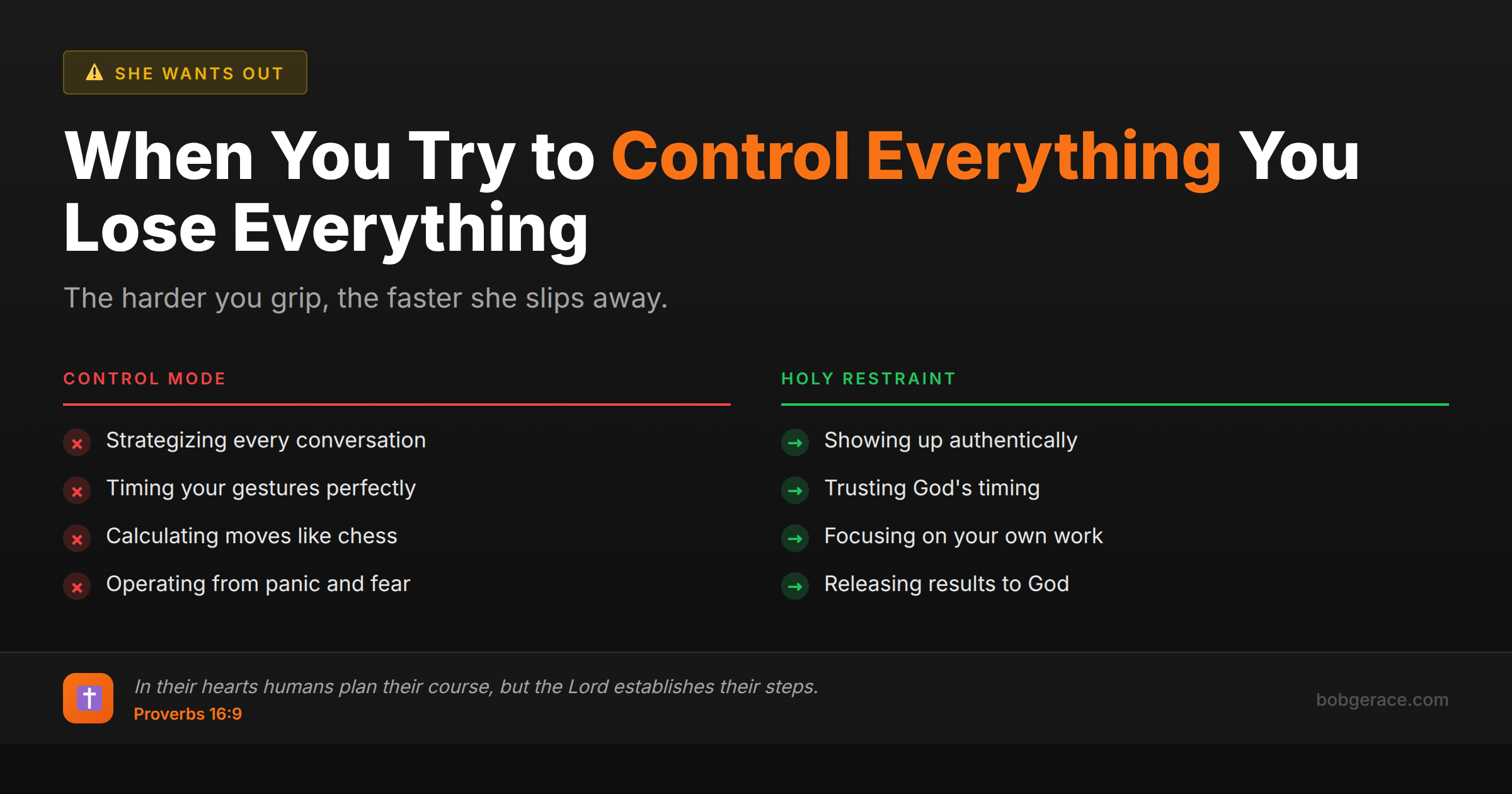
If you're asking this question, the answer is probably yes. Most men whose wives want out are unconsciously trying to control every conversation, every interaction, and every step toward reconciliation. You're strategizing your words, timing your gestures, and calculating your moves like you're playing chess. But here's the brutal truth: the harder you grip, the faster she slips away. Control feels like taking action, but it's actually fear disguised as leadership. When you try to control the outcome, you're not trusting God or respecting your wife's agency. You're operating from panic, not purpose. Holy restraint means doing your work, showing up authentically, and releasing the results to God.
The Full Picture
Control in marriage shows up in countless subtle ways. You might be timing your apologies for maximum impact, orchestrating romantic gestures to provoke specific responses, or monitoring her mood to adjust your behavior accordingly. You're essentially treating your wife like a complex problem to be solved rather than a person to be loved.
Here's what control looks like in practice:
• Transactional thinking - "If I do X, she'll respond with Y" • Outcome obsession - Every interaction is measured by whether it moves you closer to reconciliation • Emotional manipulation - Using guilt, pressure, or grand gestures to force a response • Information gathering - Constantly probing to assess where you stand • Performance mode - Being the "perfect husband" to prove your worth
The irony is devastating: control destroys the very thing you're trying to save. When you try to control outcomes, you eliminate the space your wife needs to choose you freely. Love cannot be forced, manipulated, or strategized into existence.
True change requires holy restraint - the discipline to do your own work without attachment to her response. This means showing up authentically, taking responsibility for your part, and trusting that genuine transformation will speak for itself. It's terrifying because you're releasing control, but it's the only path that actually works.
What's Really Happening
From a psychological perspective, control behaviors in distressed marriages typically stem from attachment anxiety and a dysregulated nervous system. When men feel their primary relationship is threatened, the brain activates threat-detection systems that drive controlling behaviors as a survival mechanism.
Research in Emotionally Focused Therapy shows that control is actually a protest behavior - an attempt to restore connection when the attachment bond feels threatened. The controlling partner is essentially saying, "I need you to respond to me in a predictable way so I can feel safe." Unfortunately, this creates a pursue-withdraw cycle where the more one partner tries to control, the more the other retreats.
Neurologically, when we're in control mode, we're operating from the limbic system rather than the prefrontal cortex. This means decision-making is driven by fear and urgency rather than wisdom and patience. The controlling partner loses access to their higher-order thinking and becomes reactive rather than responsive.
Cognitive behavioral patterns also play a role. Many men develop "if-then" thinking: "If I just do enough right things, then she'll come back." This creates a feedback loop where every interaction becomes a test of the strategy rather than an authentic moment of connection.
Breaking control patterns requires nervous system regulation, developing distress tolerance, and learning to sit with uncertainty. This is why mindfulness practices and therapeutic interventions that address the underlying anxiety are so crucial for sustainable change.
What Scripture Says
Scripture consistently calls us away from control and toward trust. In Proverbs 16:9, we read: "In their hearts humans plan their course, but the Lord establishes their steps." This verse reminds us that while we're called to be intentional, ultimate outcomes belong to God.
Ecclesiastes 3:1 tells us: "There is a time for everything, and a season for every activity under the heavens." Control often stems from our refusal to accept God's timing, wanting to force outcomes according to our schedule rather than His.
Jesus himself modeled holy restraint in John 6:66-67: "From this time many of his disciples turned back and no longer followed him. 'You do not want to leave too, do you?' Jesus asked the Twelve." Notice that Jesus didn't chase after those who left or manipulate them to stay. He offered truth and love, then allowed people to choose.
1 Peter 3:1-2 specifically addresses marriage: "Wives, in the same way submit yourselves to your own husbands so that, if any of them do not believe the word, they may be won over without words by the behavior of their wives, when they see the purity and reverence of your lives." The principle applies to husbands too - transformation happens through authentic living, not manipulation.
Matthew 6:26-27 challenges our need to control: "Look at the birds of the air; they do not sow or reap or store away in barns, and yet your heavenly Father feeds them... Can any one of you by worrying add a single hour to your life?" Control is often worry in action.
What To Do Right Now
-
1
Stop strategizing your interactions and start showing up authentically in each moment
-
2
Practice the 24-hour rule: wait a full day before responding to emotionally charged situations
-
3
Identify three specific control behaviors you're doing and consciously stop them today
-
4
Ask God each morning to help you trust His timing rather than forcing your own
-
5
Focus on your internal transformation rather than monitoring your wife's responses
-
6
Create space for your wife to have her own process without interference or commentary
Related Questions
- What does it mean to love without grasping?
- How did Christ pursue without coercing?
- What is 'holy restraint'?
- Is giving space an act of faith or abandonment?
- How do I honor her autonomy while fighting for us?
- What does 'dying to self' look like here?
- How do I surrender without giving up?
- What's the difference between trusting God and being passive?
- How do I discern between my will and God's will?
- How do I lead without controlling?
Also find Bob on
Subscribe for weekly videos on Christian marriage.
You Don't Have to White-Knuckle This Alone
A coach who knows your specific marriage can help you see where you're still gripping — and what holy restraint actually looks like in your situation.
Talk to Bob →