Is giving space an act of faith or abandonment?
6 min read
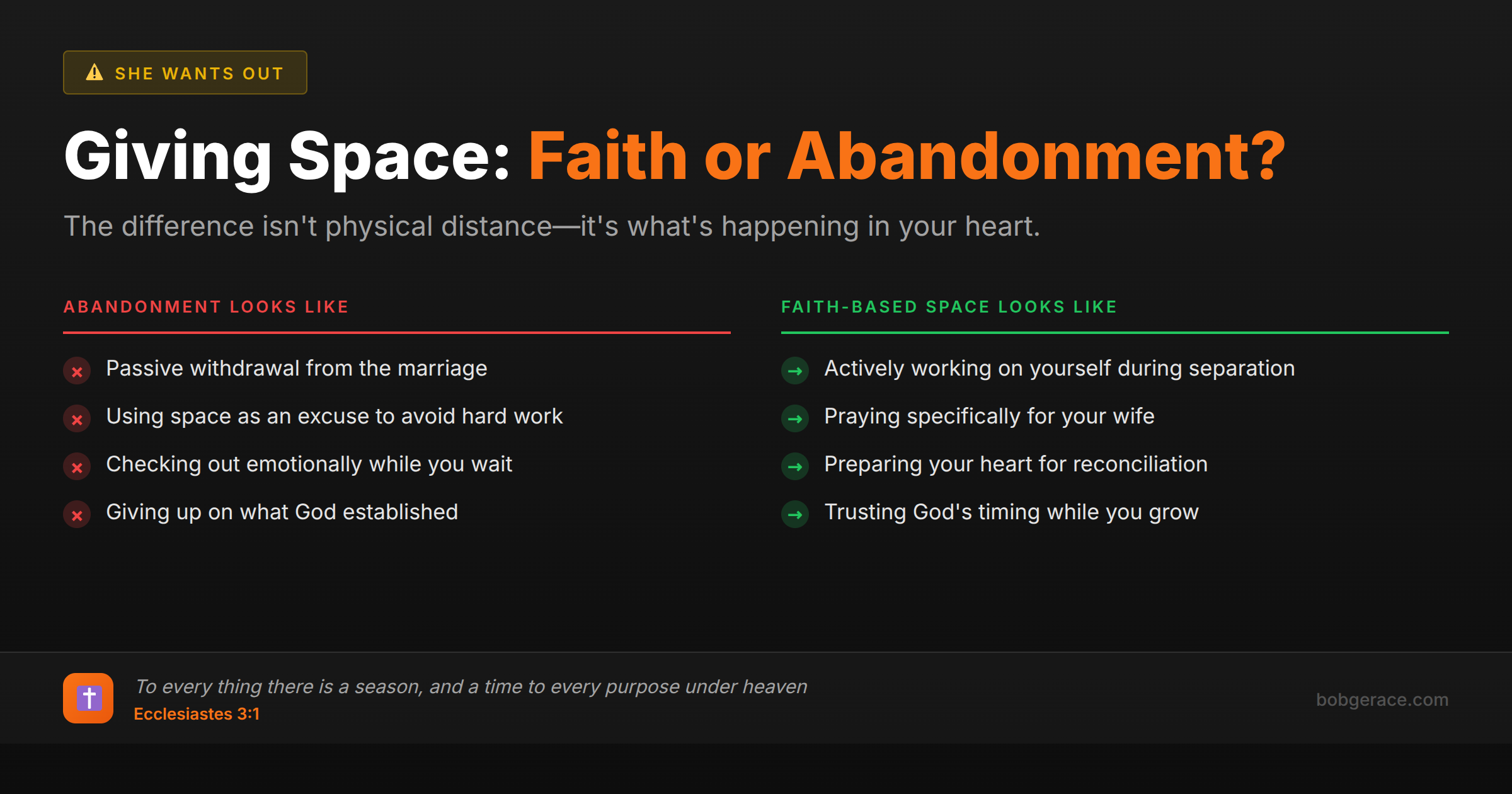
Giving space can be either faith or abandonment - it depends entirely on your heart and your actions while you wait. Faith-based space means stepping back while actively working on yourself, praying for your wife, and preparing for reconciliation. You're trusting God to work in both of your hearts during this time apart. Abandonment, on the other hand, is passive withdrawal. It's giving up, checking out emotionally, or using space as an excuse to avoid the hard work your marriage needs. The difference isn't in the physical distance - it's in whether you're using this time to grow or to give up.
The Full Picture
Here's what most men get wrong about giving space: they think it's a binary choice between fighting for their marriage or giving up entirely. But there's a third option that actually works - holy restraint.
Holy restraint is strategic love in action. It means: • Stepping back from behaviors that push her further away • Using the time apart to address your own issues • Maintaining appropriate contact without being needy or controlling • Trusting God's timing while doing your part
Common mistakes men make: • The Pursuer - He can't stop texting, calling, showing up unannounced. This isn't love, it's anxiety disguised as devotion. • The Controller - He uses manipulation, guilt, or threats to prevent her from leaving. This drives her away faster. • The Abandoner - He throws his hands up and says "fine, if you want space, you've got it" then disappears completely.
None of these work because they're all driven by fear, not faith.
Faith-based space looks different: You give her room to breathe while you get serious about becoming the man and husband God called you to be. You're not sitting around waiting for her to change her mind - you're actively changing yourself. You're praying for wisdom, seeking counsel, addressing your issues, and preparing for the possibility of reconciliation.
This isn't passive. It's the most active thing you can do - trusting God enough to work on what you can control (yourself) while releasing what you can't (her heart and timeline).
What's Really Happening
From a clinical perspective, the decision between space and pursuit often reflects our attachment style and anxiety tolerance. Men with anxious attachment tend to pursue when they feel disconnected, which activates their partner's need for distance. Those with avoidant attachment may use "giving space" as a way to emotionally withdraw and protect themselves from vulnerability.
The Gottman research shows us that successful couples learn to balance connection and autonomy. When a relationship becomes too enmeshed or too distant, it creates instability. Space, when done correctly, can actually restore this balance.
Neurologically, when someone feels overwhelmed or flooded in a relationship, their nervous system needs time to regulate. Pursuing someone in this state activates their fight-or-flight response. Strategic space allows both partners' nervous systems to calm down and think more clearly.
However, space becomes abandonment when it's used as: • Emotional punishment - withdrawing to hurt or control • Avoidance of responsibility - using distance to avoid addressing real issues • Premature detachment - giving up before genuine effort has been made
The healthiest approach involves differentiation - maintaining your sense of self and emotional stability regardless of your partner's current state. This allows you to give space from a position of strength rather than fear or manipulation.
Clinical indicators of healthy space: You can sleep, eat, and function while apart. You're using the time for genuine self-improvement. You can think about your partner with love rather than resentment. You're preparing for multiple outcomes without being controlled by any single one.
What Scripture Says
Scripture gives us a clear framework for understanding when space reflects faith versus abandonment. Ecclesiastes 3:1 reminds us that "To every thing there is a season, and a time to every purpose under heaven." Sometimes the most faithful thing we can do is step back and allow God to work.
Matthew 19:6 tells us "What therefore God hath joined together, let not man put asunder." This doesn't mean we pursue at all costs - it means we don't give up on what God has established. Faith-based space is still fighting for your marriage, just with different tactics.
1 Corinthians 7:10-11 addresses separation: "And unto the married I command, yet not I, but the Lord, Let not the wife depart from her husband: But and if she depart, let her remain unmarried, or be reconciled to her husband." Notice it doesn't say to prevent her departure by force - it acknowledges separation may happen while maintaining hope for reconciliation.
Galatians 6:9 encourages us: "And let us not be weary in well doing: for in due season we shall reap, if we faint not." Well doing includes respecting your wife's stated needs while continuing to work on yourself.
Proverbs 27:14 warns: "He that blesseth his friend with a loud voice, rising early in the morning, it shall be counted a curse to him." Even good intentions (blessing/pursuing) can become harmful when the timing or method is wrong.
James 1:19 instructs us to be "swift to hear, slow to speak, slow to wrath." Sometimes giving space is the most loving way to listen to what your wife is really saying - that she needs time and room to process.
Biblical space isn't passive waiting - it's active trust in God's timing while we do our part to become who He's called us to be.
What To Do Right Now
-
1
Examine your motives - write down whether giving space feels like faith (trusting God's timing) or abandonment (giving up)
-
2
Establish appropriate boundaries - agree on communication frequency and method that respects her need for space
-
3
Create a personal growth plan - identify specific areas where you need to change and take concrete action
-
4
Seek wise counsel - find a mentor, counselor, or coach who can help you navigate this season faithfully
-
5
Pray specifically for your wife - ask God to work in her heart while asking Him to change yours
-
6
Prepare for multiple outcomes - develop emotional and spiritual stability that isn't dependent on her immediate response
Related Questions
- Should I give her space or fight for her?
- How much space is too much?
- If I give space, won't she think I don't care?
- What's the difference between pursuing and chasing?
- When does giving space become abandonment?
- How do I honor her autonomy while fighting for us?
- What does it mean to love without grasping?
- How do I pursue without pressuring?
- What does surrendered prayer look like?
Also find Bob on
Subscribe for weekly videos on Christian marriage.
Don't Navigate This Alone
Giving space well requires knowing what to do with your heart while you wait. A coach who knows your marriage can help you tell the difference between faith and abandonment in your specific situation.
Talk to Bob →