What's the difference between standing and stagnating?
6 min read
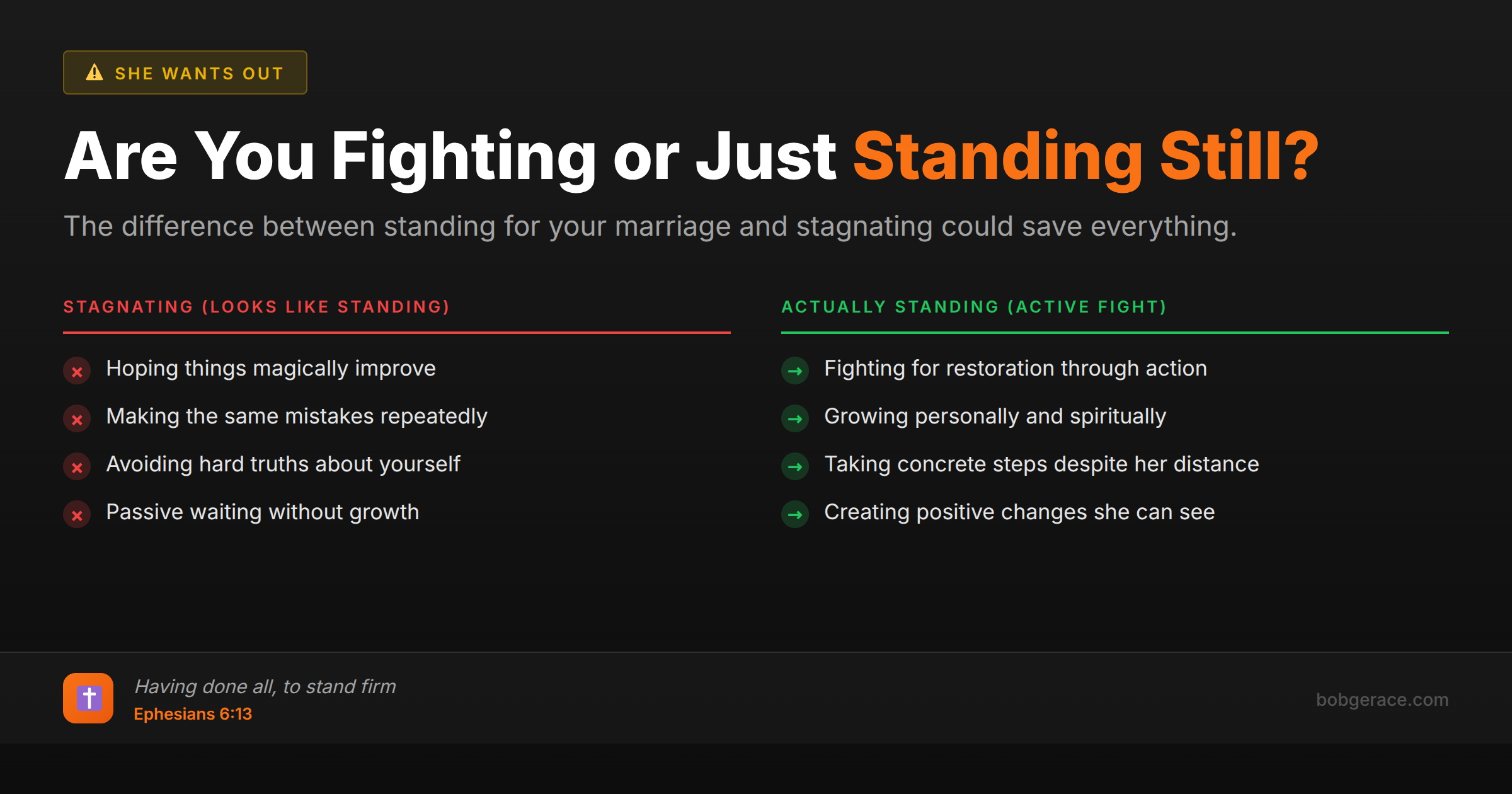
Standing for your marriage means actively fighting for restoration while growing personally and spiritually. You're engaged, learning, changing, and taking concrete steps even when she's pulled away. Stagnating is passive waiting – hoping things magically improve while you remain unchanged, making the same mistakes, and avoiding hard truths about yourself and your relationship. The difference is movement versus paralysis. When you're standing, you're in motion even when she's not responding. You're addressing your own issues, developing new skills, and creating positive changes she can actually see. Stagnating feels like standing because you're not giving up, but you're actually just stuck in the same patterns that contributed to the crisis in the first place.
The Full Picture
Standing for your marriage is active warfare. You're fighting for something worth saving, but you're fighting smart. You're identifying what went wrong, taking responsibility for your part, and making measurable changes. You're reading, learning, seeking counsel, and implementing new approaches to communication, intimacy, and leadership in your home.
Stagnating feels like faithfulness, but it's actually fear disguised as loyalty. You tell yourself you're "being patient" or "giving her space," but really you're avoiding the hard work of transformation. You're hoping she'll come around without you having to face uncomfortable truths about how you contributed to her wanting out.
Here's how to tell the difference:
• Standing involves growth – You're different today than you were three months ago • Stagnating involves repetition – You keep having the same conversations, same fights, same outcomes • Standing is strategic – You have a plan and you're working it • Stagnating is reactive – You're just responding to whatever she throws at you
Standing requires courage because it means admitting you need to change. It means facing the possibility that your "best efforts" weren't actually that good. It means getting comfortable with being uncomfortable as you develop new patterns.
Stagnating feels safer because it doesn't require you to acknowledge that your current approach isn't working. But safety is an illusion when your marriage is hemorrhaging trust and connection.
What's Really Happening
From a therapeutic perspective, stagnation often represents what we call "avoidant coping" – the unconscious strategy of managing anxiety by avoiding action. When a marriage is in crisis, the overwhelm can be so intense that the brain defaults to freeze mode rather than fight or flight.
Research in attachment theory shows us that when people feel threatened in their primary relationship, they often revert to childhood coping mechanisms. If you learned early that being "good" and not causing waves would keep you safe, you might mistake passivity for virtue in your marriage crisis.
The neurological reality is that your brain interprets any change – even positive change – as potential danger during times of relationship stress. This creates a paradox where the very actions that could save your marriage feel impossibly risky.
Standing, therapeutically speaking, requires what we call "distress tolerance" – the ability to act effectively even when experiencing intense emotional discomfort. It involves moving from an external locus of control ("if she would just...") to an internal one ("what can I influence?").
Trauma responses also play a role. Many men experiencing marriage crisis show symptoms of betrayal trauma – hypervigilance, emotional numbing, and difficulty concentrating. These symptoms can masquerade as "standing" when they're actually trauma-induced paralysis.
The therapeutic goal is helping you differentiate between wise patience (standing) and trauma-induced inaction (stagnating). True standing involves what psychologists call "approach behaviors" – moving toward growth, connection, and change despite fear.
What Scripture Says
Scripture makes a clear distinction between faithful endurance and passive waiting. Ephesians 6:13 tells us to "take up the whole armor of God, that you may be able to withstand in the evil day, and having done all, to stand firm." Notice it says "having done all" – standing comes after action, not instead of it.
Proverbs 27:14 warns that "whoever blesses his neighbor with a loud voice, rising early in the morning, will be counted as cursing." Sometimes what we think is faithfulness is actually harmful persistence in wrong approaches.
1 Corinthians 16:13 commands us to "be watchful, stand firm in the faith, act like men, be strong." True biblical standing is active – it involves watching, acting, and demonstrating strength through wise choices.
James 1:22 cuts to the heart of stagnation: "Be doers of the word, and not hearers only, deceiving yourselves." You can know all the right marriage principles, but if you're not implementing them, you're deceiving yourself about your progress.
Ecclesiastes 3:1 reminds us that there is "a time for every matter under heaven." Part of biblical wisdom is discerning when your season of standing requires different actions than it did last month.
Galatians 6:9 encourages us not to "grow weary of doing good, for in due season we will reap, if we do not give up." The key phrase is "doing good" – active, positive engagement rather than passive endurance.
What To Do Right Now
-
1
Assess honestly whether you're fundamentally different today than six months ago – if not, you're stagnating
-
2
Identify three specific behaviors or communication patterns you need to change and create a plan to address them
-
3
Schedule regular check-ins with a mentor, counselor, or coach who will hold you accountable for growth
-
4
Document your progress weekly – what you're learning, what you're implementing, what results you're seeing
-
5
Stop repeating conversations or approaches that haven't worked – if she's heard it before, don't say it again
-
6
Focus 80% of your energy on your own transformation and only 20% on trying to influence her responses
Related Questions
- How long do I wait before giving up?
- When is it actually over?
- How do I know if I'm in denial or in faith?
- What does healthy hope look like vs. fantasy?
- When does waiting become enabling?
- What does 'standing' mean clinically?
- What does real transformation look like?
- How do I change from the inside out?
- What does sustainable change require?
Also find Bob on
Subscribe for weekly videos on Christian marriage.
Standing Requires a Coach Who Knows Your Marriage
You don't need generic advice—you need someone who hears your specific story, sees where you're actually stuck, and calibrates the work to your situation.
Talk to Bob →