How do I honor her autonomy while fighting for us?
6 min read
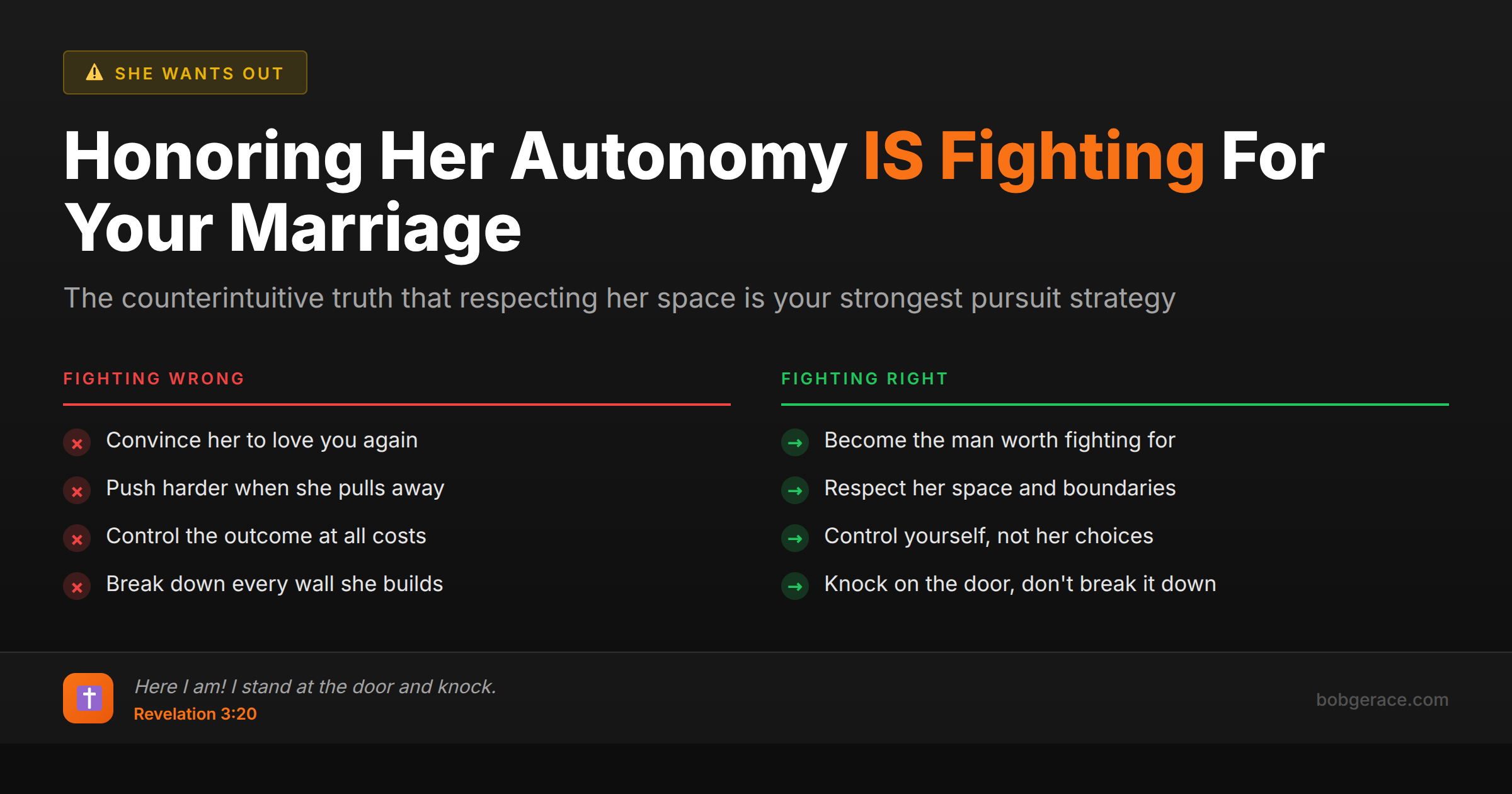
The tension you're feeling is real and it's holy. You want to fight for your marriage, but you also know that pursuing too hard pushes her further away. Here's the truth: honoring her autonomy IS fighting for your marriage. When you respect her space and choices, you're demonstrating the kind of man worth fighting for. This doesn't mean becoming passive or giving up. It means shifting from trying to control the outcome to controlling yourself. You fight by becoming the husband she fell in love with - not by convincing her to love you again. You pursue her heart by first pursuing your own healing and growth.
The Full Picture
Most men get this completely backwards. They think fighting for the marriage means more calls, more flowers, more grand gestures, more convincing. But when your wife is pulling away, these tactics feel like pressure, not love.
Autonomy means she gets to choose. Even if her choices hurt you. Even if they seem wrong. Even if you could fix everything if she'd just listen. The moment you try to override her autonomy - through manipulation, guilt, or relentless pursuit - you become part of the problem she's trying to escape.
Common mistakes that violate autonomy: • Showing up unannounced to "talk" • Bringing the kids into it to influence her decision • Going through her phone or monitoring her activities • Making unilateral decisions about counseling or separation • Using emotional manipulation ("You're destroying our family") • Refusing to respect boundaries she's clearly communicated
Fighting for the marriage looks different: • Working on yourself whether she notices or not • Respecting her timeline, not yours • Taking responsibility for your part without excuses • Creating safety through consistency, not intensity • Becoming someone worth choosing, not someone who demands to be chosen
The paradox is this: the more you honor her right to leave, the more likely she is to consider staying. When you remove the pressure, you create space for her to actually feel what she's missing.
What's Really Happening
From a psychological standpoint, autonomy is a fundamental human need. Self-Determination Theory identifies autonomy as one of three basic psychological needs essential for well-being, alongside competence and relatedness. When your wife feels her autonomy is threatened, her nervous system activates a protective response.
Reactance theory explains why pressure backfires. When people feel their freedom to choose is restricted, they experience psychological reactance - a motivation to restore that freedom. This often manifests as doing the opposite of what's being pressured, even if they might have chosen it otherwise.
Attachment patterns also play a role here. If your wife has an anxious attachment style, your pursuing might initially feel reassuring but quickly becomes overwhelming. If she's avoidant, pursuit triggers her flight response. Either way, respecting her autonomy helps regulate her nervous system and reduces her defensive responses.
The research on relationship repair consistently shows that change happens through safety, not pressure. When partners feel psychologically safe - meaning they can express themselves without fear of retaliation, judgment, or manipulation - they're more willing to be vulnerable and work on the relationship.
Respecting autonomy doesn't mean disconnection. It means differentiation - maintaining your own identity and values while allowing her to maintain hers. This creates the healthy interdependence that strong marriages are built on, rather than the enmeshment or codependency that often contributes to marital breakdown.
What Scripture Says
Scripture gives us a clear model for honoring autonomy while pursuing love. Revelation 3:20 shows us Christ's approach: *"Here I am! I stand at the door and knock. If anyone hears my voice and opens the door, I will come in and eat with that person, and they with me."* Notice - He knocks, but doesn't break down the door.
1 Peter 3:7 calls husbands to *"live with your wives in an understanding way, showing honor to the woman as the weaker vessel, since they are heirs with you of the grace of life."* The word "honor" here means to assign value and worth - recognizing her as an equal heir, not someone to be controlled.
Ephesians 5:25 doesn't say *"Husbands, make your wives submit."* It says *"Husbands, love your wives, just as Christ loved the church and gave himself up for her."* Christ's love was sacrificial, not controlling. He gave up His rights for our good.
Galatians 5:13 reminds us: *"You, my brothers and sisters, were called to be free. But do not use your freedom to indulge the flesh; rather, serve one another humbly in love."* Her freedom isn't a threat to love - it's the foundation that makes love possible.
Philippians 2:3-4 provides the framework: *"Do nothing out of selfish ambition or vain conceit. Rather, in humility value others above yourselves, not looking to your own interests but each of you to the interests of the others."* Fighting for your marriage means prioritizing her well-being over your comfort.
The biblical model is pursuit through service, not pressure. You fight for the marriage by becoming the kind of man she can freely choose to love.
What To Do Right Now
-
1
Stop all forms of pursuit and pressure - no more convincing conversations, surprise visits, or attempts to change her mind
-
2
Respect every boundary she sets, even if it seems unreasonable - this builds trust and safety over time
-
3
Focus your energy on your own healing and growth rather than monitoring her responses to your changes
-
4
Give her space to miss you by creating healthy distance and not filling every silence with words
-
5
Take full responsibility for your part in the marriage breakdown without expecting her to reciprocate
-
6
Become someone worth choosing by developing the character qualities that attracted her originally
Related Questions
- Should I give her space or fight for her?
- How do I fight without pushing her away?
- What's the difference between pursuing and chasing?
- What is 'holy restraint'?
- What does it mean to love without grasping?
- Is giving space an act of faith or abandonment?
- What does 'holding space' actually mean?
- How do I lead without controlling?
- What's the difference between leading and dominating?
- What boundaries should I set?
Also find Bob on
Subscribe for weekly videos on Christian marriage.
You Don't Have to Navigate This Alone
This tension between pursuing and respecting her space is specific to your marriage, your history, your moment. A coach who knows your story can help you calibrate what fighting for her actually looks like right now.
Talk to Bob →