What is 'holy restraint'?
5 min read
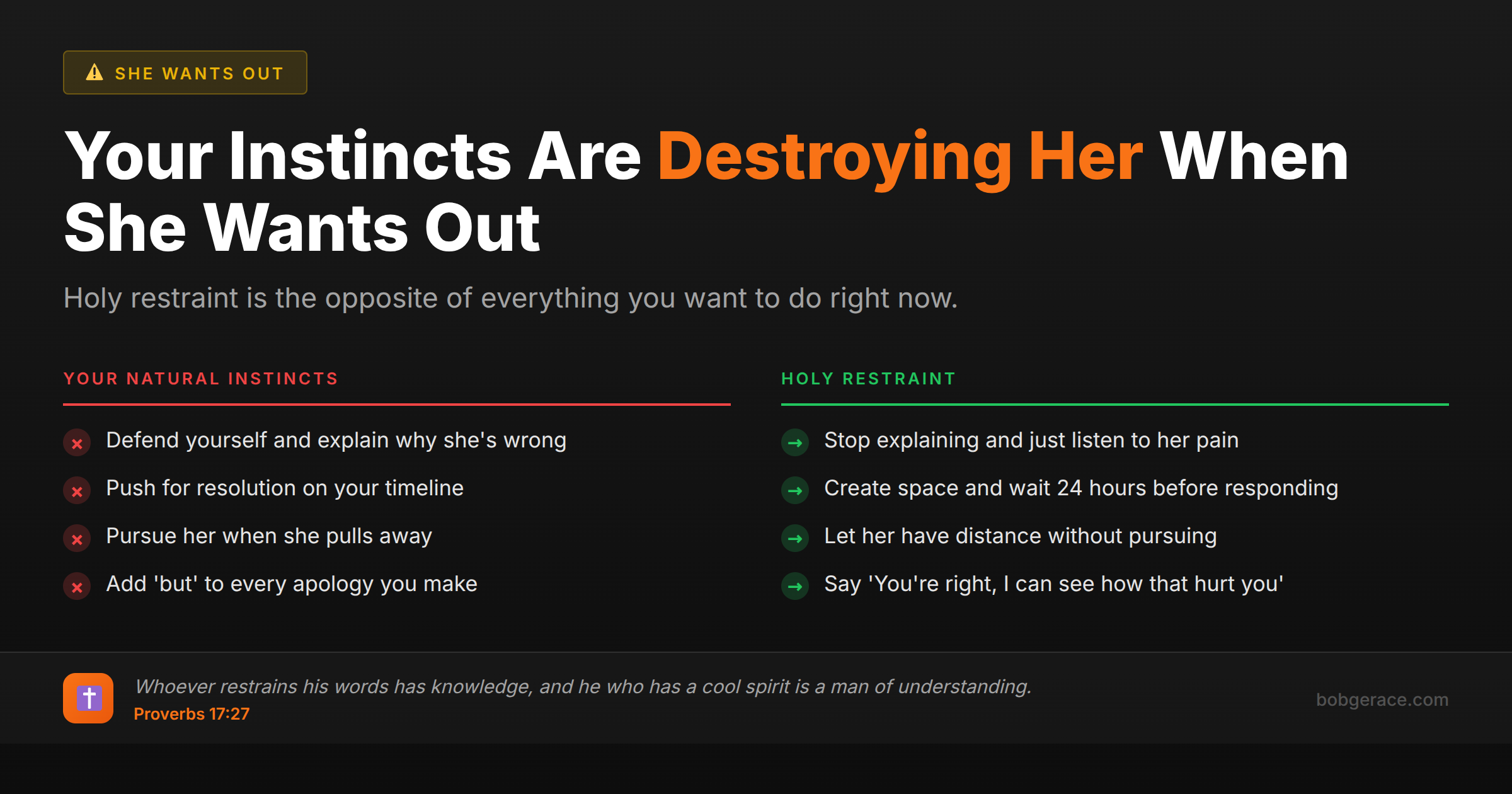
Holy restraint is disciplined self-control that honors both God and your wife. It's the conscious choice to hold back your words, actions, or impulses when they would cause harm, even when you feel justified in expressing them. This isn't weakness or passive behavior—it's actually one of the strongest things you can do as a man. When your marriage is in crisis and your wife wants out, your natural instincts often work against you. You want to defend yourself, convince her she's wrong, or push for resolution on your timeline. Holy restraint means recognizing these impulses and choosing a different path. It's creating space for healing by restraining the very behaviors that likely contributed to the damage in the first place.
The Full Picture
Holy restraint operates on multiple levels in your marriage. It's restraint of words—choosing not to defend, explain, or justify when your wife expresses her pain. It's restraint of actions—not pursuing her when she needs space, not trying to fix everything immediately, not overwhelming her with grand gestures.
Most importantly, it's restraint of your timeline. When your marriage is hanging by a thread, every instinct screams at you to act now, fix now, resolve now. Holy restraint recognizes that healing happens on God's timeline, not yours.
This isn't about becoming a doormat or suppressing healthy emotions. It's about strategic self-discipline guided by wisdom rather than panic. Many men confuse restraint with inaction, but they're different. Restraint is actively choosing not to do something harmful. It's working on yourself while giving your wife the space she needs.
Common mistakes men make: • Confusing restraint with emotional withdrawal • Using restraint as a manipulation tactic ("Look how good I'm being") • Practicing restraint inconsistently, then exploding when it gets difficult • Restraining externally while internally building resentment
True holy restraint comes from a place of humility and trust—humility to acknowledge your part in the marriage problems, and trust that God can work even when you're not actively trying to control the outcome. It's perhaps the most masculine thing you can do because it requires incredible inner strength.
What's Really Happening
From a therapeutic perspective, holy restraint activates what we call the 'wise mind'—the integration of rational thought and emotional awareness. When marriages are in crisis, both partners often operate from their 'emotion mind,' where feelings drive all decisions and reactions.
Neurologically, restraint engages the prefrontal cortex, which governs executive function and impulse control. This is crucial because in marital distress, the amygdala (fear center) is often hyperactive, triggering fight-or-flight responses that damage relationships further. Practicing restraint literally rewires your brain's response patterns.
Research in attachment theory shows that when one partner consistently demonstrates emotional regulation and restraint, it creates a 'secure base' that can help regulate the other partner's nervous system. Your wife's desire for space often stems from feeling emotionally unsafe. Restraint communicates safety at a physiological level.
However, restraint must be authentic, not performative. The difference lies in motivation—genuine restraint comes from care for your wife's wellbeing, while performative restraint is manipulation disguised as virtue. Women are exceptionally skilled at detecting this difference, often subconsciously.
Clinically, I observe that men who practice genuine restraint report decreased anxiety and increased sense of personal agency. They shift from feeling like victims of their circumstances to feeling empowered through their choices. This internal shift often precedes positive changes in the marital dynamic, though the timeline varies significantly.
What Scripture Says
Scripture consistently elevates restraint as a mark of wisdom and strength. Proverbs 17:27-28 states, "Whoever restrains his words has knowledge, and he who has a cool spirit is a man of understanding. Even a fool who keeps silent is considered wise; when he closes his lips, he is deemed intelligent."
The concept appears throughout the New Testament in discussions of self-control. Galatians 5:22-23 lists self-control as a fruit of the Spirit: "But the fruit of the Spirit is love, joy, peace, patience, kindness, goodness, faithfulness, gentleness, self-control; against such things there is no law."
1 Peter 3:7 specifically addresses husbands: "Likewise, husbands, live with your wives in an understanding way, showing honor to the woman as the weaker vessel, since they are heirs with you of the grace of life, so that your prayers may not be hindered." This "understanding way" often requires restraint—restraining our natural impulses to honor our wives' different needs and perspectives.
James 1:19 provides practical guidance: "Know this, my beloved brothers: let every person be quick to hear, slow to speak, slow to anger." Holy restraint embodies this principle—being quick to listen to your wife's pain without immediately defending or explaining.
Ecclesiastes 3:7 reminds us there is "a time to keep silence, and a time to speak." Wisdom lies in discerning which time you're in. When your marriage is in crisis, it's usually time for silence, listening, and internal work rather than external action.
Biblical restraint isn't passive—it's active obedience to God's wisdom, trusting His timing over your urgency.
What To Do Right Now
-
1
Stop explaining or defending your actions when your wife expresses hurt or frustration
-
2
Create a 24-hour rule: wait a full day before responding to emotionally charged conversations
-
3
Practice the phrase 'You're right, I can see how that hurt you' without adding 'but' statements
-
4
Resist the urge to pursue physical or emotional intimacy when she's pulling away
-
5
Ask 'What would restraint look like right now?' before taking any action in your marriage
-
6
Journal your impulses daily to recognize patterns and practice choosing different responses
Related Questions
- What does it mean to love without grasping?
- How did Christ pursue without coercing?
- Is giving space an act of faith or abandonment?
- How do I honor her autonomy while fighting for us?
- What does 'dying to self' look like here?
- What is the difference between standing and stalking?
- How do I pursue without pressuring?
- What does humble leadership look like?
- How do I love my enemy when he's sleeping with my wife?
- What does surrendered prayer look like?
Also find Bob on
Subscribe for weekly videos on Christian marriage.
Restraint Is Hard When It's Your Marriage
A coach who knows your story can help you see where restraint matters most—and where you're actually holding back too much. You don't have to guess alone.
Talk to Bob →