Why is pride the enemy of hearing truth?
6 min read
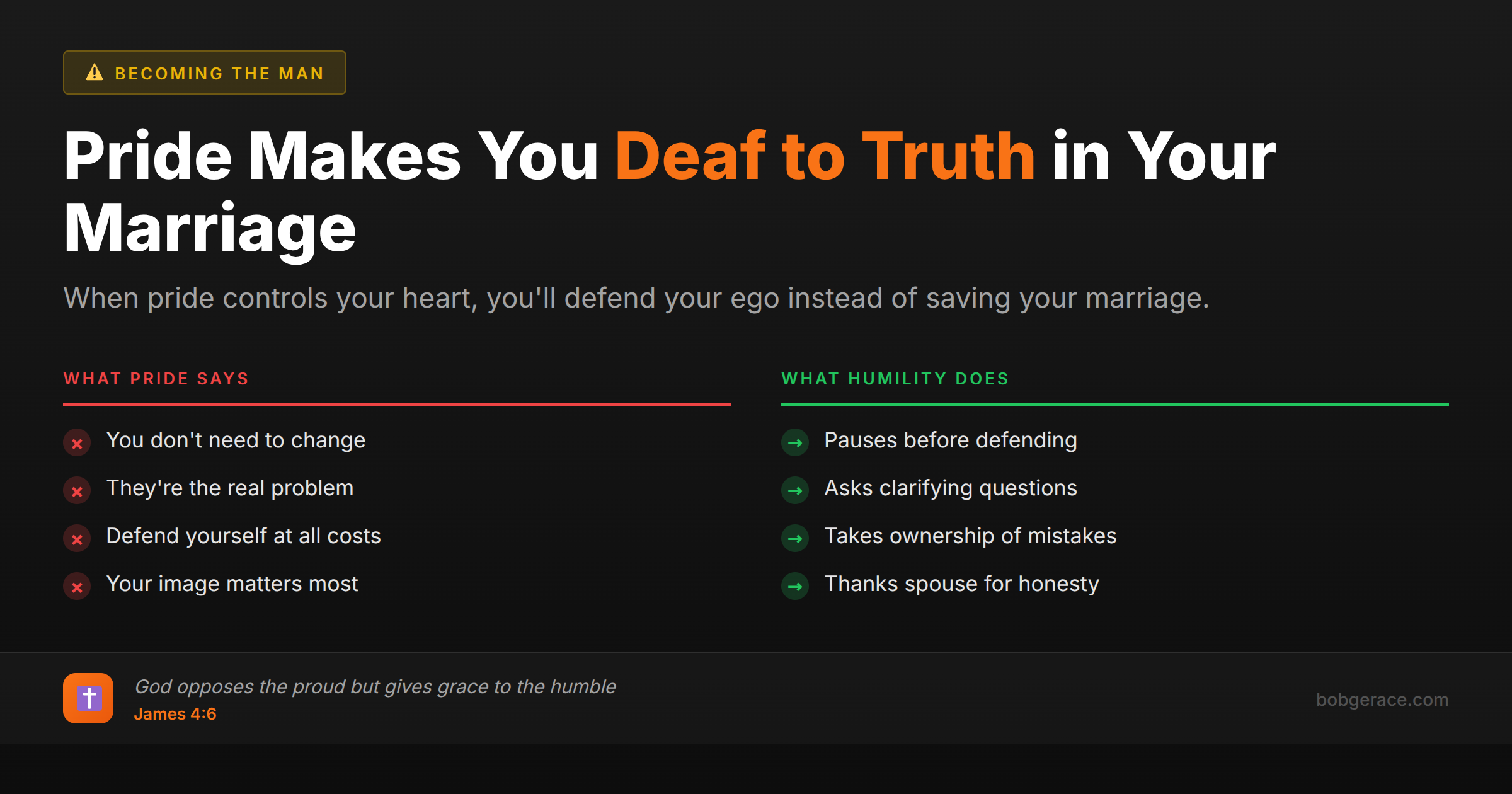
Pride is the enemy of hearing truth because it makes us defensive instead of receptive. When pride controls our heart, we're more concerned with being right than being wrong, more focused on protecting our image than receiving correction. Pride whispers lies like 'You don't need to change' or 'They're the real problem.' It creates a wall between us and the very truth that could set us free. In marriage, pride prevents us from hearing our spouse's concerns, taking responsibility for our mistakes, or admitting when we've hurt them. It keeps us stuck in cycles of defensiveness and blame instead of moving toward genuine repentance and healing.
The Full Picture
Pride operates like a defense attorney in your head, constantly building a case for why you're right and everyone else is wrong. It's the voice that says, 'I don't have a pride problem - everyone else is just too sensitive.' But here's what pride really does: it makes you unteachable.
When your spouse tries to share how they feel, pride immediately goes to work. It minimizes their concerns, deflects responsibility, and builds walls of justification. Pride says things like, 'That's not what I meant,' or 'You're being too emotional,' or 'I was just trying to help.' Notice how all of these responses avoid actually hearing what's being said.
Pride is fundamentally about self-protection. It's the fallen human instinct to preserve our sense of being good, right, and justified. But in marriage, this self-protection becomes relationship destruction. When you can't hear truth, you can't receive correction. When you can't receive correction, you can't grow. When you can't grow, your marriage stagnates.
The cruel irony is that pride, which promises to protect you, actually isolates you. It cuts you off from the very feedback you need to become the person God wants you to be. Pride makes you think you're the hero of your story when you might actually be the villain. It blinds you to your own faults while magnifying everyone else's. This is why Scripture says pride goes before destruction - because proud people destroy their relationships by refusing to hear truth.
What's Really Happening
From a clinical perspective, pride functions as a psychological defense mechanism designed to protect our ego from perceived threats. When someone offers feedback or correction, our brain's threat-detection system can activate, triggering what we call 'defensive responding.' This isn't just stubbornness - it's actually our nervous system trying to protect us from shame and perceived rejection.
Pride manifests in marriage through several predictable patterns. Deflection - immediately shifting blame to the other person. Minimization - downplaying the significance of the issue. Intellectualization - turning emotional conversations into debates about facts and logic. Stonewalling - shutting down emotionally and refusing to engage.
What's particularly destructive about pride is how it hijacks our empathy. When we're in defensive mode, we literally cannot access the parts of our brain responsible for understanding our partner's perspective. This is why proud people often say things like, 'I don't understand why you're so upset about this.' They're not lying - pride has actually impaired their ability to see beyond their own viewpoint.
The good news is that pride, like other defense mechanisms, can be changed through intentional practice. When we learn to recognize our defensive patterns and choose curiosity over self-protection, we can begin to hear truth again. This requires what I call 'distress tolerance' - the ability to sit with uncomfortable feedback without immediately defending ourselves.
What Scripture Says
Scripture is crystal clear about pride's destructive nature. Proverbs 16:18 warns us that 'Pride goes before destruction, and a haughty spirit before a fall.' This isn't just a general principle - it's describing what happens in marriages every day when pride prevents us from hearing truth.
James 4:6 tells us that 'God opposes the proud but gives grace to the humble.' Think about that - when you operate in pride, you're actually positioning yourself against God. You're choosing to resist the very grace He wants to give you. 1 Peter 5:5-6 echoes this: 'Clothe yourselves with humility toward one another, because God opposes the proud but shows favor to the humble. Humble yourselves, therefore, under God's mighty hand.'
Proverbs 12:1 cuts right to the heart of the issue: 'Whoever loves discipline loves knowledge, but whoever hates correction is stupid.' That's not me being harsh - that's God's Word. When we resist correction from our spouse, we're choosing foolishness over wisdom.
Proverbs 27:5-6 shows us the value of hard truth: 'Better is open rebuke than hidden love. Wounds from a friend can be trusted, but an enemy multiplies kisses.' Sometimes your spouse's correction feels like a wound, but it's actually a gift from someone who loves you enough to tell you the truth.
The beautiful promise comes in Proverbs 9:8-9: 'Rebuke the wise and they will love you. Instruct the wise and they will be wiser still.' When you humble yourself to receive truth, you don't just protect your marriage - you become wiser and more like Christ.
What To Do Right Now
-
1
Practice the pause - When your spouse shares feedback, count to three before responding. This breaks the automatic defensive reaction.
-
2
Ask clarifying questions - Instead of defending, say 'Help me understand what you mean by that' or 'Can you give me an example?'
-
3
Take ownership of your part - Look for the kernel of truth in what they're saying and acknowledge it, even if you disagree with other parts.
-
4
Thank them for their courage - It takes guts to give honest feedback. Acknowledge that they're taking a risk to help you grow.
-
5
Pray for a soft heart - Ask God to show you areas where pride has made you unteachable and to give you humility to receive correction.
-
6
Follow up later - After you've had time to process, circle back and share what you've learned or what you plan to change.
Related Questions
- What does Proverbs say about receiving correction?
- What does 'teachable spirit' look like?
- What does humility in conflict look like?
- How do I receive correction as from the Lord?
- What is the relationship between confession and defensiveness?
- How do I model Christ who 'did not revile in return'?
- What does 'godly sorrow' look like in practice?
- What does repentance look like for accumulated sin?
- She doesn't believe I understand what I did
- What does genuine repair look like for old wounds?
Also find Bob on
Subscribe for weekly videos on Christian marriage.
Hearing it is one thing. Applying it to your marriage is another.
A coach who knows your specific story can help you see where pride is actually showing up in your marriage — and what to do about it in real time.
Talk to Bob →