What does 'teachable spirit' look like?
6 min read
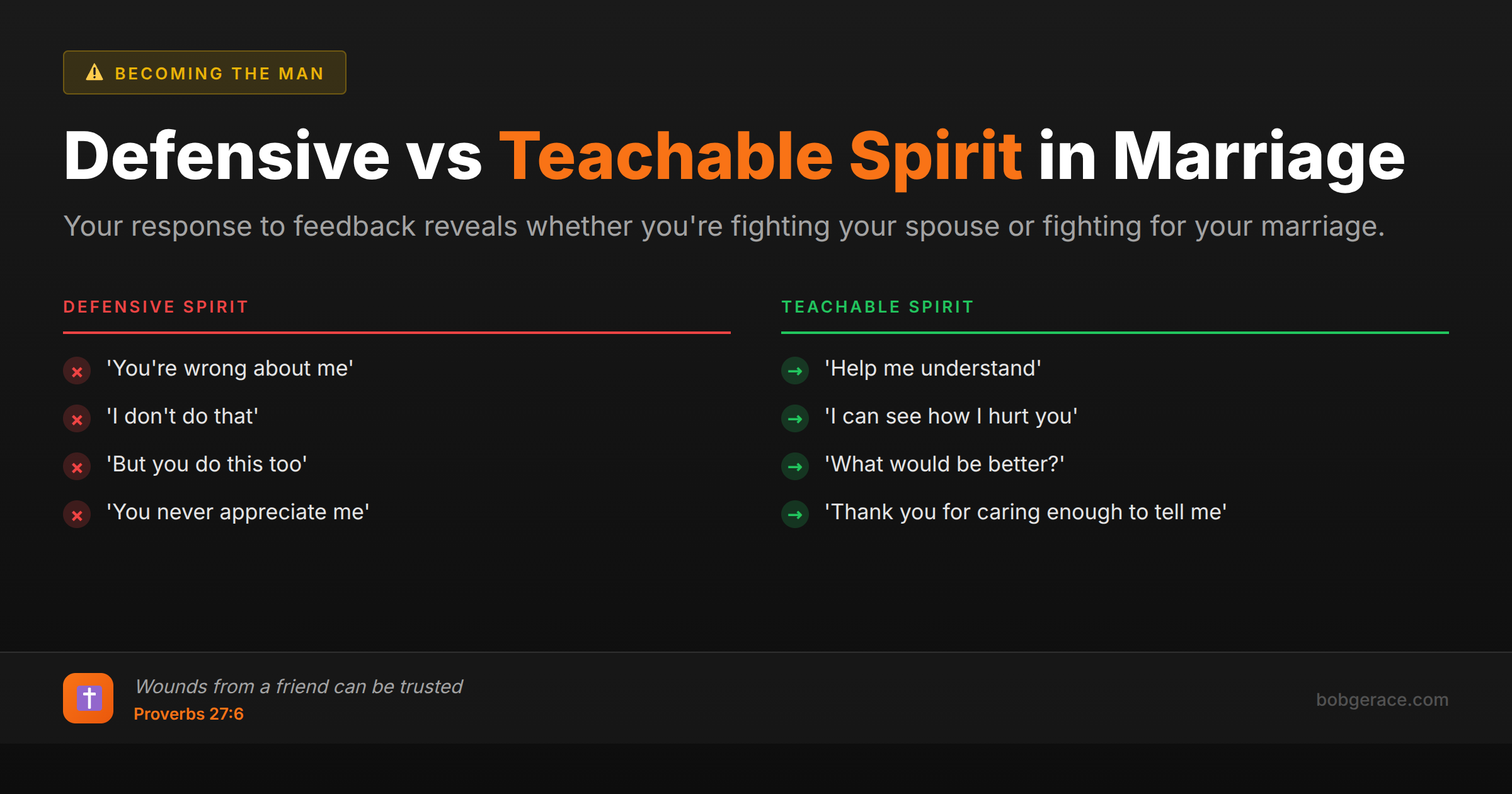
A teachable spirit in marriage looks like genuine humility that says 'I don't know everything' and 'I can be wrong.' It's the posture of someone who listens more than they defend, asks questions instead of making assumptions, and views their spouse's feedback as a gift rather than an attack. This spirit shows up practically when you pause before reacting, genuinely consider your partner's perspective, and admit mistakes without excuses. It's choosing curiosity over defensiveness, saying 'Help me understand' instead of 'You're wrong,' and being willing to change your mind when presented with truth. A teachable spirit transforms conflict from a battle to win into an opportunity to grow together.
The Full Picture
A teachable spirit is the foundation of all growth in marriage. Without it, you'll stay stuck in the same patterns, defending the same positions, and making the same mistakes over and over.
Here's what a teachable spirit actually looks like in real life:
It listens first. Instead of formulating your defense while your spouse talks, you genuinely hear them. You ask clarifying questions. You repeat back what they said to make sure you understood.
It admits ignorance. A teachable person can say 'I don't know' or 'I hadn't thought of that' without feeling diminished. They recognize that learning requires acknowledging what you don't already know.
It welcomes correction. Proverbs tells us that wise people love correction, but fools hate it. A teachable spirit sees your spouse's feedback—even when it stings—as valuable information, not a personal attack.
It changes behavior. This is crucial. A truly teachable spirit doesn't just nod and agree—it actually adjusts. If your spouse points out a pattern that's hurting them, you work to change it.
It asks for help. Pride says 'I can figure this out myself.' A teachable spirit says 'Show me how' or 'What would be better?'
It stays curious. Instead of assuming you know your spouse's motives or feelings, you ask. You explore. You remain genuinely interested in understanding them better.
The opposite of a teachable spirit is defensiveness, pride, and the need to be right. These kill intimacy and prevent growth. But when both spouses approach marriage with teachable hearts, conflicts become opportunities, feedback becomes fuel for growth, and the relationship deepens continuously.
What's Really Happening
From a psychological standpoint, a teachable spirit represents emotional maturity and secure attachment. When we're defensive, our nervous system perceives feedback as threat, triggering fight-or-flight responses that shut down learning.
Research shows that individuals with growth mindsets—who believe abilities can be developed—have stronger relationships than those with fixed mindsets who believe traits are unchangeable. A teachable spirit is essentially growth mindset applied to marriage.
Neurologically, defensiveness activates the amygdala, flooding the brain with stress hormones that impair our ability to process information rationally. A teachable spirit, conversely, engages the prefrontal cortex—our thinking brain—allowing for reflection, consideration, and genuine learning.
I often see couples stuck in what I call 'defensive loops'—each partner's defensiveness triggering the other's, creating escalating conflicts that resolve nothing. The partner who develops a teachable spirit first often breaks this cycle.
Practically, teachability requires emotional regulation skills. You must be able to tolerate the discomfort of being wrong, the vulnerability of not knowing, and the challenge of changing ingrained patterns. This is why teachable spirits are cultivated, not just discovered—they require intentional practice and often professional support to develop fully.
What Scripture Says
Scripture consistently calls believers to cultivate teachable hearts, especially in close relationships.
Proverbs 27:5-6 tells us, *'Better is open rebuke than hidden love. Wounds from a friend can be trusted, but an enemy multiplies kisses.'* Your spouse's honest feedback, even when it hurts, is actually an expression of love.
Proverbs 19:20 commands: *'Listen to advice and accept discipline, and at the end you will be counted among the wise.'* Wisdom comes through receiving instruction, not through having all the answers.
James 1:19 provides the practical framework: *'Everyone should be quick to listen, slow to speak and slow to become angry.'* This is teachability in action—prioritizing understanding over being understood.
Proverbs 12:15 exposes our natural tendency: *'The way of fools seems right to them, but the wise listen to advice.'* Without teachable spirits, we're convinced we're right even when we're destroying our marriages.
1 Corinthians 8:2 humbles our pride: *'Those who think they know something do not yet know as they ought to know.'* The more convinced you are that you have nothing to learn from your spouse, the more you actually need to learn.
Philippians 2:3 calls us to *'in humility value others above yourselves.'* A teachable spirit sees your spouse as someone who might have insights, perspectives, and wisdom that you lack.
God designed marriage as a refining process where we grow in character and wisdom. A teachable spirit allows this divine process to work instead of resisting it.
What To Do Right Now
-
1
Ask your spouse: 'What's one thing I do that makes it hard for you to share feedback with me?' Then listen without defending.
-
2
Practice the phrase 'Help me understand' in your next disagreement instead of explaining why they're wrong.
-
3
When your spouse points out a problem, ask 'What would be better?' rather than defending your current approach.
-
4
Admit one specific thing you were wrong about in your last argument and apologize without adding 'but' statements.
-
5
Create a weekly 15-minute 'feedback time' where you each share one thing the other could improve, received without defensiveness.
-
6
Before responding to criticism, take three deep breaths and ask yourself 'What if they're right about this?'
Related Questions
- What does Proverbs say about receiving correction?
- Why is pride the enemy of hearing truth?
- What does humility in conflict look like?
- How do I receive correction as from the Lord?
- What does it mean to 'take the plank out first'?
- How do I model Christ who 'did not revile in return'?
- What does real forgiveness look like?
- What does genuine repair look like for old wounds?
- What does humility in process look like?
- What does 'godly sorrow' look like in practice?
Also find Bob on
Subscribe for weekly videos on Christian marriage.
Ready to Apply This to Your Marriage?
A coach who knows your specific story can show you where defensiveness is costing you—and how to actually change the pattern in your house.
Talk to Bob →