How do I receive correction as from the Lord?
6 min read
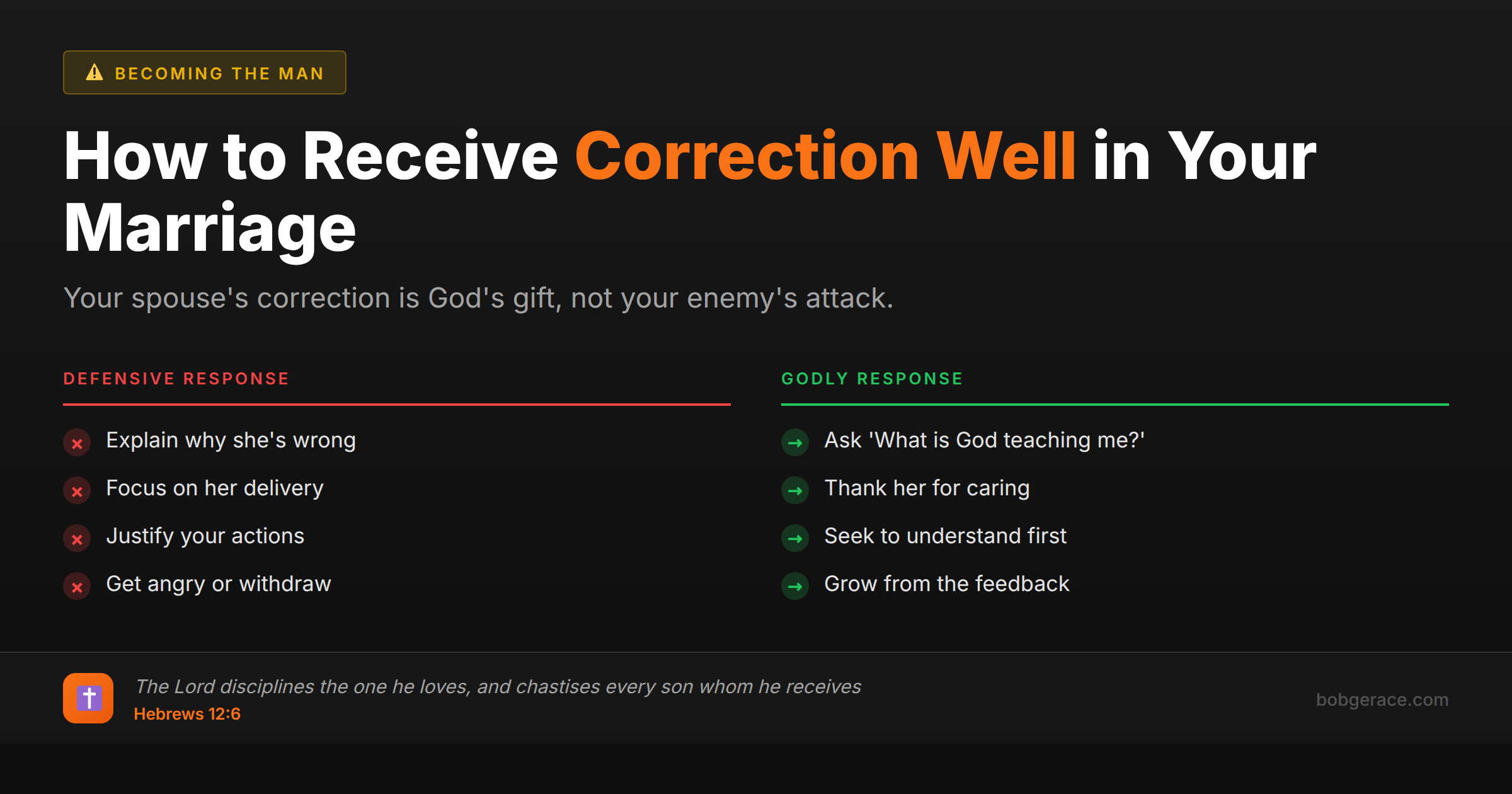
Receiving correction as from the Lord requires a fundamental shift in perspective - seeing your spouse not as your critic, but as God's instrument for your sanctification. This means approaching their feedback with humility, asking God first what He wants you to hear, and responding with gratitude rather than defensiveness. Start by pausing when correction comes and silently praying, 'Lord, what are You trying to teach me through this?' Even if your spouse's delivery isn't perfect, God can use imperfect vessels to speak truth into your life. The goal isn't to defend yourself but to grow in Christlikeness through the refining process.
The Full Picture
Most of us have it backwards when it comes to correction. We think our job is to evaluate whether the criticism is valid, whether it's delivered properly, and whether the person giving it has the right motives. But that's not how God works.
God uses broken people, imperfect timing, and sometimes harsh words to shape us into His image. When your spouse points out a fault, your first question shouldn't be 'Are they right?' It should be 'What is God trying to show me?'
This doesn't mean you become a doormat or accept abuse. It means you lead with humility instead of defensiveness. You listen for the kernel of truth that God wants to use, even if it comes wrapped in frustration or poor communication.
The reality is that your spouse sees things about you that you can't see about yourself. They live with you daily. They watch how you respond under pressure, how you treat others, how you handle disappointment. God has positioned them as a mirror to show you blind spots you'd never discover on your own.
When you start receiving correction as from the Lord, something beautiful happens - you stop taking it so personally. Instead of feeling attacked, you feel grateful that God cares enough about your character to refine it. Instead of defending your reputation, you start asking how you can grow.
This shift transforms your marriage because your spouse stops feeling like they're fighting against a brick wall. They see someone who's teachable, someone who wants to grow, someone who values their input. And ironically, this makes them want to correct you less because you're already responding to their concerns.
What's Really Happening
From a psychological perspective, our resistance to correction stems from what we call 'ego threat' - the brain's automatic response to protect our self-image when it feels under attack. This triggers our sympathetic nervous system, flooding us with stress hormones that make us fight, flee, or freeze.
But here's what's fascinating: individuals who can reframe correction as an opportunity for growth actually show decreased stress responses over time. Their brains literally rewire to see feedback as valuable rather than threatening. This is called 'cognitive reappraisal' and it's one of the most powerful tools for emotional regulation.
The theological framework Bob describes - seeing correction as from the Lord - provides the perfect cognitive structure for this reappraisal. Instead of your spouse being the threat, they become God's instrument. Instead of your worth being questioned, your growth is being facilitated.
Neurologically, this creates what we call a 'growth mindset' rather than a 'fixed mindset.' Your brain stops trying to prove you're already good enough and starts focusing on how you can become better. This reduces defensive responses and increases what psychologists call 'psychological flexibility' - your ability to adapt and respond thoughtfully rather than reactively.
The practical result is that couples who approach correction this way report higher relationship satisfaction, better communication, and faster resolution of conflicts. When one partner consistently receives feedback with humility, it creates a positive feedback loop that improves the entire relational dynamic.
What Scripture Says
Scripture is clear that God uses correction to shape us: 'The Lord disciplines the one he loves, and chastises every son whom he receives' (Hebrews 12:6). This isn't punishment - it's pruning for greater fruitfulness.
Proverbs gives us the blueprint for receiving correction well: 'Whoever loves discipline loves knowledge, but he who hates reproof is stupid' (Proverbs 12:1). Strong words, but they reveal God's heart - correction is a gift to those who want to grow.
'Listen to advice and accept instruction, that you may gain wisdom in the future' (Proverbs 19:20). Notice it doesn't say 'listen to perfect advice perfectly delivered.' It says listen and accept instruction - period.
The Psalms show us David's heart toward correction: 'Let a righteous man strike me - it is a kindness; let him rebuke me - it is oil for my head; let my head not refuse it' (Psalm 141:5). David understood that rebuke from someone who loves you is actually kindness.
James connects this to our relationships: 'Therefore, confess your sins to one another and pray for one another, that you may be healed' (James 5:16). Your spouse isn't just pointing out your faults - they're participating in God's healing work in your life.
Finally, 'Iron sharpens iron, and one man sharpens another' (Proverbs 27:17). The sharpening process involves friction, pressure, and the removal of what's dull. But the result is a blade that's more effective, more useful, more valuable than before.
What To Do Right Now
-
1
When correction comes, immediately pray silently: 'Lord, what do You want me to hear through this?'
-
2
Thank your spouse for caring enough to speak up, even if their delivery wasn't perfect
-
3
Ask clarifying questions to understand their concern better instead of explaining why they're wrong
-
4
Take 24 hours to pray about their feedback before discussing it further
-
5
Identify one specific way you can grow from their correction and share it with them
-
6
Follow up in a week to show them how you've been working on the area they addressed
Related Questions
- What does Proverbs say about receiving correction?
- What does 'teachable spirit' look like?
- Why is pride the enemy of hearing truth?
- What does humility in conflict look like?
- What does it mean to 'take the plank out first'?
- How do I model Christ who 'did not revile in return'?
- What does 'godly sorrow' look like in practice?
- What does repentance look like for accumulated sin?
- What is the relationship between confession and defensiveness?
- What does 'speaking truth in love' look like?
Also find Bob on
Subscribe for weekly videos on Christian marriage.
Stuck applying this to your actual marriage?
A coach who knows your story can help you see what God's trying to refine in you—and how to respond when your wife's delivery makes it hard to hear Him.
Talk to Bob →