What's the neuroscience of shock and why can't I eat/sleep?
5 min read
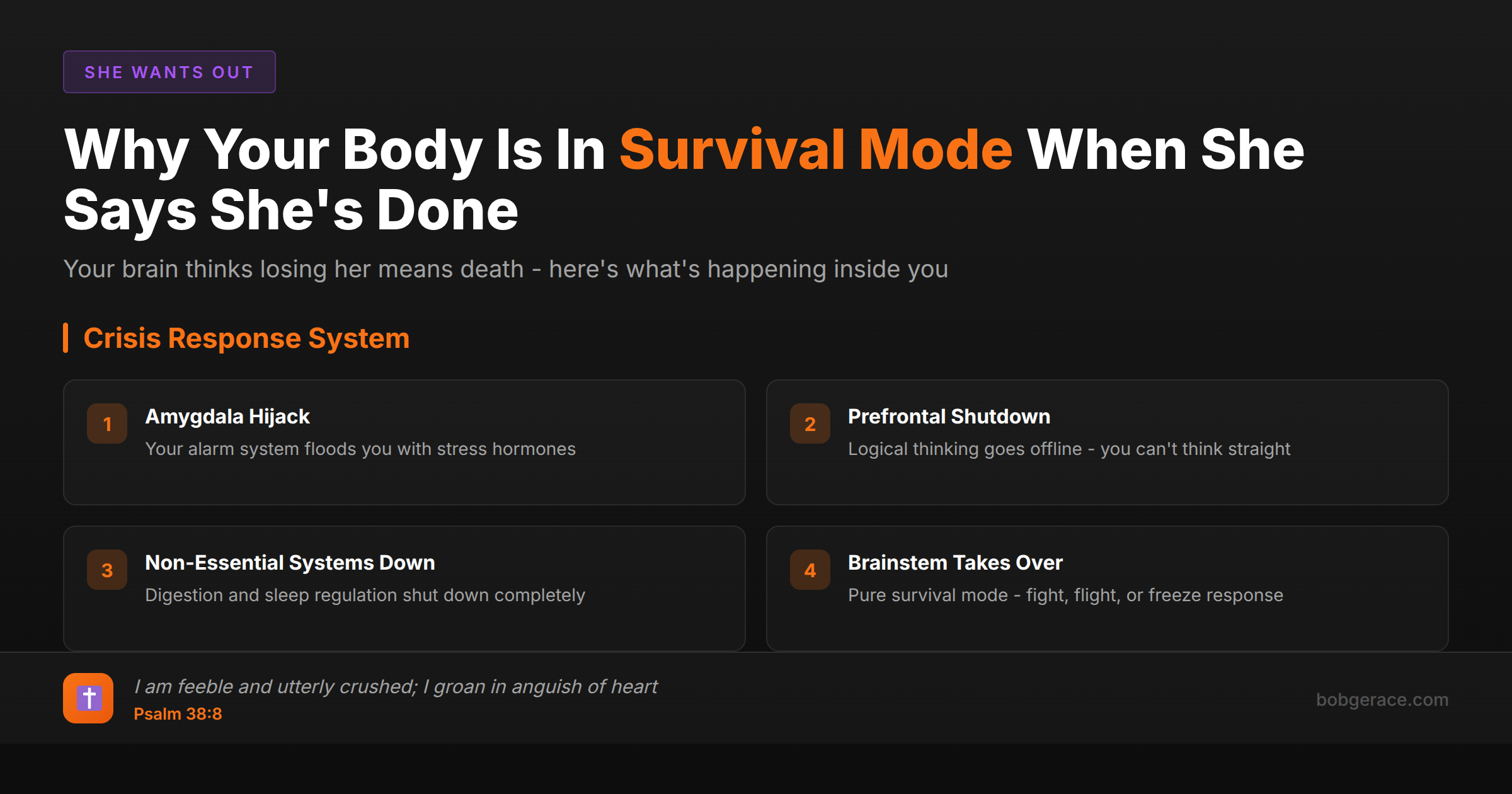
When your wife says she wants out, your brain interprets this as a life-threatening emergency - because evolutionarily, losing your primary attachment bond meant death. Your amygdala floods your system with stress hormones like cortisol and adrenaline, while shutting down non-essential functions like digestion and sleep regulation. This isn't weakness - it's your nervous system doing exactly what it's designed to do in crisis. Your prefrontal cortex (logical thinking) goes offline while your brainstem (survival mode) takes control. That's why you can't think straight, why food tastes like cardboard, and why sleep feels impossible. Understanding this helps you respond to your body's needs rather than fighting against them.
The Full Picture
Your nervous system doesn't distinguish between a saber-tooth tiger and your wife saying "I don't love you anymore." Both trigger the same ancient survival mechanisms that kept our ancestors alive.
Here's what's actually happening in your brain:
• Amygdala activation - Your brain's alarm system floods your body with stress chemicals • Prefrontal cortex shutdown - Logical thinking becomes nearly impossible • Sympathetic nervous system dominance - You're stuck in fight-or-flight mode • Digestive system suppression - Blood flow redirects from your stomach to your muscles • Sleep cycle disruption - Hypervigilance keeps your brain scanning for threats
This explains why you might feel physically sick, why simple decisions feel overwhelming, and why you oscillate between numbness and intense emotion. Your body is conserving energy for survival, not comfort.
The cruel irony? When you need your best thinking and emotional regulation most, your biology makes both nearly impossible. You might find yourself checking your phone obsessively, replaying conversations, or feeling like you're losing your mind. This is normal trauma response, not personal failure.
Most men make the mistake of trying to "power through" or "think their way out" of this state. That's like trying to reason with a smoke alarm while the house is burning. Your nervous system needs safety signals before higher brain functions come back online.
What's Really Happening
From a clinical perspective, what you're experiencing is acute stress response combined with attachment trauma. Research shows that threats to primary attachment bonds activate the same neural pathways as physical pain - literally, heartbreak hurts.
The vagus nerve, which regulates your rest-and-digest functions, becomes dysregulated during relationship trauma. This explains the physical symptoms: nausea, loss of appetite, insomnia, and that feeling of being "wired but tired." Your autonomic nervous system is stuck in sympathetic overdrive.
Neuroimaging studies reveal that during acute relationship stress, activity increases in the anterior cingulate cortex and right ventral prefrontal cortex - areas associated with physical pain processing. Simultaneously, the prefrontal cortex shows decreased activation, impacting executive function, decision-making, and emotional regulation.
Polyvagal Theory helps explain why you might feel simultaneously agitated and shut down. Your nervous system cycles between hyperarousal (anxiety, panic, racing thoughts) and hypoarousal (numbness, disconnection, hopelessness) as it searches for safety.
The good news? Neuroplasticity means your brain can recover. With proper nervous system regulation techniques - breathwork, movement, safe social connection - you can help your system recalibrate. This isn't about "getting over it" quickly; it's about supporting your nervous system through a legitimate biological crisis so your higher brain functions can come back online.
What Scripture Says
God designed your body's stress response system, and Scripture acknowledges the real physical impact of emotional trauma. You're not spiritually weak for experiencing these symptoms.
Psalm 38:8 - "I am feeble and utterly crushed; I groan in anguish of heart." David understood that emotional pain creates physical symptoms. Your loss of appetite and sleeplessness echo the experiences of biblical figures facing crisis.
Proverbs 17:22 reminds us that "A cheerful heart is good medicine, but a crushed spirit dries up the bones." This isn't metaphorical - science confirms that emotional states directly impact physical health. Your body is responding appropriately to a crushing situation.
Matthew 26:38 shows Jesus saying, "My soul is overwhelmed with sorrow to the point of death." Even Christ experienced the physical weight of emotional anguish. If the Son of God felt overwhelmed, your struggle doesn't indicate lack of faith.
1 Corinthians 6:19-20 teaches that your body is the temple of the Holy Spirit. This means caring for your physical needs during crisis isn't selfish - it's stewardship. God wants you to tend to your body's legitimate needs for rest, nutrition, and healing.
Psalm 23:2-3 promises God "makes me lie down in green pastures, he leads me beside quiet waters, he refreshes my soul." Even in crisis, God provides ways to restore your nervous system. Rest isn't laziness; it's receiving God's provision for healing.
What To Do Right Now
-
1
Breathe deeply for 4 counts in, hold for 4, exhale for 6 - repeat 10 times to activate your parasympathetic nervous system
-
2
Eat small, frequent meals even if food seems unappealing - your brain needs fuel to function properly
-
3
Move your body for 10-15 minutes daily - walk, stretch, or do pushups to metabolize stress hormones
-
4
Create a sleep routine with consistent bedtime and wake times, even if sleep is elusive
-
5
Limit checking phone/social media to specific times rather than compulsively throughout the day
-
6
Connect with one trusted friend or counselor who can provide safe social engagement to calm your nervous system
Related Questions
- What's happening in my nervous system right now?
- What is amygdala hijack and how do I get out of it?
- How do I regulate when my body is in fight-or-flight?
- What does 'window of tolerance' mean and why am I outside it?
- How long does acute stress response last?
- Why do I feel like I'm going to die if she leaves?
- What is 'betrayal trauma' and do I have it?
- Why do I feel like I'm going to die?
- What's happening to my nervous system right now?
Also find Bob on
Subscribe for weekly videos on Christian marriage.
Your Body Knows This Is Real
A coach who knows your specific situation can help you work with your nervous system, not against it. You don't have to white-knuckle this alone.
Talk to Bob →