How long does acute stress response last?
5 min read
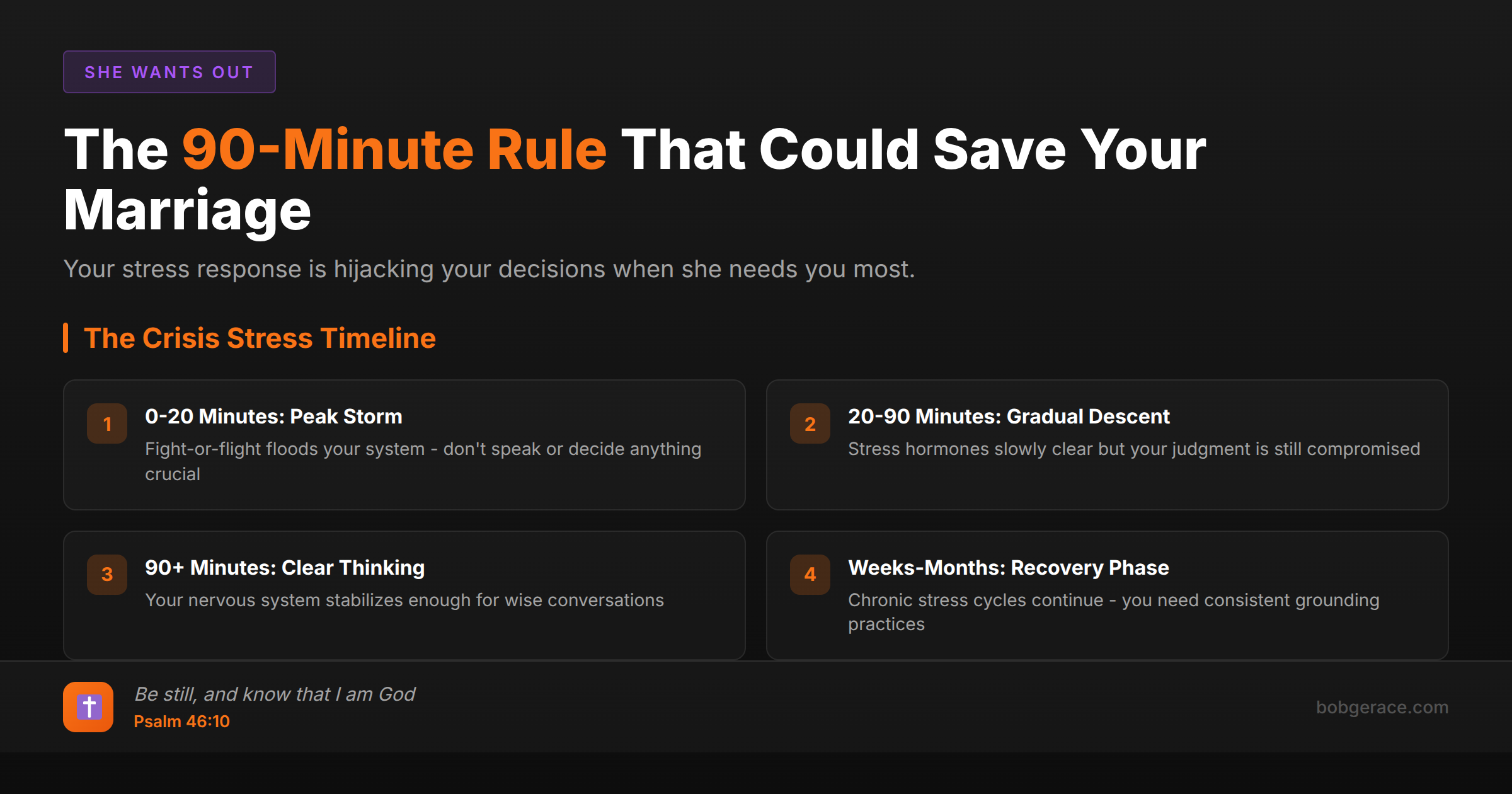
The initial acute stress response - that fight-or-flight surge you feel when she says she's done - typically peaks within 15-20 minutes and starts to subside within 90 minutes. But here's what most men don't realize: when your marriage is in crisis, your nervous system can stay in a heightened state for weeks or even months, cycling between acute episodes and chronic stress. This isn't weakness - it's biology. Your body is responding to a genuine threat to something you value deeply. The problem comes when you don't understand what's happening and try to make crucial decisions while your system is flooded with stress hormones. That's when you say things you can't take back or make moves that push her further away.
The Full Picture
When your wife drops the bomb that she's unhappy, considering separation, or "done," your nervous system launches into full protective mode. The immediate response happens in seconds - your heart rate spikes, adrenaline floods your system, and your thinking brain goes offline. This is your sympathetic nervous system doing exactly what it's designed to do.
But marriage crisis isn't a single event - it's an ongoing threat state. This means your nervous system never fully returns to baseline. You might feel somewhat normal in the morning, then spiral again after a tense conversation or when you see her texting someone.
Here's the timeline most men experience: • 0-20 minutes: Peak acute response - heart racing, tunnel vision, fight-or-flight mode • 20-90 minutes: Initial hormone clearing, but still highly activated • 2-6 hours: Cortisol levels remain elevated, creating underlying tension • Days to weeks: Chronic stress state with periodic acute episodes
The real danger zone is making decisions during those first 90 minutes when you're flooded. This is when you send the desperate texts, make ultimatums, or have conversations that make everything worse. Your prefrontal cortex - the part that handles rational thinking and emotional regulation - is essentially hijacked.
Many men stay in chronic activation for months, which leads to sleep problems, difficulty concentrating, and emotional volatility. You become reactive instead of responsive, which is exactly the opposite of what your marriage needs right now.
What's Really Happening
From a neurobiological perspective, acute stress response involves a complex cascade of hormonal and neural changes. When the brain perceives threat - in this case, threats to attachment and security - the amygdala triggers the hypothalamic-pituitary-adrenal (HPA) axis, flooding the system with cortisol and adrenaline.
Research shows that cortisol levels can remain elevated for 6-24 hours after a single acute stressor. However, in chronic relationship distress, we see prolonged dysregulation of the HPA axis. The system becomes hypervigilant, interpreting neutral interactions as threats and maintaining a state of physiological readiness that's exhausting and counterproductive.
What's particularly relevant for men in marital crisis is how chronic stress affects emotional regulation and communication patterns. Studies demonstrate that elevated cortisol impairs working memory and executive function while increasing emotional reactivity. This creates a destructive cycle: stress makes you less capable of the very skills needed to repair the relationship.
The polyvagal theory helps us understand why some men oscillate between fight-or-flight activation and emotional shutdown. When the sympathetic response fails to resolve the threat, the dorsal vagal system can engage, leading to withdrawal, numbness, or dissociation. This explains why you might feel panicked one moment and completely disconnected the next.
Effective intervention requires understanding that this isn't just about willpower or communication techniques - it's about nervous system regulation. Without addressing the physiological component, attempts at relationship repair often fail because the man's system remains in a defensive state that prevents genuine connection and clear thinking.
What Scripture Says
Scripture acknowledges that we face overwhelming circumstances that can shake us to our core. Psalm 55:4-5 captures this experience: "My heart is in anguish within me; the terrors of death have fallen on me. Fear and trembling have beset me; horror has overwhelmed me." David understood what it felt like when his world was falling apart.
But God doesn't leave us in that state. Psalm 46:10 commands us to "Be still, and know that I am God." This isn't passive resignation - it's active regulation. The Hebrew word for "be still" means to cease striving, to let go of frantic activity. When your nervous system is flooded, stillness becomes a spiritual discipline that creates space for God's peace.
Philippians 4:6-7 gives us the antidote to anxiety: "Do not be anxious about anything, but in every situation, by prayer and petition, with thanksgiving, present your requests to God. And the peace of God, which transcends all understanding, will guard your hearts and your minds in Christ Jesus." Notice that God's peace specifically guards our hearts and minds - the very areas compromised during stress response.
Isaiah 26:3 promises, "You will keep in perfect peace those whose minds are steadfast, because they trust in you." A steadfast mind isn't one that never experiences stress, but one that returns to truth despite emotional turbulence.
Finally, Proverbs 19:2 warns us: "Desire without knowledge is not good - how much more will hasty feet miss the way!" When your nervous system is activated, everything feels urgent, but Scripture calls us to wisdom over reactivity. Proverbs 27:14 even warns that good intentions expressed at the wrong time can be counterproductive - timing matters, especially when stress is high.
What To Do Right Now
-
1
Recognize the 90-minute rule - avoid major conversations or decisions for at least 90 minutes after feeling triggered
-
2
Practice box breathing - inhale for 4 counts, hold for 4, exhale for 4, hold for 4, repeat for 2-3 minutes
-
3
Use cold exposure - splash cold water on your face or wrists to activate your vagus nerve and calm your system
-
4
Ground yourself physically - feel your feet on the floor, name 5 things you can see, 4 you can touch, 3 you can hear
-
5
Write before you speak - journal your thoughts and feelings instead of immediately sharing them with your wife
-
6
Create a daily regulation routine - consistent sleep, exercise, and prayer to build nervous system resilience
Related Questions
- What's happening in my nervous system right now?
- What is amygdala hijack and how do I get out of it?
- How do I regulate when my body is in fight-or-flight?
- What does 'window of tolerance' mean and why am I outside it?
- What's the neuroscience of shock and why can't I eat/sleep?
- How do I function at work after hearing this?
- What is 'betrayal trauma' and do I have it?
- What's happening to my nervous system right now?
- Why do I feel like I'm going to die?
- What does trauma recovery look like?
Also find Bob on
Subscribe for weekly videos on Christian marriage.
You Don't Have to Regulate Alone
When your nervous system has been running hot for weeks, a coach who knows your specific marriage can help you see what you can't see yourself. Bob works with men who are still in it, still fighting for their relationship.
Talk to Bob →