What is 'state-dependent learning'?
6 min read
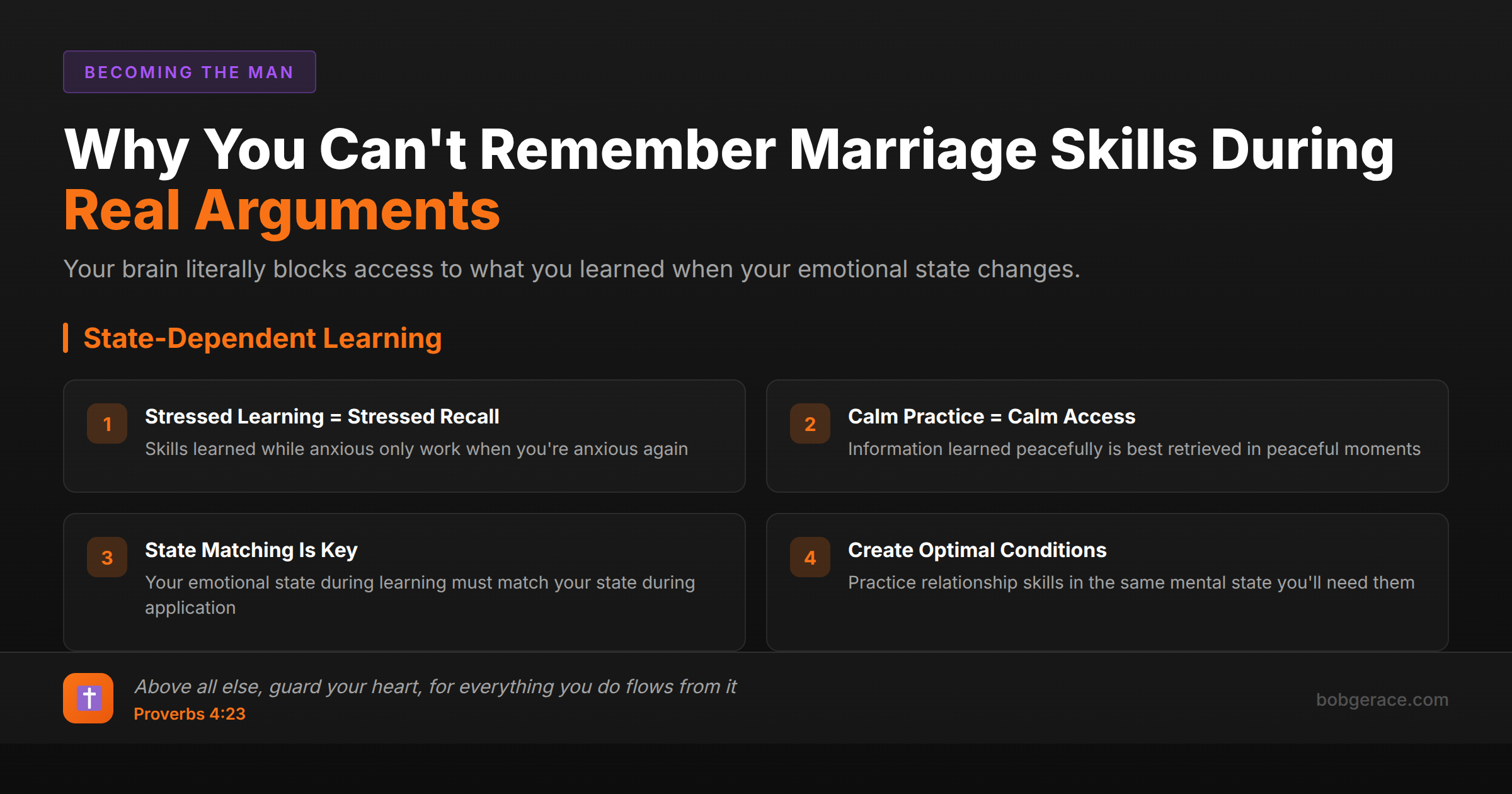
State-dependent learning is a neurological principle where information learned in a particular emotional, physical, or environmental state is best recalled when you're in that same state again. For marriage transformation, this means the emotional and mental state you're in while learning new relationship skills directly impacts how well you'll remember and apply them later. When you're stressed, angry, or defensive while trying to learn better communication patterns, your brain literally encodes that learning differently than if you were calm, open, and focused. This is why many men struggle to apply what they've learned during heated arguments - their stressed state doesn't match the peaceful state where they originally learned the skills. Understanding this principle helps you create optimal conditions for lasting change in your marriage.
The Full Picture
State-dependent learning reveals why traditional marriage advice often fails when you need it most. Your brain doesn't just store information - it packages that information with the complete context of when and how you learned it. The room you were in, your emotional state, your stress level, even your posture all become part of the memory.
This has profound implications for marriage transformation. If you learn conflict resolution skills while sitting calmly in a counselor's office, your brain creates neural pathways that are literally tied to that calm, reflective state. But when your wife brings up a sensitive topic and your stress hormones spike, you're operating from a completely different neurological state.
The State Mismatch Problem
Most marriage education happens in artificial environments - books, seminars, counseling sessions - where you're calm and receptive. But marital conflicts happen in kitchens, bedrooms, and cars when emotions are high and stress is present. This creates a fundamental mismatch between the learning state and the application state.
Why Good Men Fail
You might know exactly what to do when discussing your marriage over coffee with a friend. You can articulate healthy communication principles, quote relationship experts, and genuinely want to change. But in the heat of an argument, those same neural pathways become inaccessible because your brain is in survival mode, not learning mode.
The Neurological Reality
When stress hormones like cortisol flood your system during conflict, they literally inhibit access to your prefrontal cortex - the part of your brain responsible for higher-order thinking, emotional regulation, and accessing learned skills. This isn't a character flaw or lack of commitment. It's basic neuroscience.
Understanding state-dependent learning helps you stop beating yourself up for 'forgetting' what you know and start creating systems that work with your brain's natural wiring instead of against it.
What's Really Happening
In my practice, I see the effects of state-dependent learning every day. Husbands come to sessions frustrated, saying things like 'I know what I should do, but in the moment, I just react.' They think it's a willpower problem. It's not - it's a neuroscience problem.
The brain's memory consolidation process is intimately connected to our autonomic nervous system. When we learn something while in a parasympathetic state (calm, rest-and-digest mode), those neural pathways are encoded with that physiological signature. When we're later triggered into a sympathetic state (fight-or-flight mode), accessing those same pathways becomes neurologically challenging.
Clinical Applications
This is why I often conduct sessions in different physical positions, vary the emotional intensity, and sometimes even introduce controlled stress. We're not just learning skills - we're building what I call 'state-flexible neural networks' that remain accessible across different emotional contexts.
I've observed that men who practice new behaviors while experiencing mild stress or emotional activation show significantly better skill transfer to real-world situations. We might role-play difficult conversations, practice responses while standing or walking, or deliberately access challenging emotions during skill-building exercises.
The Therapeutic Breakthrough
The real breakthrough comes when clients understand that their 'failures' aren't moral shortcomings - they're predictable neurological responses. This shifts the focus from shame and self-criticism to strategic skill-building that accounts for how the brain actually works.
Successful transformation requires what we call 'contextual rehearsal' - practicing new responses in states that mirror real-world challenges. Only then do these skills become truly integrated and accessible when you need them most.
What Scripture Says
Scripture consistently emphasizes the connection between our internal state and our ability to access wisdom and respond righteously. The Bible doesn't use modern neuroscience terminology, but it clearly recognizes that our spiritual, emotional, and mental condition affects our capacity to live out what we know.
"Above all else, guard your heart, for everything you do flows from it." - Proverbs 4:23
This verse reveals the biblical understanding that our internal state determines our external actions. Just as state-dependent learning shows that our emotional condition affects access to learned skills, Scripture teaches that guarding our heart - our internal state - is fundamental to right living.
"Be still, and know that I am God." - Psalm 46:10
God repeatedly calls His people to stillness before learning and growth. This isn't just spiritual poetry - it's practical neuroscience. A still, calm state optimizes our capacity to receive truth, integrate wisdom, and access what we've learned when we need it.
"Let every person be quick to hear, slow to speak, slow to anger; for the anger of man does not produce the righteousness of God." - James 1:19-20
James understood that anger - a heightened emotional state - inhibits our ability to produce righteousness. This perfectly aligns with state-dependent learning research showing that elevated stress states limit access to higher-order thinking and learned behaviors.
"Do not be conformed to this world, but be transformed by the renewal of your mind." - Romans 12:2
True transformation requires more than information transfer - it requires mind renewal that happens in the right conditions. Paul understood that lasting change comes through intentional, repeated practice that literally rewires our thinking patterns.
"Whatever is true, whatever is honorable, whatever is just... think about these things." - Philippians 4:8
Paul prescribes intentional state management - directing our thoughts toward what produces peace and righteousness rather than anxiety and reactivity.
"The simple believes everything, but the prudent gives thought to his steps." - Proverbs 14:15
Wisdom requires creating space between stimulus and response - exactly what state-dependent learning teaches us about accessing our best thinking in challenging moments.
What To Do Right Now
-
1
Practice new marriage skills while experiencing mild physical stress - stand up, walk around, or do light exercise while rehearsing better responses to common conflicts
-
2
Create 'state anchors' by associating calming physical cues (deep breathing, specific posture, prayer) with moments when you successfully apply relationship skills
-
3
Identify your personal stress signals and develop immediate interventions to return to a learning-receptive state before attempting difficult conversations
-
4
Schedule regular practice sessions where you deliberately recall and rehearse marriage principles while in various emotional states, not just when you're calm
-
5
Develop a pre-conflict ritual that helps shift your nervous system into the same state where you learned your best relationship skills
-
6
Keep a simple card with your core marriage commitments visible during typical conflict locations (kitchen, bedroom, car) to trigger state-appropriate responses
Related Questions
Ready to Master Your Internal State?
Stop letting stress sabotage your marriage progress. Learn proven techniques that work with your brain's natural wiring, not against it.
Get Started Today →