How long does it take to rewire the brain?
6 min read
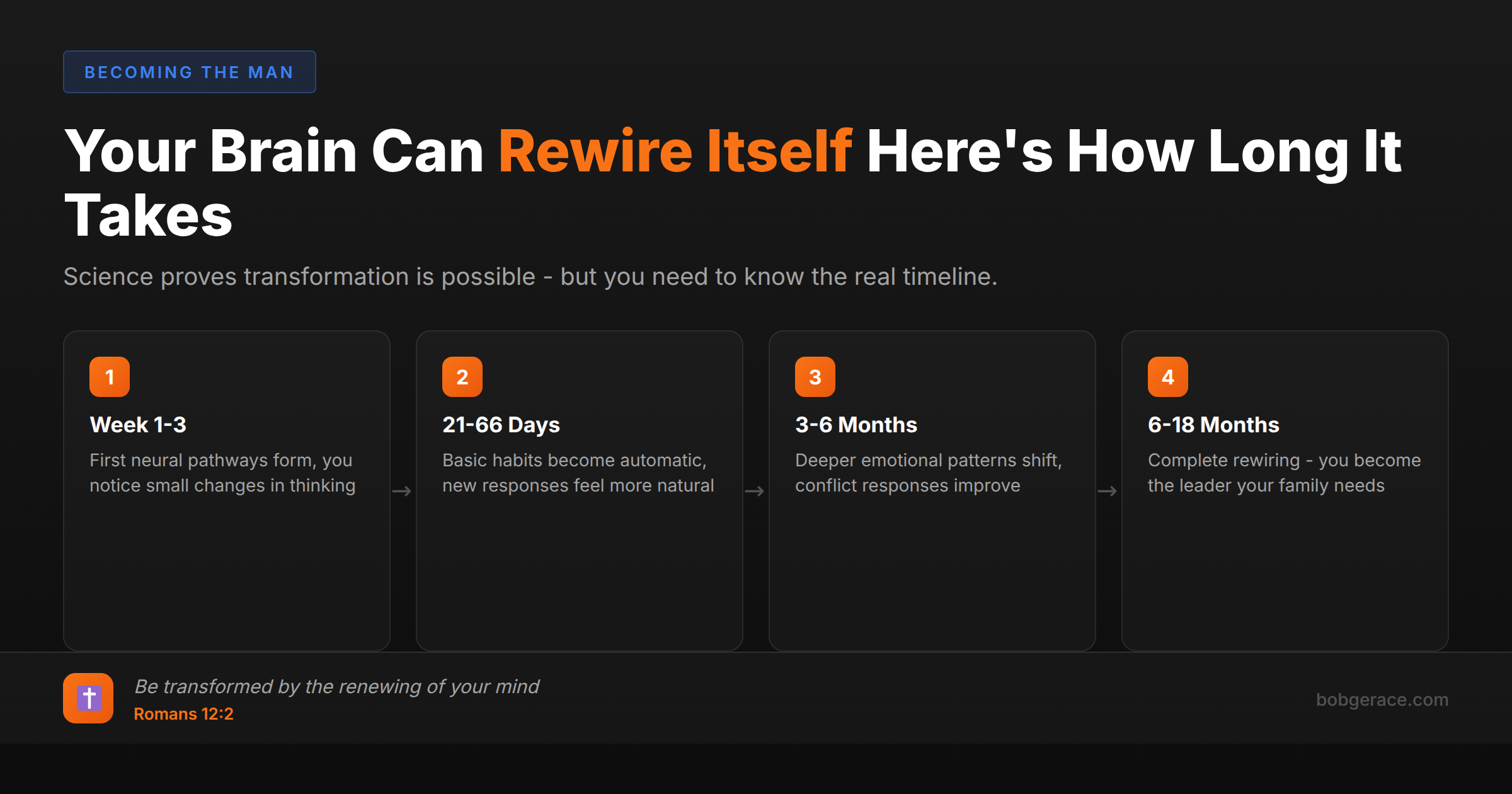
Brain rewiring happens on multiple timelines. Basic habit formation takes 21-66 days on average, but research shows most people need about 66 days to make new behaviors automatic. However, deeper neurological changes - the kind that transform how you respond to conflict, manage emotions, and lead your family - typically require 6-18 months of consistent practice. The good news? You'll start noticing changes within weeks. Your brain begins forming new neural pathways immediately when you start new patterns of thinking and behavior. The key is consistency - your brain needs repetition to strengthen these new pathways while allowing old, destructive patterns to weaken through disuse.
The Full Picture
Your brain is remarkably adaptable - scientists call this neuroplasticity. Every time you choose a new response instead of an old pattern, you're literally rewiring your neural networks. But the timeline isn't as simple as "21 days to change a habit."
The Real Timeline: - Days 1-21: Initial neural pathway formation begins - Days 21-66: New behaviors start becoming more automatic - 3-6 months: Significant rewiring of deeper emotional and behavioral patterns - 6-18 months: Profound transformation in core responses and character traits
For men working to become better husbands and fathers, this means the angry outbursts, defensive reactions, or withdrawal patterns you've developed over years won't disappear overnight. But they will change with consistent effort.
What affects your timeline: - Consistency - Daily practice accelerates rewiring - Emotional intensity - High-stakes moments create stronger neural impressions - Sleep and stress - Poor sleep and chronic stress slow the process - Age - Younger brains adapt faster, but change is possible at any age - Belief and motivation - Your conviction that change is possible literally affects brain chemistry
The most encouraging truth? Every single time you choose the new way instead of the old way, you're making the next right choice easier. Your brain is working for you, not against you.
What's Really Happening
From a neurological standpoint, we're looking at three distinct processes happening simultaneously. First, synaptic pruning - your brain literally starts dismantling the neural highways you're no longer using. Second, myelination - new pathways get wrapped in a fatty sheath that makes them faster and more efficient. Third, neurogenesis - your brain actually grows new neurons to support these changes.
In my practice, I see men get discouraged around the 3-4 week mark because they expect linear progress. But brain change isn't linear - it's more like compound interest. You might not notice much for weeks, then suddenly realize you handled a conflict completely differently than you would have months ago.
The prefrontal cortex - your executive control center - is particularly responsive to intentional change. This is where decision-making, impulse control, and emotional regulation happen. When men consistently practice new responses, we can actually measure increased activity in this region within 8-12 weeks.
Here's what's crucial: stress hormones like cortisol actively interfere with neuroplasticity. This is why men who are overwhelmed, sleep-deprived, or constantly in crisis mode struggle more with lasting change. The brain needs a sense of safety and adequate rest to rewire effectively. This isn't weakness - it's biology.
What Scripture Says
Scripture speaks repeatedly about transformation as both an instant work of God and a process that unfolds over time. Romans 12:2 tells us to "be transformed by the renewing of your mind" - the Greek word *metamorphoo* suggests a complete change, but the present tense indicates an ongoing process.
2 Corinthians 3:18 reveals we are "being transformed into his image from one degree of glory to another." Notice - degrees, not instant perfection. God designed transformation to happen progressively.
Philippians 1:6 assures us that "he who began a good work in you will carry it on to completion." The word "carry on" implies continuous action over time. Your brain's ability to change reflects God's design for ongoing sanctification.
Ephesians 4:22-24 instructs us to "put off your old self... and put on the new self." This isn't a one-time decision but a daily practice of choosing new patterns over old ones.
The most encouraging truth is found in Isaiah 43:19: "See, I am doing a new thing! Now it springs up; do you not perceive it?" God is actively working to create new pathways in your life - including in your brain. Your responsibility is to cooperate with His process through faithful obedience, while trusting His timeline for complete transformation.
Galatians 6:9 reminds us: "Let us not become weary in doing good, for at the proper time we will reap a harvest if we do not give up." Brain rewiring requires this same perseverance - trusting that consistent faithfulness will yield transformation in God's perfect timing.
What To Do Right Now
-
1
Identify one specific pattern you want to change and define the exact new response you want to develop
-
2
Create a daily practice routine - same time, same trigger, same new response for 66 days minimum
-
3
Track your progress with simple marks on a calendar to visualize your consistency
-
4
Optimize your brain chemistry with 7-8 hours of sleep, regular exercise, and stress management
-
5
Find an accountability partner who will check your progress weekly without judgment
-
6
Celebrate small wins - acknowledge every time you choose the new way over the old way
Related Questions
- What does neuroplasticity mean for adult change?
- What conditions optimize neural rewiring?
- What role does repetition play?
- How do I change patterns that feel hardwired?
- What is 'white-knuckling' vs. real transformation?
- Why do old patterns come back when I'm triggered?
- How long does recovery take?
- How long does real change actually take?
- What is the typical betrayal trauma recovery timeline?
- How long until new behaviors become automatic?
Also find Bob on
Subscribe for weekly videos on Christian marriage.
You Don't Have to Rewire Alone
A coach who knows your marriage can calibrate the work to where you actually are—not where a generic program thinks you should be.
Talk to Bob →