What does neuroplasticity mean for adult change?
6 min read
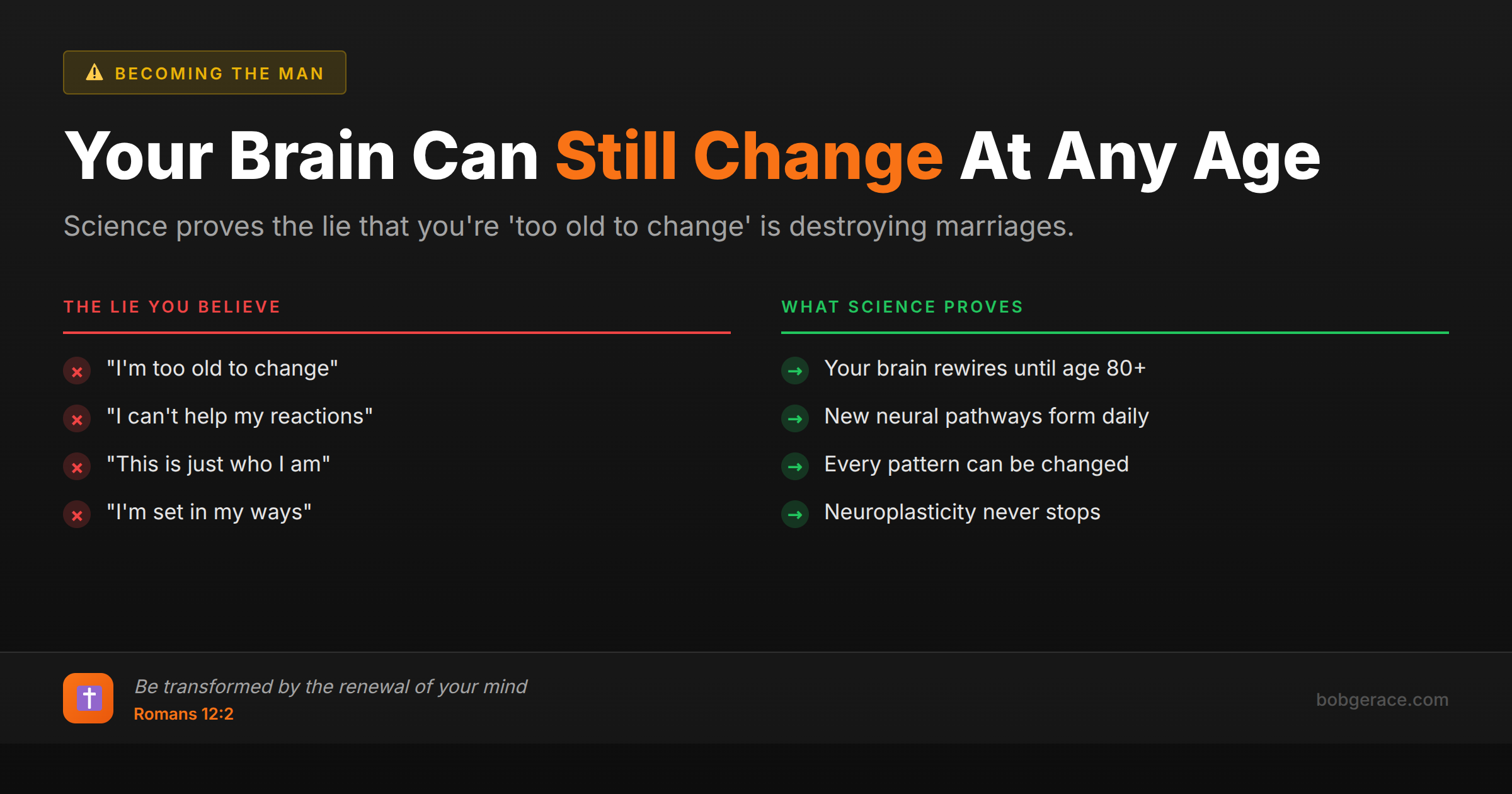
Neuroplasticity is your brain's ability to reorganize, form new neural connections, and literally rewire itself throughout your entire life. This scientific reality demolishes the lie that you're 'too old to change' or 'set in your ways.' Your brain remains moldable and adaptable well into your 80s and beyond. For men in marriage, this means every destructive pattern—anger, withdrawal, pornography, emotional unavailability—can be rewired. Your brain doesn't care how long you've been stuck; it responds to new thoughts, behaviors, and habits by creating fresh neural pathways. The husband who claims he 'can't help' his reactions is either uninformed or unwilling. Science proves change is possible, and Scripture commands it.
The Full Picture
For decades, neuroscientists believed adult brains were fixed and unchangeable. This devastating lie kept countless men trapped in destructive patterns, believing transformation was impossible. That paradigm is dead.
Neuroplasticity research reveals your brain continuously reorganizes itself based on your thoughts, behaviors, and experiences. Every time you choose a new response over an old pattern, you're literally reshaping your neural architecture. The angry husband can develop patience circuits. The withdrawn man can build emotional connection pathways. The porn-addicted husband can rewire his reward systems.
Here's what actually happens: When you repeatedly practice new behaviors, your brain strengthens those neural pathways while weakening unused ones. Think of it like hiking trails—the path you walk most becomes the superhighway, while abandoned trails get overgrown.
This isn't positive thinking or willpower alone. It's measurable, biological change. Brain scans show actual structural differences in people who've transformed long-standing patterns. The key factors that accelerate neuroplastic change include:
- Repetition and consistency - New patterns must be practiced repeatedly - Emotional engagement - Change happens faster when connected to strong motivation - Environmental support - Surrounding yourself with people who reinforce new patterns - Sleep and stress management - Your brain consolidates new pathways during rest - Physical exercise - Movement enhances neuroplastic capacity
The implications for marriage are staggering. No matter how long you've been the 'angry guy' or the 'checked-out husband,' your brain can learn new ways of being. The question isn't whether you can change—science proves you can. The question is whether you will choose the discipline required for transformation.
What's Really Happening
In my practice, I regularly witness neuroplasticity in action. Men who've been emotionally reactive for decades can develop remarkable emotional regulation through targeted interventions. The process isn't mysterious—it's methodical.
Neuroplasticity operates through several key mechanisms. Synaptic plasticity allows connections between neurons to strengthen or weaken based on use. When a husband practices responding calmly instead of exploding, those calm-response neural networks literally grow stronger. Structural plasticity can actually grow new neurons and neural connections, particularly in areas like the prefrontal cortex responsible for executive function and emotional regulation.
What's fascinating is how quickly change can begin. While deep transformation takes months or years, I see men start experiencing different responses within 2-4 weeks of consistent practice. Their brains begin defaulting to new patterns instead of old reactive ones.
The critical factor is intentional practice. Random good intentions don't rewire brains—deliberate, repeated practice does. This is why programs that combine behavioral practice with emotional and spiritual motivation tend to be most effective. When a man connects his desire to change with his love for his family and his faith, the emotional engagement accelerates neuroplastic change.
One warning: stress and crisis can temporarily revert you to old patterns as your brain defaults to familiar neural highways. This doesn't mean you haven't changed—it means you need continued practice to make new patterns truly automatic. The goal is developing such strong new neural networks that even under pressure, you respond from your transformed patterns rather than your historical ones.
What Scripture Says
Long before neuroscientists discovered neuroplasticity, Scripture declared the reality of transformation. God doesn't command what's impossible—He commands change because change is possible through Him.
Romans 12:2 provides the blueprint: *'Do not be conformed to this world, but be transformed by the renewal of your mind, that by testing you may discern what is the will of God, what is good and acceptable and perfect.'* The Greek word 'metamorphoo' (transformed) describes complete structural change—exactly what neuroplasticity reveals happens in your brain.
2 Corinthians 5:17 declares: *'Therefore, if anyone is in Christ, he is a new creation. The old has passed away; behold, the new has come.'* This isn't just positional truth—it's neurological reality. When you're in Christ, your brain has access to supernatural transformation power.
Ephesians 4:22-24 commands: *'Put off your old self, which belongs to your former manner of life and is corrupt through deceitful desires, and to be renewed in the spirit of your minds, and to put on the new self, created after the likeness of God in true righteousness and holiness.'* Notice the process: put off old patterns, renew your mind, put on new patterns. This is neuroplasticity in biblical language.
Philippians 4:8 provides the content for mental rewiring: *'Finally, brothers, whatever is true, whatever is honorable, whatever is just, whatever is pure, whatever is lovely, whatever is commendable, if there is any excellence, if there is anything worthy of praise, think about these things.'* What you meditate on literally reshapes your neural networks.
God designed your brain for transformation. Claiming you 'can't change' insults both His design and His power working within you.
What To Do Right Now
-
1
Identify one specific pattern you want to change and write down the new response you want to develop instead
-
2
Practice the new response in low-stakes situations daily for 2 weeks to begin building new neural pathways
-
3
Create environmental cues that remind you to choose new patterns (phone reminders, accountability partner check-ins)
-
4
Engage your 'why' - connect your desired change to your love for family and obedience to God for emotional fuel
-
5
Track your progress - note when you catch yourself using new patterns instead of old ones to reinforce neuroplastic change
-
6
Be patient with setbacks - reversion to old patterns under stress is normal; recommit to practice rather than giving up
Related Questions
- How long does it take to rewire the brain?
- What conditions optimize neural rewiring?
- How do I change patterns that feel hardwired?
- What is 'white-knuckling' vs. real transformation?
- Why do old patterns come back when I'm triggered?
- What makes change sustainable vs. temporary?
- How long does recovery take?
- What is the typical betrayal trauma recovery timeline?
- How long does real transformation take?
Also find Bob on
Subscribe for weekly videos on Christian marriage.
Ready to Apply This to Your Marriage?
Neuroplasticity is real, but rewiring your specific patterns—the ones showing up in your actual marriage—requires someone who knows your story and can see what you can't.
Talk to Bob →