What role does repetition play?
6 min read
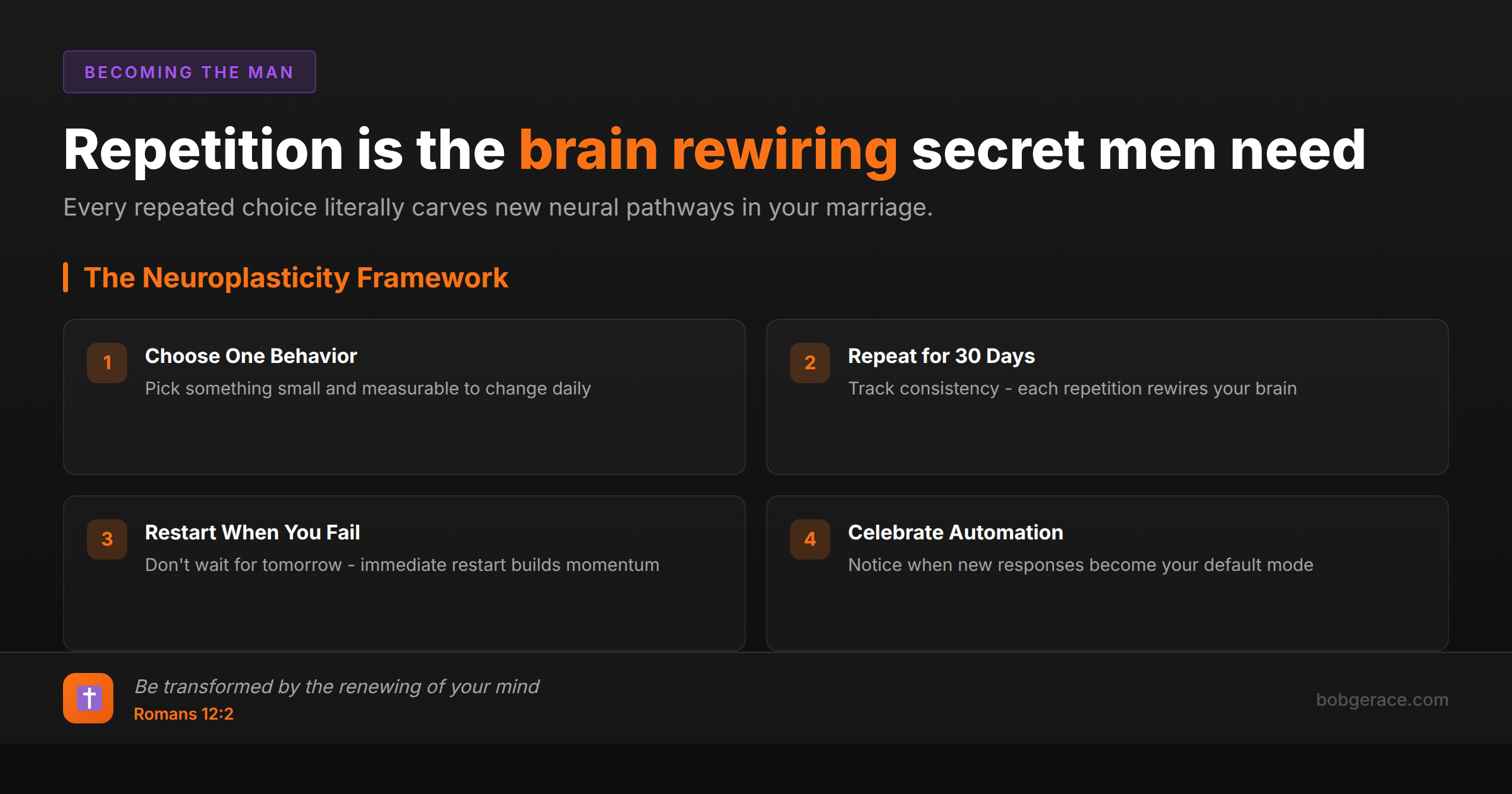
Repetition is the engine of neurological transformation. Every time you repeat a new behavior, thought pattern, or response, you're literally rewiring your brain through neuroplasticity. Think of it like carving a path through a forest - the first time is difficult, but each subsequent journey makes the path clearer and easier to follow. In marriage transformation, repetition turns conscious choices into automatic responses. When you repeatedly choose patience over anger, kindness over criticism, or listening over defending, you're building new neural pathways that eventually become your default mode. This isn't just positive thinking - it's brain science. The old patterns that damaged your marriage can be overwritten, but only through consistent, intentional repetition of better choices.
The Full Picture
Your brain is constantly reshaping itself based on what you repeatedly do, think, and feel. This process, called neuroplasticity, means you're not stuck with the patterns that are currently damaging your marriage. But here's the crucial part - change doesn't happen through understanding alone. It happens through repetition.
The Neuroscience of Habit Formation
When you repeat any behavior, your brain creates and strengthens neural pathways. Initially, new behaviors require significant mental energy because you're forging new connections. But with repetition, these pathways become more efficient, requiring less conscious effort. Eventually, the new behavior becomes automatic.
This is why your current destructive patterns feel so natural - they've been repeated thousands of times. Your brain has become incredibly efficient at anger, defensiveness, criticism, or withdrawal. The good news? The same process that created these patterns can create new ones.
Why Repetition Trumps Intensity
Many men think they need massive, dramatic changes to transform their marriage. They try to overhaul everything at once, burning out within weeks. But neurological change works differently. Consistent, small repetitions create more lasting change than sporadic intense efforts.
Think of it like building muscle. You don't get strong by lifting weights once really hard. You get strong by lifting consistently over time, allowing your muscles to adapt and grow. Your brain works the same way - it needs consistent repetition to build new neural muscle.
The Marriage Application
Every interaction with your wife is either strengthening old patterns or building new ones. When you choose to listen without interrupting for the 50th time, you're not just being nice in that moment - you're rewiring your brain to default to listening. When you consistently choose appreciation over criticism, you're literally changing your neural architecture to see your wife differently.
What's Really Happening
From a neurological standpoint, repetition is how we encode new information into long-term memory and create automatic behavioral responses. The process involves several key brain structures working together: the prefrontal cortex (conscious decision-making), the basal ganglia (habit formation), and the hippocampus (memory consolidation).
When clients first attempt new behaviors, their prefrontal cortex is working overtime. This is why change feels exhausting initially - it requires tremendous cognitive energy. However, with consistent repetition, the basal ganglia begins to take over, creating what we call 'chunking' - where complex behaviors become automatic sequences requiring minimal conscious effort.
The critical threshold appears to be around 66 days of consistent practice, though this varies significantly based on the complexity of the behavior and individual neurological factors. What's fascinating is that the brain actually becomes more efficient at the cellular level - neurons fire faster along frequently used pathways, and myelin sheaths thicken around these neural highways, speeding transmission.
For marriage transformation, this means that repeated positive interactions literally reshape your brain's relationship patterns. Your amygdala (threat detection center) learns to be less reactive to your spouse's words or behaviors. Your neural networks associated with empathy and connection strengthen. Even your mirror neuron systems - which help you understand and respond to your spouse's emotions - become more finely tuned through repetitive positive engagement.
The key insight for men is this: you're not trying to force change through willpower alone. You're strategically using repetition to make your brain work for you rather than against you. Each repetition is an investment in your neurological future.
What Scripture Says
Scripture consistently emphasizes the power of repetition in spiritual and personal transformation. God designed our minds to change through consistent practice, not one-time events.
Repetition Renews the Mind
*"Do not conform to the pattern of this world, but be transformed by the renewing of your mind."* - Romans 12:2
The word 'renewing' here implies an ongoing process, not a single event. Your mind is renewed through repeated exposure to truth and repeated practice of godly patterns.
*"Finally, brothers and sisters, whatever is true, whatever is noble, whatever is right, whatever is pure, whatever is lovely, whatever is admirable—if anything is excellent or praiseworthy—think about such things."* - Philippians 4:8
Paul doesn't say think about these things once. The implication is repetitive, ongoing focus that gradually transforms your thought patterns.
Practice Creates Character
*"Train yourself to be godly."* - 1 Timothy 4:7
The word 'train' comes from the Greek word for athletic training - repetitive, consistent practice that builds strength and skill over time.
*"But solid food is for the mature, who by constant use have trained themselves to distinguish good from evil."* - Hebrews 5:14
Maturity comes through 'constant use' - repeated application that trains our discernment and responses.
God's Pattern of Repetition
*"These commandments that I give you today are to be on your hearts. Impress them on your children. Talk about them when you sit at home and when you walk along the road, when you lie down and when you get up."* - Deuteronomy 6:6-7
God commanded repetition because He understands how transformation actually works. Truth becomes part of us through repetition, not through single exposures.
*"Day after day every priest stands and performs his religious duties; again and again he offers the same sacrifices."* - Hebrews 10:11
Even in worship, God established patterns of repetition because repetition creates lasting change in our hearts and minds.
What To Do Right Now
-
1
Choose ONE specific behavior to change in your marriage - make it small and measurable (like listening for 2 minutes without interrupting)
-
2
Commit to repeating this behavior daily for the next 30 days - mark it on your calendar and track your consistency
-
3
When you fail (and you will), restart immediately rather than waiting for tomorrow - each repetition counts toward rewiring your brain
-
4
Notice when the behavior starts feeling more automatic - celebrate these neurological victories as evidence of real change
-
5
Add a second small behavior only after the first becomes consistent - your brain needs time to solidify each new pathway
-
6
Find an accountability partner who will ask about your daily repetitions - external accountability accelerates neural pattern formation
Related Questions
- How long does it take to rewire the brain?
- What is 'neuroplasticity' and how do I leverage it?
- What conditions optimize neural rewiring?
- How do I change patterns that feel hardwired?
- What makes change sustainable vs. temporary?
- What is 'implementation intention' and why does it help?
- How long does recovery take?
- What does real transformation look like?
- How long does real change actually take?
- What daily practices indicate commitment?
Also find Bob on
Subscribe for weekly videos on Christian marriage.
You Can't Repeat What You Don't Know
Repetition only works if you're repeating the right thing. A coach helps you identify what to practice in your specific marriage—not generic advice.
Talk to Bob →