What conditions optimize neural rewiring?
6 min read
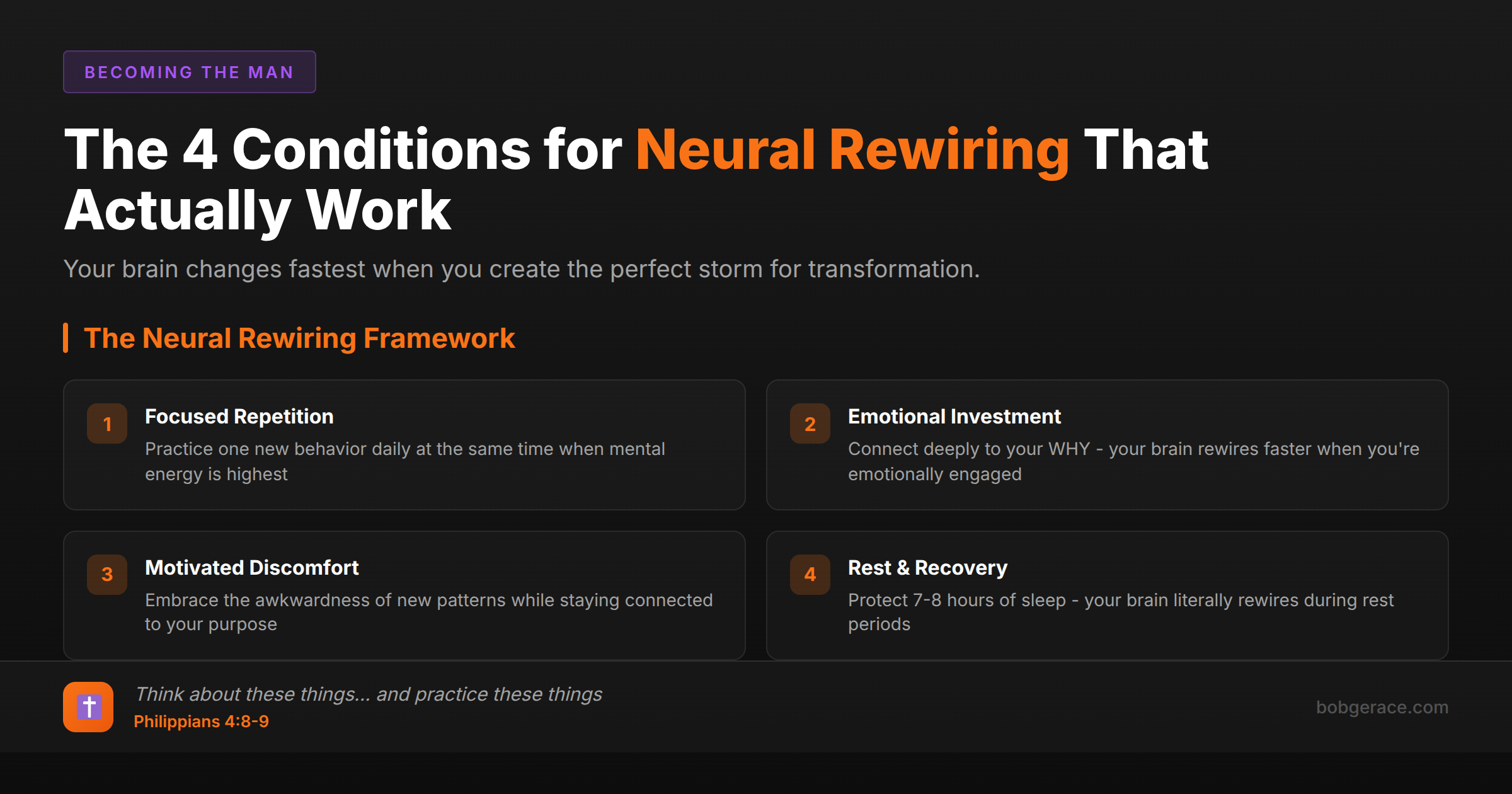
Your brain rewires most effectively under specific conditions that create the perfect storm for lasting change. The key factors include consistent repetition of new behaviors, emotional engagement with the process, adequate sleep for memory consolidation, and what neuroscientists call 'focused attention' - being fully present during the practice of new patterns. The most critical element is what I call 'motivated discomfort' - being willing to push through the awkwardness of new behaviors while staying connected to your deeper 'why.' Your brain literally builds new neural pathways faster when you're emotionally invested in the outcome and willing to embrace the temporary discomfort of growth.
The Full Picture
Think of your brain like a hiking trail through dense forest. The old destructive patterns are well-worn paths - easy to walk but leading nowhere you want to go. Creating new neural pathways is like blazing a new trail. At first, it's difficult, slow, and requires constant attention. But with the right conditions, that new path becomes stronger and more automatic.
The non-negotiable conditions for optimal neural rewiring:
Repetition with intention - Your brain doesn't change from understanding or wanting to change. It changes from doing. You need consistent, deliberate practice of new behaviors, ideally at the same time each day to leverage your brain's natural rhythm.
Emotional activation - Cold, mechanical repetition creates weak neural pathways. But when you're emotionally engaged - whether through excitement about your future or healthy anger at your past patterns - your brain releases neurochemicals that strengthen new connections.
Recovery and consolidation - Your brain literally rewires itself during sleep and rest periods. Men who skimp on sleep or never allow downtime sabotage their own transformation efforts.
Progressive challenge - Just like physical training, your brain needs increasing challenge to continue growing. What feels difficult today should feel easier in two weeks, signaling it's time to level up.
Environmental support - Your surroundings either support or sabotage rewiring. This includes physical spaces, the people you're around, and the media you consume. Your brain is constantly taking cues from your environment about which patterns to reinforce.
What's Really Happening
From a neurological perspective, optimal rewiring occurs when we create what's called a 'neuroplastic state' - a brain condition primed for change. This happens through the interaction of several key neurotransmitter systems working in harmony.
Dopamine, often misunderstood as just a 'reward' chemical, actually signals the brain that something important is happening and attention should be focused. When you practice new behaviors while genuinely excited about your future marriage, dopamine helps encode those patterns more deeply.
Norepinephrine, released during focused attention and mild stress, acts like a highlighter for your brain, marking new experiences as significant. This is why stepping slightly outside your comfort zone accelerates change - you're literally neurochemically flagging the experience as important.
The timing of sleep after learning new patterns is crucial. During REM sleep, your brain rehearses new neural pathways up to 20,000 times, strengthening the connections you practiced during the day. Men who practice new communication skills then get quality sleep show dramatically faster improvement than those who don't prioritize rest.
Perhaps most importantly, the prefrontal cortex - your brain's 'CEO' - needs glucose and isn't unlimited in capacity. This is why transformation efforts fail when men try to change everything at once. Focus on 1-2 key patterns at a time, practice them when your mental energy is highest (usually mornings), and be strategic about when you attempt difficult conversations or challenging situations.
What Scripture Says
Scripture reveals that God designed us for transformation, and the conditions He prescribes align perfectly with what neuroscience confirms about optimal brain change.
Focused, intentional practice: *"Whatever is true, whatever is honorable, whatever is just, whatever is pure, whatever is lovely, whatever is commendable, if there is any excellence, if there is anything worthy of praise, think about these things"* (Philippians 4:8). Paul isn't suggesting casual positive thinking - he's prescribing focused, repetitive attention on specific mental patterns.
The power of community and environment: *"Iron sharpens iron, and one man sharpens another"* (Proverbs 27:17). God designed us to change in relationship, not isolation. Your brain literally rewires faster when supported by others pursuing similar growth.
Rest as a spiritual discipline: *"In returning and rest you shall be saved; in quietness and in trust shall be your strength"* (Isaiah 30:15). Rest isn't laziness - it's the condition where God often does His deepest work in us, including the neurological consolidation that makes new patterns stick.
Emotional engagement with truth: *"Let the word of Christ dwell in you richly"* (Colossians 3:16). The word 'dwell' implies deep, experiential engagement, not intellectual assent. When God's truth moves from your head to your heart, it creates the emotional activation that strengthens neural change.
Progressive growth: *"But grow in the grace and knowledge of our Lord and Savior Jesus Christ"* (2 Peter 3:18). Growth is progressive, requiring both grace (rest and recovery) and increasing knowledge (progressive challenge).
God isn't just interested in your eternal destiny - He's actively involved in rewiring your brain for His glory and your marriage's flourishing.
What To Do Right Now
-
1
Choose ONE specific behavior to focus on for the next 30 days - trying to change everything at once overwhelms your prefrontal cortex
-
2
Practice your new behavior at the same time each day when your mental energy is highest (usually within 2 hours of waking)
-
3
Before practicing, spend 30 seconds connecting emotionally to WHY this change matters for your marriage and family
-
4
Protect 7-8 hours of sleep, especially during periods of intensive personal growth - your brain rewires during rest
-
5
Find one person who will ask you weekly about your progress and celebrate small wins with you
-
6
Schedule 10 minutes of complete stillness daily - no phone, no input - allowing your brain to consolidate new patterns
Related Questions
- What does neuroplasticity mean for adult change?
- How long does it take to rewire the brain?
- What role does repetition play?
- What role does emotion play in change?
- What role does environment play?
- How do I change patterns that feel hardwired?
- What does chronic anger do to my nervous system?
- How long does recovery take?
- What does trauma recovery look like?
- What is 'window of tolerance' and how do I widen mine?
Also find Bob on
Subscribe for weekly videos on Christian marriage.
Your Brain Won't Rewire on Theory Alone
You know the conditions. Now you need someone who knows your marriage—what's actually blocking the rewiring, what your wife needs to see change, where you're getting stuck. That's what coaching does.
Talk to Bob →