How do I break destructive patterns?
5 min read
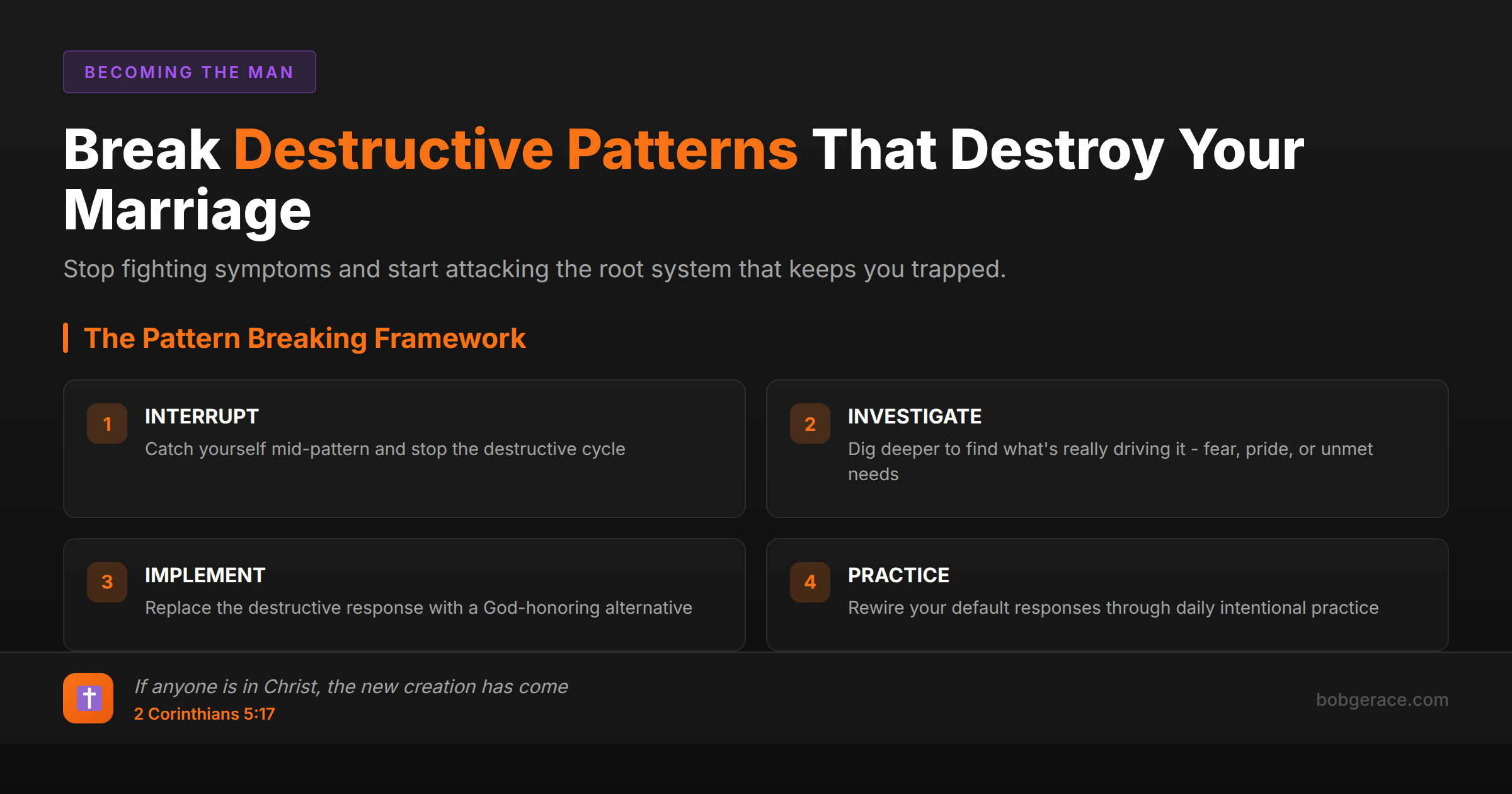
Breaking destructive patterns starts with brutal honesty about what you're actually doing, not what you think you're doing. Most people stay stuck because they're fighting the wrong battle - they're trying to fix symptoms instead of addressing the root system that keeps feeding the problem. The key is interrupt, investigate, and implement. First, you have to catch yourself in the moment and stop the pattern mid-stream. Then you dig deeper to understand what's driving it - usually fear, pride, or unmet needs. Finally, you replace the destructive response with a God-honoring alternative. This isn't about willpower; it's about rewiring your default responses through intentional practice and divine help.
The Full Picture
Here's what nobody tells you about breaking destructive patterns: they exist for a reason. Your brain created these responses because at some point, they solved a problem or met a need. Maybe arguing gave you a sense of control when you felt powerless. Maybe withdrawing protected you from further hurt. Maybe people-pleasing bought you temporary peace.
The pattern isn't random - it's your nervous system's attempt to help you survive. But what helped you survive might be killing your marriage.
Destructive patterns have three components: a trigger (what sets you off), a response (what you do), and a payoff (what you get from it). Most people focus on changing the response, but that's like trying to stop a river by building a dam downstream. You need to address the trigger and eliminate the payoff.
For example, if you blow up when you feel disrespected, the trigger is the feeling of disrespect, the response is anger, and the payoff might be that your spouse backs down and you feel powerful again. But that payoff is poisoning your connection.
The pattern will fight back when you try to change it. Your brain will tell you this new way doesn't work, that you need to go back to the old way. This is normal. Every pattern you've ever broken fought back first.
Change happens in layers. You might stop the obvious destructive behavior but still carry the internal attitude that fueled it. Or you might change your actions but not your expectations. Real transformation touches your thoughts, emotions, behaviors, and beliefs. It's not enough to act differently; you need to become different.
The good news? You're not stuck. Every pattern was learned, which means it can be unlearned. But it takes more than good intentions. It takes a strategy, accountability, and often professional help to see what you can't see about yourself.
What's Really Happening
From a clinical perspective, destructive patterns are neurological highways that have been reinforced over time. Every time you repeat a pattern, you strengthen the neural pathways that make it automatic. The brain loves efficiency, so it defaults to these well-worn paths even when they're destructive.
What makes patterns particularly stubborn in marriages is that they often involve two people's nervous systems co-regulating in dysfunctional ways. Your partner's anxiety might trigger your control response, which increases their anxiety, which amplifies your need to control. You're stuck in what we call a 'negative feedback loop.'
Trauma often plays a role. Many destructive patterns are protective mechanisms that developed in response to earlier wounds. The spouse who withdraws might have learned early that emotional expression wasn't safe. The spouse who explodes might have learned that anger was the only emotion that got attention.
Breaking patterns requires neuroplasticity - your brain's ability to form new neural pathways. This happens through conscious repetition of new responses. But here's the key: you have to practice the new response when you're calm, not just when you're triggered. The brain learns best when it's not flooded with stress hormones.
Somatic awareness - understanding how patterns show up in your body - is crucial. Most people don't realize they're entering a destructive pattern until they're fully activated. Learning to recognize the early physical signs (tension, shallow breathing, heat) gives you a window to choose differently.
Environmental factors matter too. Stress, sleep deprivation, and poor boundaries all make destructive patterns more likely. Sometimes the most effective intervention isn't therapy - it's getting eight hours of sleep and reducing your commitments.
What Scripture Says
God's Word has always addressed the human tendency toward destructive patterns. Scripture calls these 'strongholds' - mental and behavioral fortresses that resist God's truth and keep us trapped in cycles that destroy what we love.
Transformation is possible: 'Therefore, if anyone is in Christ, the new creation has come: The old has gone, the new is here!' (2 Corinthians 5:17). You're not condemned to repeat the same patterns forever. In Christ, you have access to a completely new way of being.
Renewal of the mind is essential: 'Do not conform to the pattern of this world, but be transformed by the renewing of your mind' (Romans 12:2). Destructive patterns are often worldly patterns - responding to hurt with hurt, meeting selfishness with selfishness. God's way requires a different operating system.
Truth breaks strongholds: 'We demolish arguments and every pretension that sets itself up against the knowledge of God, and we take captive every thought to make it obedient to Christ' (2 Corinthians 10:5). Destructive patterns are built on lies - lies about what you need, what you deserve, what works. Truth demolishes these foundations.
God's power enables change: 'His divine power has given us everything we need for a godly life through our knowledge of him' (2 Peter 1:3). You're not trying to change through willpower alone. God's power is available for transformation.
Walking in the Spirit breaks cycles: 'So I say, walk by the Spirit, and you will not gratify the desires of the flesh' (Galatians 5:16). Destructive patterns are often flesh patterns - immediate, selfish, fear-based responses. The Spirit offers a different way.
Community provides accountability: 'As iron sharpens iron, so one person sharpens another' (Proverbs 27:17). Breaking patterns usually requires help from others who can see what we can't see about ourselves.
What To Do Right Now
-
1
Map your pattern: Write down the specific trigger, your typical response, and what payoff you get from it
-
2
Identify your early warning signs: Notice the physical sensations that happen before you're fully activated
-
3
Create a pattern interrupt: Develop a specific action to take when you notice the early warning signs
-
4
Design a replacement response: Choose a God-honoring alternative that meets the same underlying need
-
5
Practice the new response daily when you're calm, not just when you're triggered
-
6
Get accountability: Ask someone to help you see the pattern and support your commitment to change
Related Questions
Ready to Break Free from What's Been Holding You Back?
Destructive patterns don't break themselves. Get the personalized strategy and accountability you need to create lasting change.
Get Help Now →