What does accountability mean?
6 min read
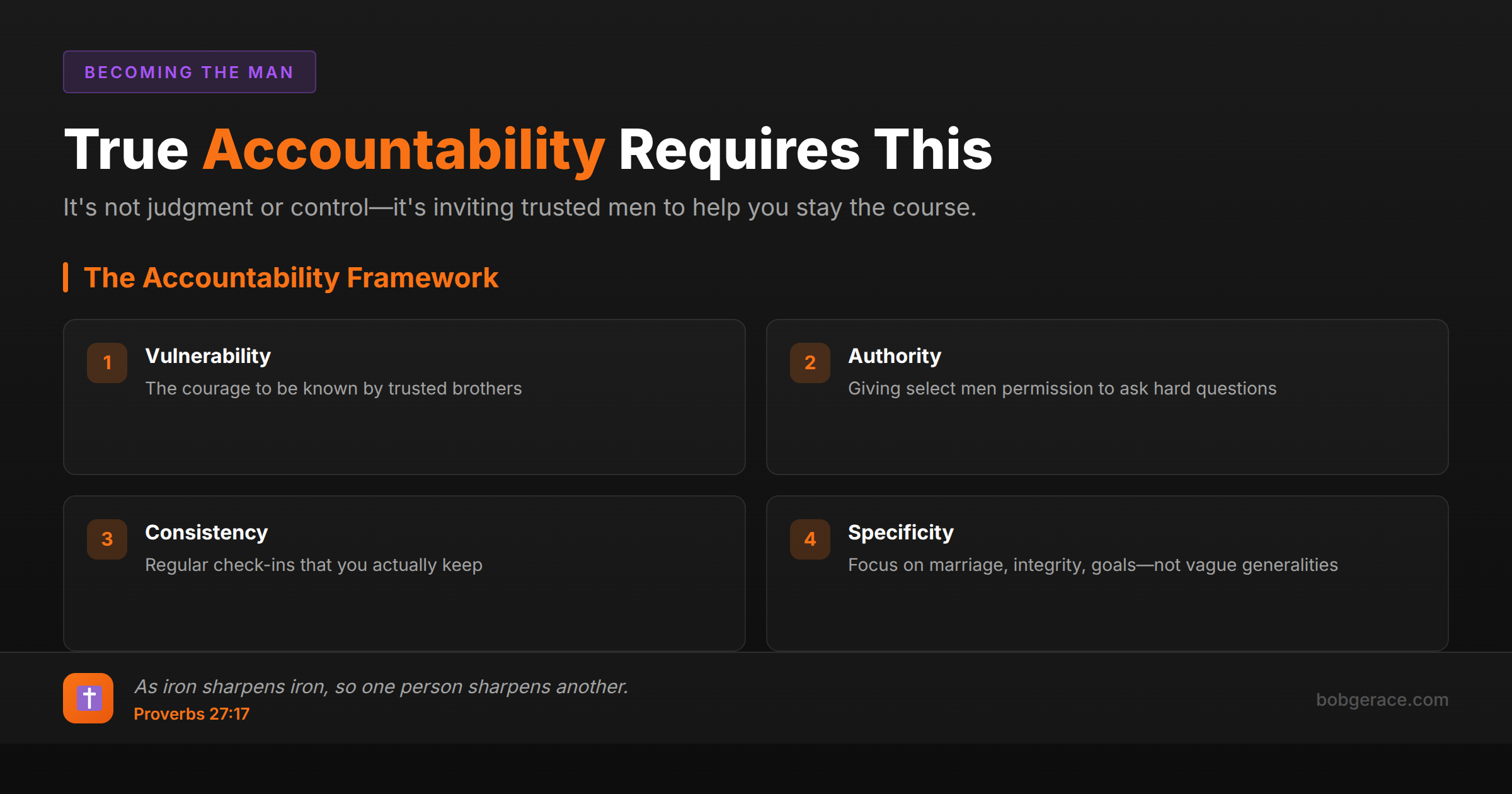
Accountability means willingly submitting yourself to the loving oversight of trusted brothers who have permission to speak truth into your life. It's not about judgment or control – it's about inviting men you respect to help you stay aligned with your values, commitments, and the man you're called to be. True accountability requires vulnerability, humility, and the courage to be known. It means giving select men in your life the authority to ask hard questions, challenge your choices, and call you back to your commitments when you drift. This isn't weakness – it's wisdom. Every great man throughout history had accountability partners who helped him stay the course.
The Full Picture
Most men have a distorted view of accountability. They think it's about having someone police their behavior or shame them when they mess up. That's not accountability – that's control. Real accountability is an invitation, not an imposition.
Accountability is proactive, not reactive. You don't wait until you're struggling to engage accountability partners. You establish these relationships when you're strong, clear-minded, and committed to growth. You're essentially saying, "I know I have blind spots. I know I can rationalize poor choices. I'm inviting you to help me see clearly."
It requires the right people. Not every man is qualified to speak into your life. Your accountability partners should be men who share your values, demonstrate integrity in their own lives, and have earned the right to challenge you. They should be further along than you in areas where you need growth.
It's about alignment, not perfection. The goal isn't to never make mistakes. The goal is to stay aligned with your deepest convictions and commitments, especially when emotions run high or circumstances get difficult. Your accountability partners help you remember who you are and who you're becoming when you're tempted to forget.
It must be mutual. Healthy accountability isn't one-sided. You're not just receiving input – you're also speaking truth into the lives of your brothers. This creates a culture of growth and mutual investment that strengthens everyone involved.
Without accountability, even the strongest men eventually drift. With it, ordinary men accomplish extraordinary things.
What's Really Happening
From a psychological perspective, accountability addresses fundamental aspects of human behavior change and moral development. Research consistently shows that external accountability significantly increases follow-through on commitments and goals.
The brain's prefrontal cortex, responsible for executive decision-making, can be compromised under stress, fatigue, or emotional intensity. This is when we're most likely to act inconsistently with our stated values. Accountability partners serve as an external prefrontal cortex, helping us think clearly when our internal systems are compromised.
Accountability leverages social psychology principles. Humans are inherently social beings who modify behavior based on social expectations and relationships. When we know trusted individuals will ask about our choices, we're neurologically primed to make better decisions in the moment.
It also addresses the fundamental attribution error – our tendency to judge ourselves by our intentions while others judge us by our actions. Accountability partners help us see the gap between our intentions and our actual behavior patterns.
However, accountability must be structured properly to be effective. Shame-based accountability actually triggers defensive mechanisms and can lead to increased secrecy and behavior problems. Effective accountability combines clear expectations with unconditional positive regard for the person, even when challenging their behavior.
The research is clear: men who engage in structured, voluntary accountability relationships show significantly better outcomes in marriage satisfaction, personal goal achievement, and overall life satisfaction.
What Scripture Says
Scripture consistently emphasizes the importance of accountability and mutual support among believers, particularly men walking in godly leadership.
Proverbs 27:17 - "As iron sharpens iron, so one person sharpens another." This isn't a gentle process. Iron sharpening iron creates sparks, heat, and friction. True accountability involves the loving friction of truth spoken between trusted brothers.
Ecclesiastes 4:12 - "Though one may be overpowered, two can defend themselves. A cord of three strands is not quickly broken." Isolation makes us vulnerable. Brotherhood provides strength and protection against temptation and poor decisions.
Galatians 6:1-2 - "Brothers and sisters, if someone is caught in a sin, you who live by the Spirit should restore that person gently. But watch yourselves, or you also may be tempted. Carry each other's burdens, and in this way you will fulfill the law of Christ." Accountability involves both speaking truth and bearing burdens together.
James 5:16 - "Therefore confess your sins to each other and pray for each other so that you may be healed. The prayer of a righteous person is powerful and effective." Confession and accountability go hand in hand.
Hebrews 3:13 - "But encourage one another daily, as long as it is called 'Today,' so that none of you may be hardened by sin's deceitfulness." Sin is deceitful – it blinds us to our own condition. Daily encouragement and accountability help us see clearly.
1 Thessalonians 5:11 - "Therefore encourage one another and build each other up, just as in fact you are doing." Biblical accountability always aims at building up, not tearing down.
What To Do Right Now
-
1
Identify 2-3 men you respect who share your values and demonstrate integrity in their own lives
-
2
Have an honest conversation about mutual accountability - explain what you're looking for and ask if they'd be willing to engage
-
3
Establish regular check-in schedules (weekly or bi-weekly) and stick to them consistently
-
4
Create specific areas of focus - marriage, integrity, goals, spiritual growth - rather than vague general accountability
-
5
Give your accountability partners permission to ask hard questions and challenge you when necessary
-
6
Commit to complete honesty in these relationships, even when it's uncomfortable or embarrassing
Related Questions
Ready to Build Real Brotherhood?
Accountability isn't something you figure out alone. Let me help you build the kind of brotherhood that will transform your marriage and your life.
Work With Me →