What does Gottman research say about how marriages die?
6 min read
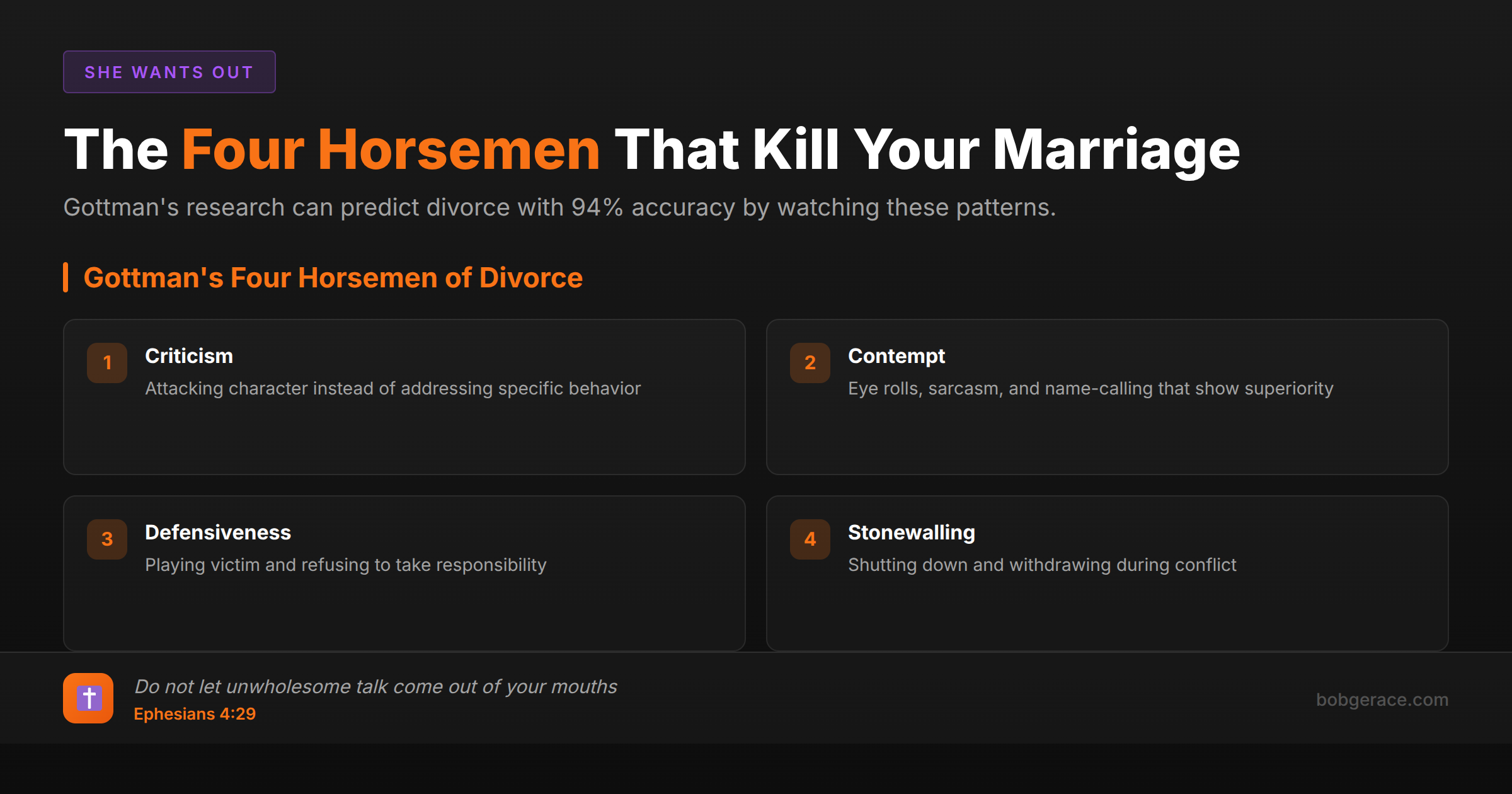
Dr. John Gottman's groundbreaking research identified that marriages don't die from one big blow-up—they die from what he calls the Four Horsemen: criticism, contempt, defensiveness, and stonewalling. His studies can predict divorce with 94% accuracy by watching these patterns play out. Here's the brutal truth: your marriage likely didn't collapse overnight. It died slowly through thousands of small cuts—eye rolls, dismissive comments, shutting down during conflict, and attacking character instead of addressing behavior. Gottman found that couples heading for divorce have a 5:1 ratio flipped—more negative interactions than positive ones. The good news? These are learned behaviors, which means they can be unlearned if you're willing to do the work.
The Full Picture
Gottman's research spanning over 40 years and 3,000 couples reveals that marriages follow predictable patterns toward either success or failure. The Four Horsemen of the Apocalypse aren't dramatic events—they're everyday communication patterns that slowly poison intimacy:
Criticism attacks your wife's character rather than addressing specific behavior. Instead of "You forgot to pay the bills," it becomes "You're so irresponsible with money."
Contempt is the most toxic horseman—eye rolling, sarcasm, name-calling, and moral superiority. When you treat your wife like she's beneath you, you're actively destroying the foundation of respect.
Defensiveness shows up when you play the victim instead of taking responsibility. "It's not my fault" and counter-attacks become your default response to any complaint.
Stonewalling happens when you shut down completely, giving the silent treatment or emotionally checking out during conflict.
Gottman also discovered the Distance and Isolation Cascade. First, you flood with overwhelming emotions during conflict. Then you develop negative thoughts about your marriage. These thoughts become permanent, leading you to live parallel lives and eventually consider separation.
The research shows that 69% of relationship problems are perpetual—they never get fully resolved. Successful couples learn to manage these differences with humor and affection, while failing couples get gridlocked in endless, unsolvable conflicts that breed resentment.
What's Really Happening
From a therapeutic perspective, Gottman's research validates what we see consistently in couple's therapy: marriages fail due to negative interaction cycles that become self-reinforcing. The Four Horsemen create what we call a "negative sentiment override"—where neutral or even positive behaviors get interpreted negatively.
Neurologically, when couples are stuck in these patterns, their brains literally change. The amygdala becomes hyperactivated during conflict, triggering fight-or-flight responses that make rational communication impossible. This is what Gottman calls "flooding"—when your heart rate exceeds 100 BPM and you lose access to your prefrontal cortex.
What's particularly significant is Gottman's finding about repair attempts—efforts to de-escalate tension during conflict. In stable marriages, these attempts work 83% of the time. In failing marriages, they're ignored or rejected, creating a cascade toward emotional disconnection.
The research also reveals that emotional attunement—the ability to tune into your partner's emotional world—is crucial for marital survival. Couples who turn toward each other's "bids for connection" (small attempts at engagement) stay together. Those who turn away or against these bids slowly drift apart.
Clinically, I see how the Four Horsemen often mask deeper attachment wounds. The man who stonewalls may be protecting himself from feeling inadequate. The woman who shows contempt might be desperately trying to feel heard and valued. Understanding these underlying dynamics is essential for real healing.
What Scripture Says
Scripture anticipated Gottman's findings by thousands of years. The patterns that destroy marriages directly contradict biblical principles for relationships:
Ephesians 4:29 says, "Do not let any unwholesome talk come out of your mouths, but only what is helpful for building others up according to their needs, that it may benefit those who listen." Criticism and contempt violate this completely—they tear down rather than build up.
James 1:19 instructs us: "Everyone should be quick to listen, slow to speak and slow to become angry." Defensiveness and stonewalling are the opposite—we're quick to speak, slow to listen, and quick to anger.
Proverbs 15:1 reminds us that "A gentle answer turns away wrath, but a harsh word stirs up anger." The Four Horsemen are harsh words that escalate rather than de-escalate conflict.
1 Corinthians 13:4-5 defines love as patient and kind, "it does not dishonor others, it is not self-seeking, it is not easily angered, it keeps no record of wrongs." Contempt dishonors, defensiveness is self-seeking, and criticism keeps detailed records of wrongs.
Colossians 3:19 specifically tells husbands: "Love your wives and do not be harsh with them." Harshness—through criticism, contempt, or stonewalling—directly disobeys God's design for marriage.
Matthew 7:3-5 challenges us to examine our own hearts before pointing out our spouse's faults, countering the blame-shifting that fuels the Four Horsemen.
What To Do Right Now
-
1
Identify which of the Four Horsemen you use most—track your communication patterns for three days without changing them
-
2
Practice the 24-hour rule—when flooded with emotion, take a break and revisit the conversation when your heart rate is normal
-
3
Replace criticism with specific behavior requests—say "I need" instead of "You always" or "You never"
-
4
Eliminate contempt completely—no eye rolling, sarcasm, or name-calling, even when you feel justified
-
5
Take responsibility for your part in conflicts without deflecting or counter-attacking when she brings up concerns
-
6
Learn to turn toward her emotional bids—respond positively when she attempts to connect, even in small ways
Related Questions
- What are the Four Horsemen and which ones killed us?
- What is 'negative sentiment override' and does she have it?
- What is the 'distance and isolation cascade'?
- What does it mean when contempt enters a marriage?
- What are 'failed bids for connection' and how many did I miss?
- What is 'turning away' vs. 'turning against'?
- What is 'emotional disengagement'?
- What's the difference between conflict and disengagement?
- What is 'accumulated resentment'?
Also find Bob on
Subscribe for weekly videos on Christian marriage.
Your Marriage Has Its Own Four Horsemen
I need to hear what yours look like in your actual fights, your actual history. A human coach sees what a tool can't—the specific pattern killing your marriage.
Talk to Bob →