What are the Four Horsemen and which ones killed us?
5 min read
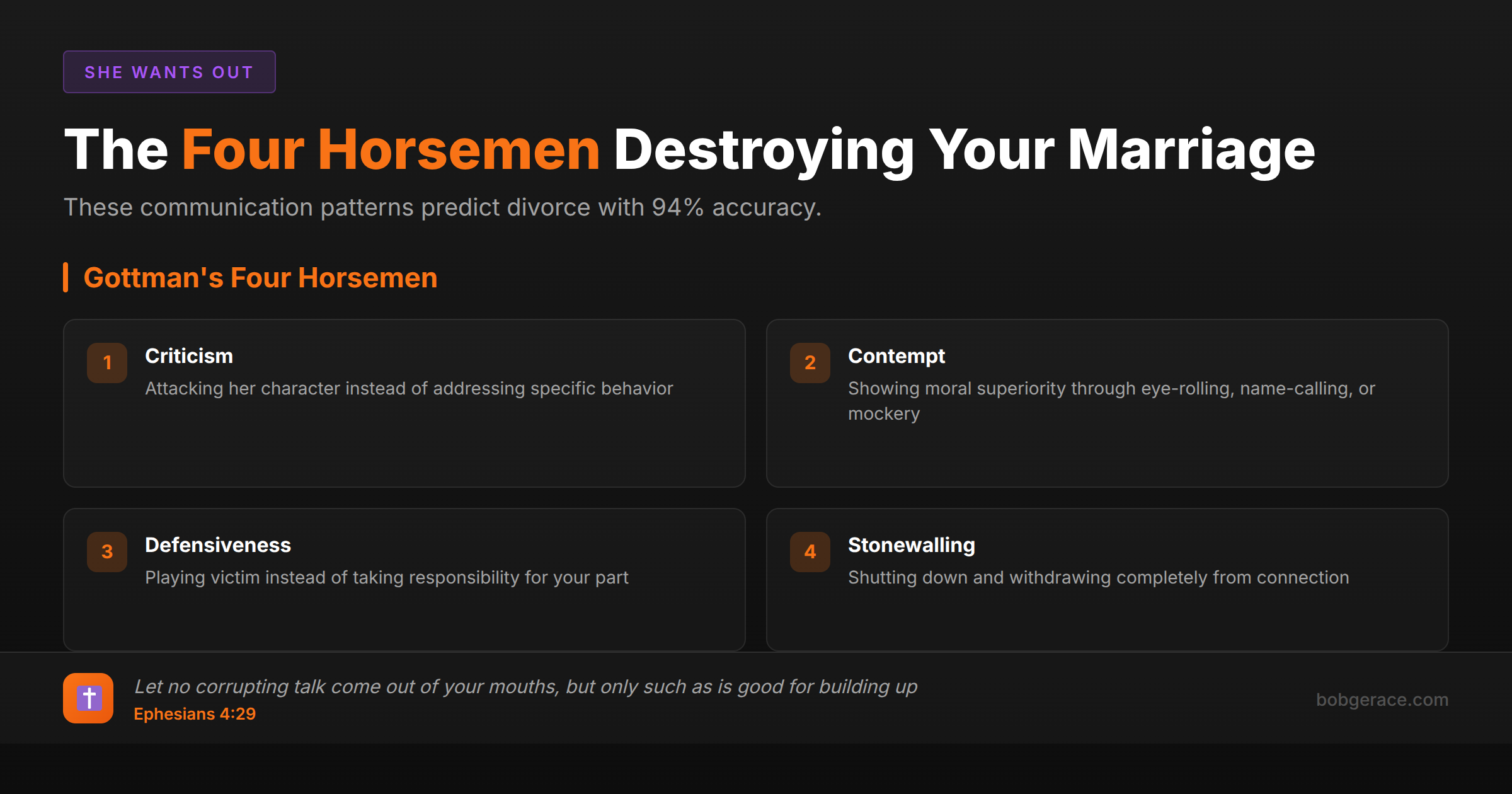
Dr. John Gottman's Four Horsemen are criticism, contempt, defensiveness, and stonewalling - the communication patterns that predict divorce with 94% accuracy. Most guys I work with are hit by at least three of them, often without realizing the damage they're causing. Criticism attacks character instead of addressing behavior. Contempt shows moral superiority through eye-rolling, name-calling, or mockery. Defensiveness plays the victim instead of taking responsibility. Stonewalling shuts down and withdraws completely. Here's the hard truth: if your wife is pulling away, you've likely been riding one or more of these horsemen for years. The good news? Once you identify which ones destroyed your connection, you can learn to replace them with healthier responses. But it requires brutal honesty about your patterns and consistent effort to change them.
The Full Picture
Gottman's research followed thousands of couples for decades, and these four patterns consistently appeared before relationships died. Criticism goes beyond complaints about actions to attacks on character - "You never help" becomes "You're selfish and lazy." Contempt is the most toxic horseman, involving moral superiority, sarcasm, eye-rolling, and name-calling. When you treat your wife like she's beneath you, you're injecting poison into your marriage.
Defensiveness seems natural when you feel attacked, but it actually escalates conflict. Instead of listening to her concerns, you play victim: "It's not my fault" or "You're being unfair." Stonewalling happens when you shut down completely - the silent treatment, walking away, or emotional withdrawal. You think you're avoiding conflict, but you're actually abandoning the relationship.
Most men don't realize they're doing these things. You might think you're just defending yourself or avoiding drama. But from her perspective, you're either attacking her character, treating her with disdain, refusing responsibility, or completely checking out. Over time, these patterns erode trust, intimacy, and respect.
The progression usually follows this path: criticism leads to contempt, contempt triggers defensiveness, and chronic defensiveness results in stonewalling. By the time you're stonewalling regularly, she's likely already emotionally disconnected. The key is identifying which horseman you ride most often and learning the antidotes before it's too late.
What's Really Happening
From a neurological perspective, the Four Horsemen trigger what we call "diffuse physiological arousal" - your nervous system goes into fight, flight, or freeze mode. When couples engage these patterns repeatedly, their brains literally rewire to expect threat from their partner. The criticism-contempt cycle activates the amygdala's threat detection system, while defensiveness engages the sympathetic nervous system's survival mechanisms.
Stonewalling often represents emotional flooding - when your heart rate exceeds 100 BPM, your prefrontal cortex goes offline and rational thinking becomes impossible. Men are particularly susceptible to flooding due to slower heart rate recovery, which explains why many husbands withdraw when conflict escalates.
What's particularly damaging is the negative sentiment override that develops. Once these patterns become entrenched, partners interpret even neutral behaviors as negative. A simple question like "Did you pick up milk?" gets filtered through years of criticism and contempt, triggering defensive responses even when none was intended.
The research shows that successful couples maintain a 5:1 ratio of positive to negative interactions. When the Four Horsemen dominate, this ratio flips, creating a downward spiral of disconnection. The good news is neuroplasticity - brains can rewire with consistent new patterns. But it requires approximately 90 days of conscious, repeated practice to establish new neural pathways and begin rebuilding trust.
What Scripture Says
Scripture addresses each horseman directly. Regarding criticism, Ephesians 4:29 says, "Let no corrupting talk come out of your mouths, but only such as is good for building up, as fits the occasion, that it may give grace to those who hear." When we attack character instead of addressing behavior, we tear down rather than build up.
Contempt directly violates Philippians 2:3: "Do nothing from selfish ambition or conceit, but in humility count others more significant than yourselves." Treating your wife with disdain or superiority is the opposite of Christ-like humility. Matthew 5:22 warns that calling someone a fool puts you in danger of hell's fire - contempt has eternal consequences.
Defensiveness contradicts James 1:19: "Let every person be quick to hear, slow to speak, slow to anger." When we immediately defend instead of listening, we're being slow to hear and quick to speak. Proverbs 27:5-6 reminds us that "better is open rebuke than hidden love" - defensiveness often masks pride that prevents us from receiving correction.
Stonewalling violates our covenant commitment. Malachi 2:14 calls your wife "your companion and your wife by covenant." When you withdraw and shut down, you're abandoning your covenant partner. 1 Peter 3:7 commands husbands to live with their wives "in an understanding way" - stonewalling is the opposite of understanding. God calls us to engage, not escape.
What To Do Right Now
-
1
Identify your primary horseman by reviewing recent arguments and asking which pattern you use most
-
2
Track your emotional flooding by monitoring when your heart rate spikes during conversations
-
3
Practice the antidote to criticism by making specific behavioral requests instead of character attacks
-
4
Replace contempt with building a culture of appreciation by finding one thing daily to genuinely praise
-
5
Counter defensiveness by taking responsibility for your part without deflecting or making excuses
-
6
Combat stonewalling by calling timeouts when flooded and returning within 20 minutes to continue the conversation
Related Questions
- What is 'negative sentiment override' and does she have it?
- What does Gottman research say about how marriages die?
- What is the 'distance and isolation cascade'?
- What does it mean when contempt enters a marriage?
- What are 'failed bids for connection' and how many did I miss?
- What is 'turning away' vs. 'turning against'?
- What is defensiveness in Gottman's Four Horsemen?
- Why do I get defensive every time?
- I can't control my anger
Also find Bob on
Subscribe for weekly videos on Christian marriage.
Which Horsemen Are Killing Your Marriage?
You just read the theory. A coach who knows your actual fights can tell you which patterns are doing the damage and what to do about them today.
Talk to Bob →