What is 'turning away' vs. 'turning against'?
6 min read
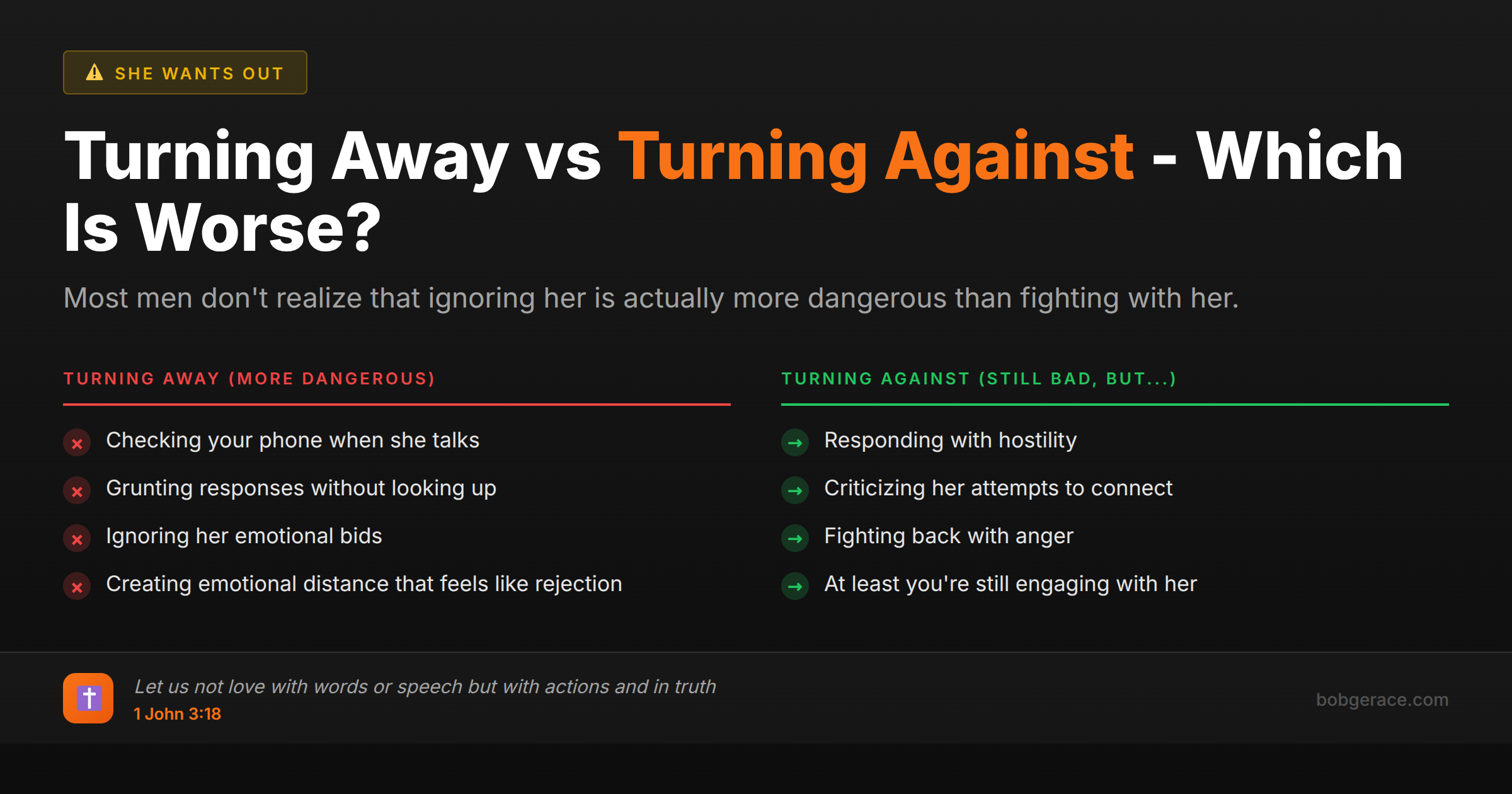
In marriage research, 'turning away' means dismissing or ignoring your spouse's attempts to connect, while 'turning against' means actively responding with hostility or criticism. Here's what most men don't realize: turning away is actually more dangerous to your marriage than turning against. When you turn against her, at least you're engaging - even if it's negative. But when you turn away - checking your phone when she's talking, grunting responses, or simply not responding to her emotional bids - you're creating emotional distance that feels like rejection. This pattern slowly erodes her feelings of love and connection until she starts believing you don't care about her at all.
The Full Picture
Dr. John Gottman's research revealed that successful couples respond positively to each other's 'bids for connection' about 86% of the time. Failed marriages? They only respond positively 33% of the time.
What are bids for connection? They're those small moments when your wife tries to engage with you: • 'Look at that sunset' • 'How was your meeting today?' • 'I'm worried about mom' • 'This song reminds me of our honeymoon'
Turning Away responses: • Continuing to scroll your phone • 'Mm-hmm' without looking up • Changing the subject • Complete silence
Turning Against responses: • 'Can't you see I'm busy?' • 'Why do you always interrupt me?' • 'That's stupid' • Eye rolling or sighing
Here's the shocking truth: turning away is more damaging than turning against. When you turn against her, she at least knows you heard her. When you turn away, she feels invisible, unimportant, and unloved.
Most men turn away because they're overwhelmed, distracted, or don't recognize these moments as important. You might think, 'She's just commenting on the sunset - it's not a big deal.' But to her, your response determines whether she feels connected to you or alone in the marriage.
The tragedy is that turning away becomes a habit. The more you do it, the less she tries to connect. Eventually, she stops making bids altogether and starts looking elsewhere for emotional connection.
What's Really Happening
From a neurobiological perspective, turning away triggers the same pain centers in the brain as physical injury. When a wife's bids for connection are consistently ignored, her nervous system interprets this as rejection and threat, activating her fight-or-flight response.
This creates what we call 'negative sentiment override' - a state where the relationship becomes characterized by distrust and emotional distance. The wife's brain begins to interpret even neutral behaviors as negative, and she becomes hypervigilant to signs of rejection.
Attachment theory explains why turning away is so damaging. Humans have an innate need for secure emotional bonds. When these bids for connection are repeatedly dismissed, it creates attachment injury - a deep wound that threatens the foundation of trust and safety in the relationship.
Interestingly, men who turn away aren't usually trying to hurt their wives. Often, they're experiencing emotional flooding - feeling overwhelmed by stimuli and retreating into themselves as a coping mechanism. However, this self-protective behavior inadvertently damages the very relationship they're trying to preserve.
The good news is that turning toward - responding positively to bids for connection - can be learned. It requires developing emotional awareness, recognizing bids when they happen, and choosing to engage even when it feels inconvenient. Research shows that even small improvements in turning toward can significantly impact relationship satisfaction and stability.
What Scripture Says
Scripture calls us to love through our actions, not just our words. 1 John 3:18 reminds us, 'Dear children, let us not love with words or speech but with actions and in truth.' Every bid for connection from your wife is an opportunity to love her through your response.
Philippians 2:4 instructs us to 'not look to your own interests but each of you to the interests of the others.' Turning away is often about protecting our own comfort or agenda, while turning toward requires us to set aside our immediate desires to serve our wife's need for connection.
The principle of being 'quick to listen, slow to speak and slow to become angry' from James 1:19 directly applies here. Turning toward requires us to listen first - really listen - before we respond. This biblical wisdom predates marriage research by thousands of years yet perfectly describes healthy relationship dynamics.
Ephesians 4:29 tells us to speak 'only what is helpful for building others up according to their needs, that it may benefit those who listen.' This doesn't just apply to avoiding harsh words - it also means we can't remain silent when our spouse reaches out to us.
1 Peter 3:7 specifically calls husbands to be 'considerate' as we live with our wives. The Greek word here implies careful attention and understanding. We can't be considerate if we're not paying attention to her attempts to connect.
Finally, 1 Corinthians 13:5 reminds us that love 'is not self-seeking.' Turning toward your wife's bids requires dying to self and choosing her needs over your immediate comfort or convenience.
What To Do Right Now
-
1
Identify your turning away patterns - notice when you check your phone, give short responses, or ignore her attempts to connect
-
2
Create phone-free zones during dinner, bedtime conversations, and when she first gets home from work
-
3
Practice the 6-second rule - when she makes a bid, give her 6 seconds of full attention before doing anything else
-
4
Ask follow-up questions when she shares something - show genuine curiosity about her thoughts and feelings
-
5
Stop multitasking when she's talking - close the laptop, put down the remote, turn your body toward her
-
6
Apologize specifically for times you've turned away - acknowledge how this made her feel invisible and commit to change
Related Questions
- What are the Four Horsemen and which ones killed us?
- What are 'failed bids for connection' and how many did I miss?
- What is 'negative sentiment override' and does she have it?
- What does Gottman research say about how marriages die?
- What is the 'distance and isolation cascade'?
- What does it mean when contempt enters a marriage?
- She stopped fighting — is that worse?
- She's indifferent — not angry, just empty
- She shuts down when I try to connect
- What is 'stonewalling' and why does she do it?
Also find Bob on
Subscribe for weekly videos on Christian marriage.
You Don't Have to Guess What She Needs
A coach who knows your marriage can tell you what turning toward looks like in your specific situation—not just the theory, but what to do Tuesday night when she's talking and you're exhausted.
Talk to Bob →