What's the pursue-withdraw cycle and how do I stop it?
6 min read
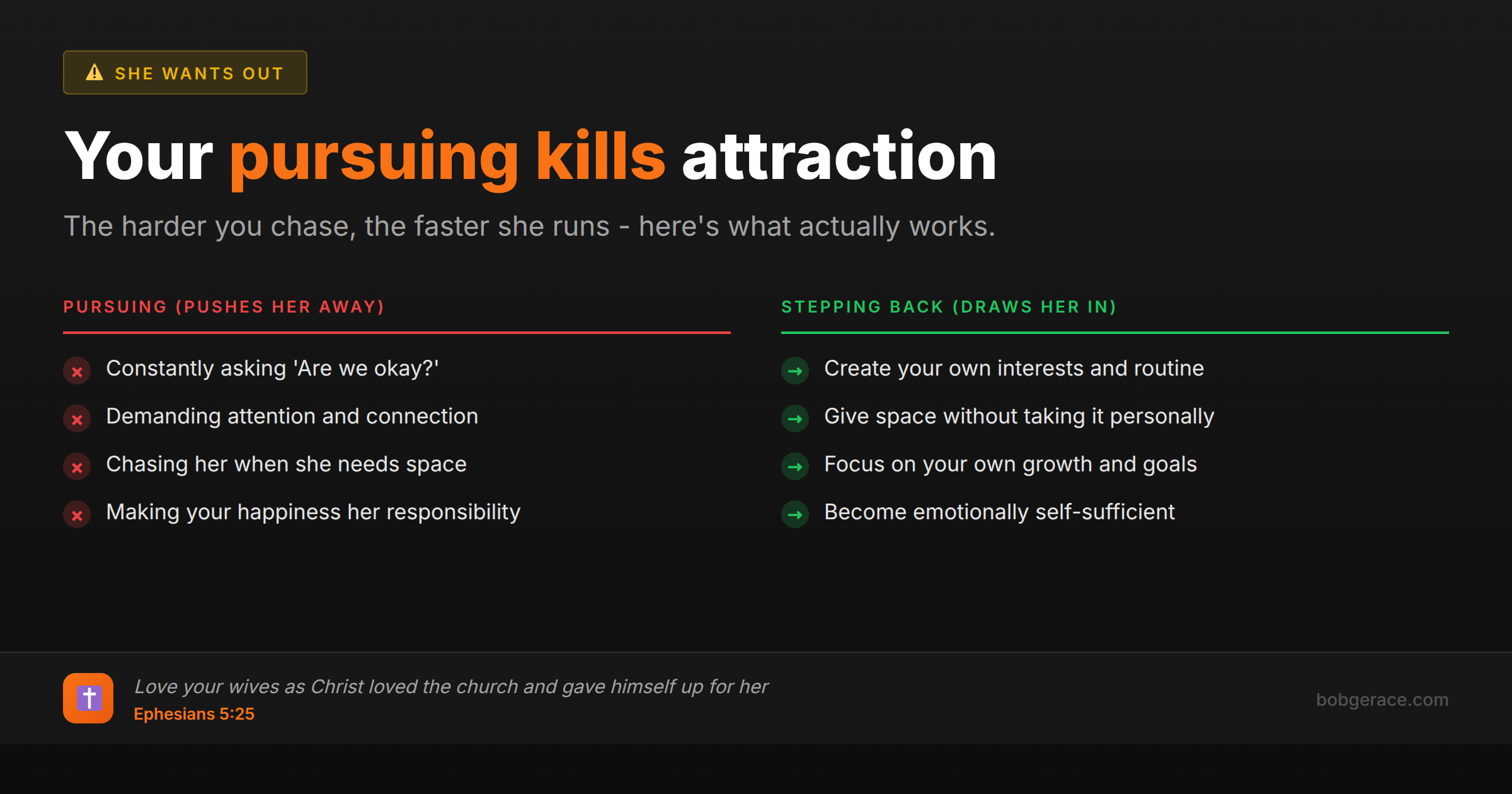
The pursue-withdraw cycle is the dance of death for marriages. You feel disconnected, so you chase harder - asking questions, trying to fix things, demanding attention. She feels suffocated and pulls away further. So you pursue more desperately. She withdraws more completely. It's a vicious cycle that pushes you apart exactly when you're trying to get closer. Here's the hard truth: your pursuing is part of the problem. When you chase, you're actually confirming her fears that you're needy and unable to stand on your own. The more you pursue, the less attractive you become. Breaking this cycle requires you to do the counterintuitive thing - step back, work on yourself, and become the man she can respect again.
The Full Picture
The pursue-withdraw cycle is one of the most destructive patterns in marriage, and it's happening in your house right now. Here's how it typically plays out:
The Downward Spiral: - You sense distance and try to close the gap through talking, questions, or physical affection - She feels pressured and creates more space - You interpret her withdrawal as rejection and pursue harder - She feels overwhelmed and shuts down completely - You panic and either explode in anger or collapse into desperation - She confirms her belief that leaving might be the only option
Why This Happens: This isn't about her being cold or you being needy. It's about mismatched attachment responses under stress. When you feel the relationship threatened, your attachment system kicks in and says "get closer." When she feels overwhelmed or criticized, her attachment system says "create safety through distance."
Common Mistakes Men Make: - Trying to logic their way back into connection - Increasing physical affection when she's emotionally distant - Having "the talk" repeatedly about the relationship - Making grand gestures or promises to change - Monitoring her phone, schedule, or emotional state - Taking her need for space as personal rejection
The brutal reality is that your pursuing confirms her fears about you. Every time you chase, you're proving that you can't handle her emotions, that you need her validation to feel okay, and that you're more concerned with your comfort than her wellbeing. This makes you less attractive, not more.
Breaking this cycle requires recognizing that connection comes through differentiation, not fusion. She needs to see you as a separate, whole person who can handle your own emotions and respect her boundaries.
What's Really Happening
From a clinical perspective, the pursue-withdraw cycle represents a dysregulated attachment system under threat. Research by Dr. Sue Johnson and others in Emotionally Focused Therapy shows this pattern exists in over 80% of distressed couples.
The Neuroscience Behind It: When you sense disconnection, your brain's attachment system triggers a fight-or-flight response. For pursuers, this typically manifests as hypervigilance - constantly scanning for signs of rejection or distance. Your nervous system interprets her withdrawal as a threat to survival, because evolutionarily, abandonment meant death.
Her Withdrawal Response: Her withdrawal often stems from emotional flooding - when her nervous system becomes overwhelmed by the intensity of your pursuit. What you experience as loving attention, she experiences as suffocating pressure. Her brain shifts into a defensive mode where creating distance feels like the only way to regulate her emotions.
The Trauma Component: Many couples get stuck here because both partners have unresolved attachment wounds. Your pursuing might stem from childhood experiences of abandonment or inconsistent caregiving. Her withdrawing might come from experiences of criticism, control, or emotional overwhelm in her family of origin.
Breaking the Neurological Pattern: Recovery requires co-regulation - learning to manage your own nervous system first. When you can stay calm and grounded in the face of her distance, you provide safety for her nervous system to relax. This isn't about suppressing your needs, but about meeting them in healthier ways.
The goal is earned secure attachment - where both partners can maintain their individual emotional regulation while staying emotionally available to each other.
What Scripture Says
Scripture provides profound wisdom about healthy relationship dynamics that directly applies to breaking the pursue-withdraw cycle.
Ephesians 5:25 tells husbands to "love your wives as Christ loved the church and gave himself up for her." Notice that Christ's love involved sacrifice and service, not pursuing and demanding. Jesus didn't chase after people who rejected Him - He loved them by giving them space to choose.
1 Peter 3:7 instructs husbands to live with their wives "in an understanding way, showing honor to the woman as the weaker vessel, since you are joint heirs of the grace of life." Understanding means respecting her emotional needs and responses, even when they differ from yours. Honor means treating her withdrawal as valid rather than something to overcome.
Galatians 6:4-5 says "Let each one test his own work... For each will have to bear his own load." This speaks to healthy differentiation - taking responsibility for your own emotions and reactions rather than making them her responsibility to fix. Your emotional stability cannot depend on her responses.
Proverbs 27:14 warns that "whoever blesses his neighbor with a loud voice, rising early in the morning, will be counted as cursing." Sometimes our attempts to love and connect can feel like pressure rather than blessing if we're not sensitive to timing and approach.
Matthew 7:12, the Golden Rule, reminds us to "do unto others as you would have them do unto you." Ask yourself: if you were feeling overwhelmed and needed space, would you want someone pursuing you harder, or would you want them to respect your need for breathing room?
James 1:19 calls us to be "quick to hear, slow to speak, slow to anger." Breaking the pursue-withdraw cycle requires listening to understand rather than listening to respond, especially when her need for space triggers your fears of abandonment.
What To Do Right Now
-
1
Stop pursuing immediately - no more relationship talks, checking in on her emotions, or trying to force connection
-
2
Create your own space and routine - develop interests, friendships, and activities that don't revolve around her
-
3
Practice emotional regulation - when you feel the urge to pursue, pause and ask what you need that doesn't involve her
-
4
Respect her boundaries without taking them personally - if she needs space, give it freely without pouting or punishing
-
5
Focus on your own growth - work on becoming the man she married rather than trying to get her to change
-
6
Communicate your own needs clearly once, then let it go - state what you need without demanding or repeating yourself
Related Questions
- Why does my pursuing make her pull away more?
- What is 'anxious protest behavior' and am I doing it?
- What does healthy pursuit look like vs. desperate pursuit?
- How do I show love without activating her withdrawal?
- What's the difference between presence and pressure?
- What is the 'attachment dance' and how do I change my steps?
- What is anxious attachment and am I doing it right now?
- What does 'protest behavior' look like and am I doing it?
- How do I pursue without pressuring?
- What is the '180' approach and does it work?
Also find Bob on
Subscribe for weekly videos on Christian marriage.
Get a Coach on This Today
You're in active crisis and the pursue-withdraw cycle is tightening. A coach who knows your specific situation can tell you what to do tomorrow morning—not in theory, in your marriage.
Talk to Bob →