What's the difference between conflict and disengagement?
6 min read
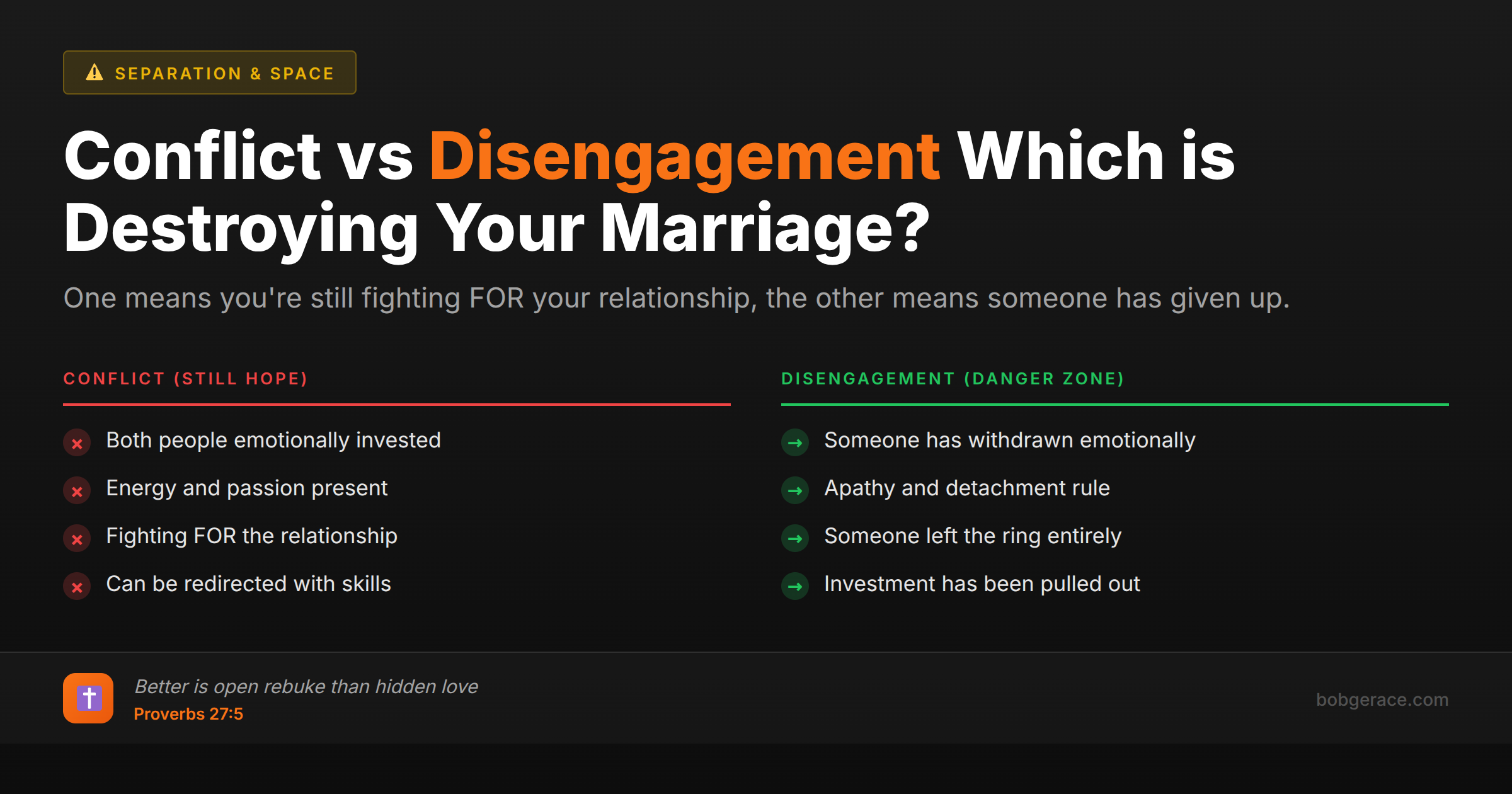
Conflict is active engagement - even when it's heated, both people are still emotionally invested and fighting for the relationship. Disengagement is emotional withdrawal where one or both partners stop caring enough to fight. In conflict, there's energy and emotion; in disengagement, there's apathy and detachment. The key difference is investment. Conflict means you're both still in the ring swinging, even if poorly. Disengagement means someone has left the ring entirely. Conflict can be worked with and redirected; disengagement is much more dangerous because it signals that emotional investment has been withdrawn. Understanding this difference is crucial for knowing how to respond appropriately.
The Full Picture
Here's what most people don't understand: conflict isn't the enemy of your marriage - disengagement is. I've worked with thousands of couples, and I'll take a couple who fights passionately over one where someone has emotionally checked out any day of the week.
Conflict is active engagement. When you're arguing, you're both still emotionally invested. You care enough to get upset, to raise your voice, to fight for your position. There's energy, emotion, and most importantly - there's still connection. Even negative connection is still connection.
Disengagement is the emotional equivalent of giving up. It's when phrases like "whatever," "I don't care," and "fine" become the norm. It's when one person stops initiating conversations, stops sharing their day, stops caring about resolving issues. The energy is gone. The investment has been withdrawn.
Think of it this way: conflict is like two people fighting over the thermostat - they both care about the temperature in the house. Disengagement is when one person moves out emotionally and stops caring what temperature the house is at all.
The danger signs of disengagement include: - Conversations becoming purely transactional - Stopping mid-argument with "forget it" - No longer sharing personal thoughts or feelings - Indifference to your spouse's actions or decisions - Emotional flatness where there used to be passion
Conflict can be redirected and improved with better communication skills. Disengagement requires rebuilding emotional investment from the ground up. One is a skill problem; the other is a heart problem.
What's Really Happening
From a clinical perspective, conflict and disengagement represent completely different neurological and emotional states. During conflict, the brain's emotional centers are highly activated - we see increased activity in the amygdala and decreased activity in the prefrontal cortex. While this creates poor decision-making in the moment, it indicates strong emotional attachment and investment in the relationship outcome.
Disengagement, however, shows a different pattern entirely. We see what's called 'emotional numbing' - a protective mechanism where the brain essentially shuts down emotional responses to avoid further pain. This often follows what Dr. John Gottman calls 'flooding' - when someone becomes so overwhelmed by conflict that they begin to withdraw as a survival mechanism.
The clinical term for this is 'stonewalling,' and research shows it's one of the strongest predictors of relationship dissolution. When someone disengages, they're not just avoiding conflict - they're protecting themselves from what their nervous system perceives as a threat to their emotional well-being.
What makes disengagement particularly challenging is that it often feels like relief initially. The person withdrawing experiences less immediate stress, while their partner may initially appreciate the 'peace.' However, this apparent calm is actually relationship death by a thousand cuts. Without emotional engagement, couples lose their repair mechanisms, their intimacy, and ultimately their connection.
Recovery from disengagement requires deliberate re-engagement strategies, often including individual therapy to address the underlying emotional flooding that triggered the withdrawal in the first place.
What Scripture Says
Scripture gives us clear guidance on both conflict and engagement in relationships. God doesn't call us to avoid all conflict - He calls us to handle it righteously.
Proverbs 27:5-6 tells us: *"Better is open rebuke than hidden love. Wounds from a friend can be trusted, but an enemy multiplies kisses."* This shows us that honest, direct communication - even when it's difficult - is better than superficial peace or emotional withdrawal.
Ephesians 4:26-27 instructs: *"In your anger do not sin: Do not let the sun go down while you are still angry, and do not give the devil a foothold."* Notice it doesn't say don't get angry - it says don't sin in your anger and don't let it fester. Engagement, even difficult engagement, is biblical.
Matthew 18:15 gives us the pattern: *"If your brother or sister sins, go and point out their fault, just between the two of you."* This is about active, loving engagement - the opposite of disengagement and withdrawal.
But Scripture also warns against destructive conflict. Proverbs 15:1 reminds us: *"A gentle answer turns away wrath, but a harsh word stirs up anger."*
1 Corinthians 13:4-7 shows us what love looks like in action - and notice it's active, not passive or withdrawn: *"Love is patient, love is kind... it is not easily angered, it keeps no record of wrongs... It always protects, always trusts, always hopes, always perseveres."*
God calls us to stay engaged, to work through difficulties, and to love actively - not to withdraw, shut down, or give up on each other.
What To Do Right Now
-
1
Honestly assess which category your marriage is in - Are you having conflict (engagement) or experiencing disengagement? Be brutally honest about what you're seeing.
-
2
If you're in conflict, focus on fighting fair - Learn proper communication techniques, take breaks when flooded, attack problems not people, and remember you're on the same team.
-
3
If there's disengagement, address it immediately - This is a marriage emergency. The withdrawn person needs to communicate why they've checked out, and both need to commit to re-engaging.
-
4
Create safe spaces for difficult conversations - Set ground rules, agree on break signals, and establish that both people will stay in the conversation until resolution or planned continuation.
-
5
Rebuild emotional investment gradually - Start with small positive interactions, express appreciation, share thoughts and feelings, and deliberately choose connection over withdrawal.
-
6
Get professional help if disengagement has set in - This isn't something you should try to fix alone. A skilled marriage counselor can help navigate the re-engagement process safely and effectively.
Related Questions
- What is 'emotional disengagement'?
- What are Gottman's signs of 'turning away'?
- What is the 'pursuer-distancer' dynamic?
- What's the difference between her being withdrawn and being done?
- Why did she stop fighting?
- What does giving up look like vs. regulating?
- She stopped fighting — is that worse?
- She's indifferent — not angry, just empty
- What is 'stonewalling' and why does she do it?
- She won't talk about our problems
Also find Bob on
Subscribe for weekly videos on Christian marriage.
Your Marriage Needs a Coach Today
If she's already disengaged, you need someone who knows your specific situation and can help you move fast. Bob works with men in active crisis.
Talk to Bob →