What are Gottman's signs of 'turning away'?
6 min read
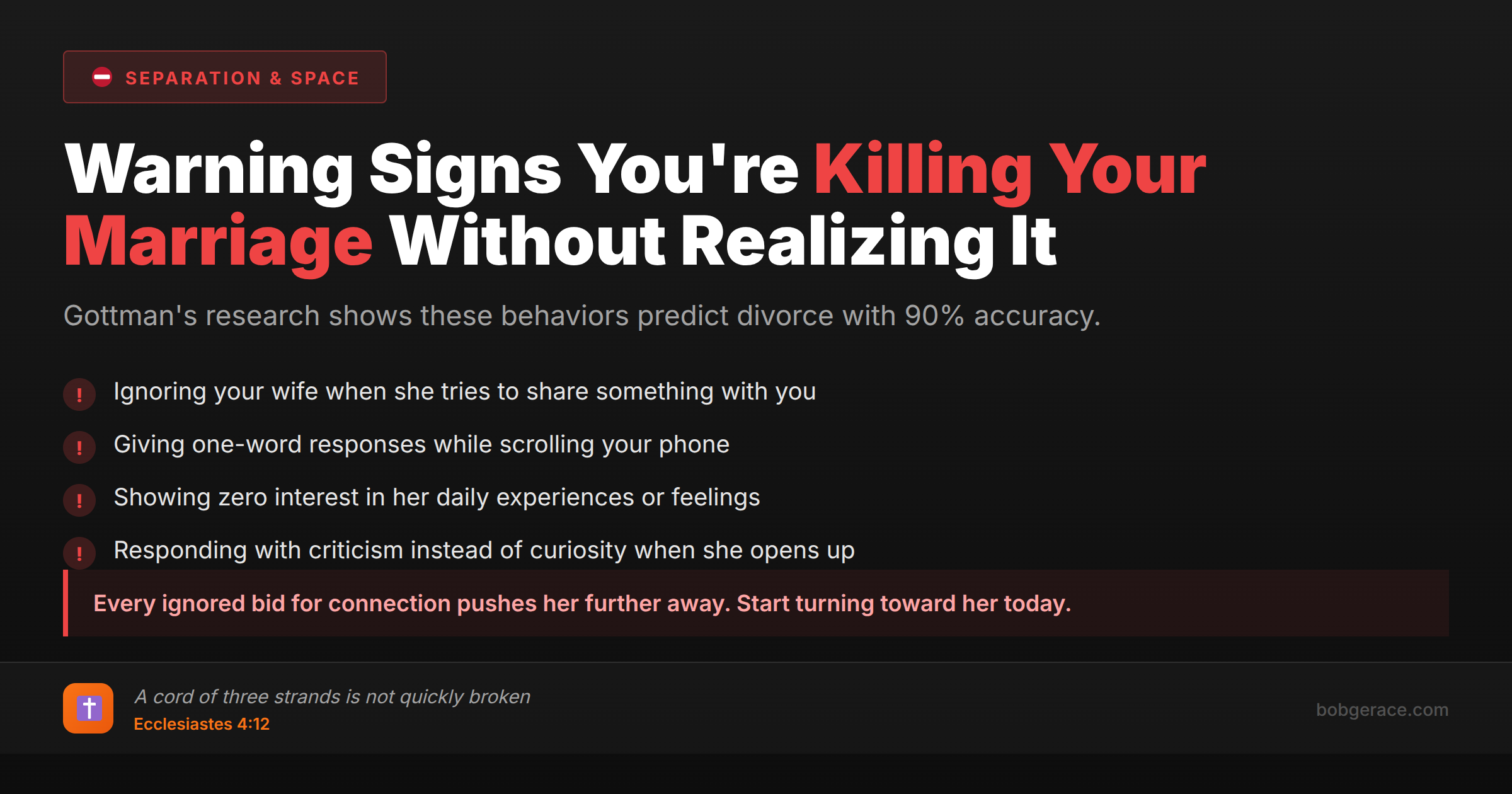
Dr. John Gottman's research identifies 'turning away' as one of the most damaging patterns in marriage. It occurs when partners consistently fail to respond to each other's bids for connection - those small attempts to share thoughts, feelings, or experiences throughout the day. The signs include: ignoring your spouse when they speak, giving minimal responses to their attempts at conversation, being distracted by phones or TV during interactions, showing no interest in their daily experiences, failing to acknowledge their emotions, and responding with criticism or contempt instead of curiosity. These behaviors create emotional distance and predict relationship failure with startling accuracy.
The Full Picture
Gottman's research on 'turning away' represents decades of studying thousands of couples in his famous 'Love Lab.' What he discovered was sobering: couples who consistently turn away from each other's bids for connection have only a 14% chance of staying together long-term.
Turning away happens in small moments throughout the day. Your wife mentions feeling stressed about work, and you grunt without looking up from your phone. Your husband tries to share something funny that happened, and you respond with 'uh-huh' while scrolling social media. These micro-rejections accumulate like poison in your relationship.
The pattern typically escalates. It starts with distraction - being physically present but emotionally absent. Then it progresses to active dismissal, where bids for connection are met with irritation or criticism. Finally, it reaches complete emotional shutdown, where partners stop making bids altogether because they've learned their spouse won't respond.
Key warning signs include: - Conversations that feel like interviews rather than exchanges - Feeling like roommates instead of lovers - Decreased physical affection and intimacy - Spending more time on devices than talking - Making plans without consulting each other - Feeling emotionally lonely even when together
This isn't about being busy or having bad days. It's about a systematic pattern of emotional unavailability that slowly erodes the foundation of your marriage. The good news? Once you recognize it, you can change it.
What's Really Happening
From a clinical perspective, 'turning away' is often a protective mechanism gone wrong. When people feel overwhelmed, criticized, or emotionally flooded, they instinctively withdraw to self-regulate. However, this creates a destructive cycle where one partner's withdrawal triggers the other's pursuit or their own withdrawal.
Neurologically, repeated experiences of being turned away activate the brain's threat detection system. The rejected partner begins to perceive their spouse as emotionally unsafe, triggering fight-or-flight responses even during normal interactions. This explains why small moments of disconnection can escalate into major conflicts.
The attachment system is particularly vulnerable here. Those with anxious attachment styles may increase their bids for connection when turned away, creating pressure that drives their partner further into withdrawal. Those with avoidant styles may interpret normal bids for connection as clingy or overwhelming, leading them to turn away preemptively.
I often see couples where both partners are simultaneously turning away while desperately wanting connection. They're caught in what I call 'parallel loneliness' - feeling isolated while living in the same house. The tragedy is that both want the same thing but have learned maladaptive ways of protecting themselves from the vulnerability that true connection requires.
Recovery requires conscious rewiring of these automatic responses and rebuilding trust in the safety of emotional connection.
What Scripture Says
Scripture consistently calls us toward connection rather than withdrawal in our marriages. God's design for marriage involves deep emotional intimacy and mutual responsiveness.
Ecclesiastes 4:12 reminds us that 'a cord of three strands is not quickly broken.' When we turn away from our spouse, we're weakening that cord, making our marriage vulnerable to attack.
1 Peter 3:7 instructs husbands to 'live with your wives in an understanding way,' which requires active attention and engagement. You can't understand someone you consistently ignore or dismiss.
Ephesians 4:32 calls us to 'be kind to one another, tenderhearted, forgiving one another.' Turning away violates all three principles - it's neither kind, tenderhearted, nor does it create space for forgiveness and reconciliation.
Proverbs 18:13 warns that 'he who gives an answer before he hears, it is folly and shame to him.' Many couples turn away because they assume they know what their spouse will say, but Scripture calls us to actually listen.
1 Corinthians 13:5 tells us that love 'is not irritable or resentful.' When we consistently respond to our spouse's bids with irritation, we're failing to love them as Christ commands.
God designed marriage as a picture of Christ's relationship with the church. Christ never turns away from us when we reach out to Him. He's always available, always listening, always responding with love and grace. Our marriages should reflect this same attentiveness and responsiveness.
What To Do Right Now
-
1
Audit your responses - For the next three days, notice every time your spouse makes a bid for connection and how you respond
-
2
Put devices away - Create phone-free zones during meals and the first 30 minutes after coming home
-
3
Practice the 6-second rule - When your spouse speaks to you, give them 6 full seconds of eye contact before responding
-
4
Ask follow-up questions - Instead of just acknowledging what they said, show genuine curiosity about their experience
-
5
Schedule daily check-ins - Set aside 15 minutes each day for uninterrupted conversation about your day
-
6
Apologize and reconnect - If you catch yourself turning away, immediately stop, apologize, and ask them to repeat what they said
Related Questions
- What is 'negative sentiment override' and does she have it?
- What are the Four Horsemen and which ones killed us?
- What does Gottman research say about how marriages die?
- What are 'failed bids for connection' and how many did I miss?
- What is 'turning away' vs. 'turning against'?
- What does it mean when contempt enters a marriage?
- She won't talk about our problems
- She shuts down when I try to connect
- What is 'emotional disengagement'?
- She stopped fighting — is that worse?
Also find Bob on
Subscribe for weekly videos on Christian marriage.
Your Marriage Needs More Than Pattern Recognition
You see the turning away. Bob can help you figure out what's driving it in your specific situation and what to do about it today.
Talk to Bob →