What is the 'pursuer-distancer' dynamic?
6 min read
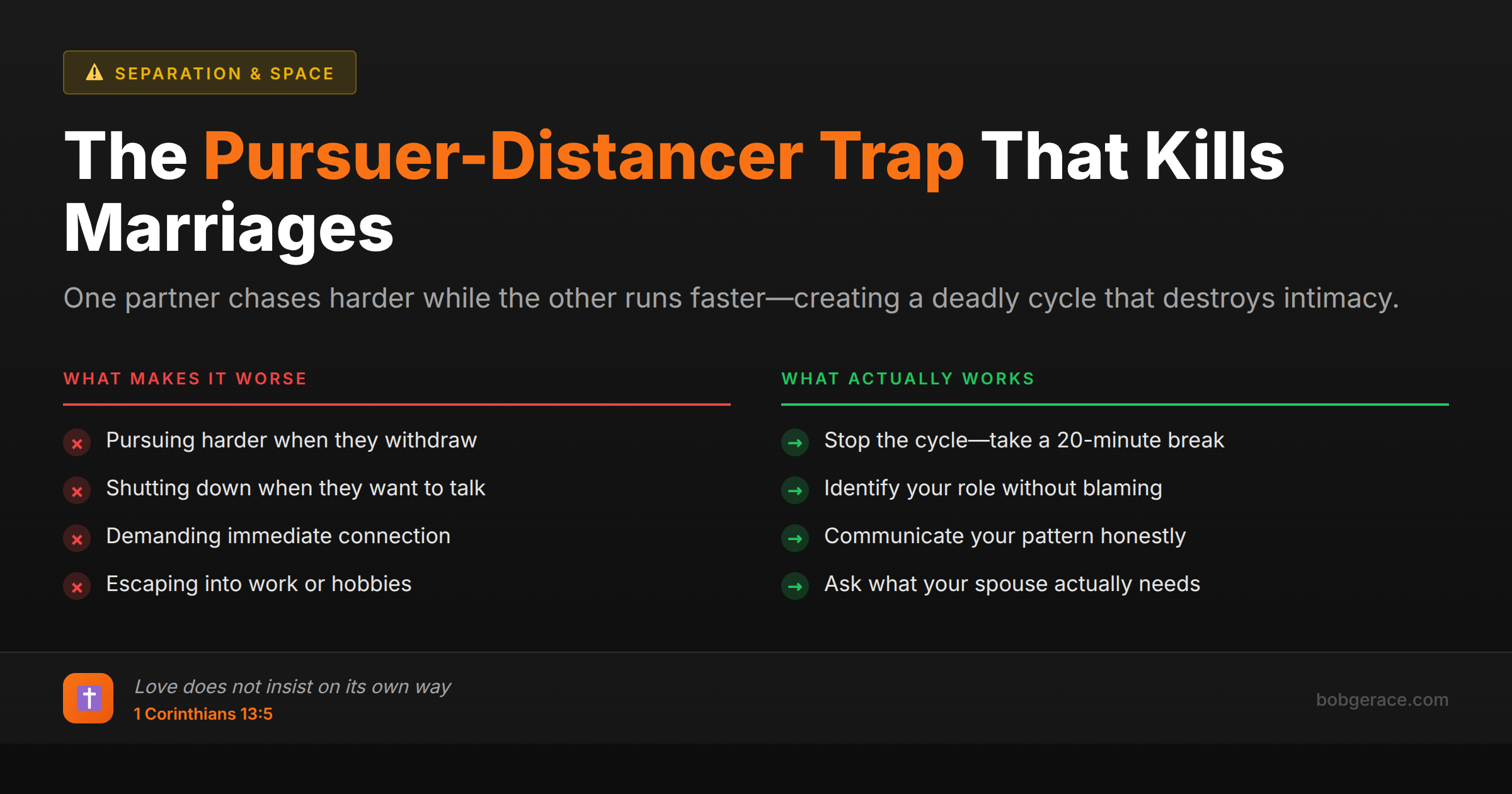
The pursuer-distancer dynamic is a destructive relationship pattern where one partner (the pursuer) seeks connection through increasing efforts to engage, while the other partner (the distancer) responds by withdrawing or shutting down. The more the pursuer pushes for closeness, conversation, or resolution, the more the distancer pulls away, creating a vicious cycle that destroys intimacy. This isn't just about personality differences—it's about how two people's attachment styles and coping mechanisms clash in ways that make both feel misunderstood and hurt. The pursuer feels rejected and abandoned, so they pursue harder. The distancer feels overwhelmed and controlled, so they distance more. Without intervention, this cycle escalates until one or both partners give up entirely.
The Full Picture
The pursuer-distancer dynamic is one of the most common and destructive patterns I see in struggling marriages. It's a dance where both partners are trying to get their needs met, but their strategies actually push away what they're seeking.
The Pursuer's World: The pursuer typically craves connection, communication, and emotional intimacy. When they sense distance from their spouse, their instinct is to close the gap. They initiate conversations, ask questions, make requests for time together, and express their feelings—often repeatedly. To them, this feels like loving pursuit. They're fighting FOR the relationship.
The Distancer's World: The distancer often values autonomy, space, and peace. When faced with what feels like demands or pressure, their instinct is to create space to breathe and think. They withdraw into work, hobbies, silence, or even other relationships. To them, this feels like self-preservation. They're not necessarily fighting AGAINST the relationship—they're trying to survive it.
The Deadly Cycle: Here's where it gets toxic: The pursuer's efforts to connect feel overwhelming to the distancer, who withdraws further. The distancer's withdrawal triggers the pursuer's abandonment fears, causing them to pursue more intensely. Each person's solution becomes the other person's problem.
I've watched this cycle destroy marriages because both partners become convinced their spouse doesn't love them. The pursuer thinks, "If they loved me, they'd want to be close." The distancer thinks, "If they loved me, they'd give me space." Both are wrong, and both are right.
Why This Happens: This dynamic often stems from childhood attachment styles, family of origin patterns, and learned coping mechanisms. The pursuer may have learned that love means constant connection, while the distancer learned that love means not being controlled or overwhelmed.
What's Really Happening
From a clinical perspective, the pursuer-distancer dynamic represents a fundamental mismatch in attachment strategies and nervous system responses to relationship stress. This isn't simply about communication styles—it's about how each partner's brain and body respond to perceived threats to the relationship.
The pursuer typically exhibits anxious attachment patterns. When they sense disconnection, their nervous system activates a "protest response"—an evolutionary mechanism designed to prevent abandonment. This triggers behaviors like increased communication attempts, emotional expression, and physical proximity-seeking. Neurologically, they're experiencing genuine distress that drives the pursuit.
The distancer often demonstrates avoidant attachment patterns. When faced with emotional intensity or what feels like demands, their nervous system activates a "deactivation strategy"—shutting down emotional expression and creating physical or emotional distance. This isn't cruelty; it's their nervous system's attempt to regulate overwhelming stimuli.
The Neurobiological Reality: What makes this cycle so persistent is that each person's regulatory strategy dysregulates their partner. The pursuer's activation increases the distancer's overwhelm, while the distancer's shutdown increases the pursuer's anxiety. Both are stuck in reactive states that prevent the prefrontal cortex—responsible for higher-order thinking and empathy—from fully engaging.
Breaking the Pattern: Successful intervention requires helping both partners understand their own and their spouse's nervous system responses. The pursuer must learn to self-regulate before pursuing connection. The distancer must learn to stay present even when feeling overwhelmed. This isn't about changing who they are—it's about expanding their capacity to stay connected while honoring both partners' legitimate needs for intimacy and autonomy.
What Scripture Says
Scripture provides profound wisdom for breaking the pursuer-distancer cycle by addressing both partners' hearts and calling them to love that transcends their natural instincts.
Love Seeks the Other's Good: *"Love is patient, love is kind... it does not insist on its own way"* (1 Corinthians 13:4-5). This challenges both the pursuer's insistence on connection and the distancer's insistence on space. True love asks, "What does my spouse actually need right now?" rather than "How can I get what I need?"
Wisdom in Approach: *"A gentle answer turns away wrath, but a harsh word stirs up anger"* (Proverbs 15:1). Pursuers often escalate their intensity when met with distance, but Scripture calls for gentleness. Similarly, distancers' withdrawal can feel harsh to their pursuing spouse.
Understanding Before Being Understood: *"Be quick to listen, slow to speak, slow to anger"* (James 1:19). Both partners in this cycle tend to be quick to react from their own pain rather than slow to understand their spouse's experience. The pursuer needs to listen to why their spouse withdraws; the distancer needs to hear why their spouse pursues.
Mutual Submission: *"Submit to one another out of reverence for Christ"* (Ephesians 5:21). This means the pursuer sometimes submits by giving space, and the distancer sometimes submits by engaging even when it feels uncomfortable.
Bearing One Another's Burdens: *"Carry each other's burdens, and in this way you will fulfill the law of Christ"* (Galatians 6:2). The pursuer's burden is fear of abandonment; the distancer's burden is fear of being overwhelmed. Instead of adding to these burdens through reactive patterns, spouses are called to help carry them.
*"Above all, love each other deeply, because love covers over a multitude of sins"* (1 Peter 4:8). This cycle isn't just about incompatibility—it's about two broken people needing grace to love beyond their natural responses.
What To Do Right Now
-
1
STOP the cycle immediately - Recognize when you're in pursuit or distance mode and take a 20-minute break to regulate your nervous system before continuing any conversation
-
2
Identify your role honestly - Write down whether you're typically the pursuer or distancer, and list three specific ways this shows up in your marriage without blaming your spouse
-
3
Communicate your pattern to your spouse - Say something like: 'I realize I tend to [pursue/distance] when I feel scared, and I want to understand how that affects you'
-
4
Create a new signal system - Agree on a code word either of you can use when you feel the cycle starting, followed by a 30-minute cooling-off period
-
5
Practice opposite actions - If you're a pursuer, practice giving space graciously; if you're a distancer, practice engaging even when you want to withdraw
-
6
Schedule structured connection - Set specific times for emotional conversations so the pursuer feels secure and the distancer can prepare mentally
Related Questions
- Why does my pursuing make her pull away more?
- What's the pursue-withdraw cycle and how do I stop it?
- What does 'protest behavior' look like and am I doing it?
- What is 'anxious protest behavior' and am I doing it?
- How do I show love without activating her withdrawal?
- What is the 'attachment dance' and how do I change my steps?
- What is anxious attachment and am I doing it right now?
- She seems cold and detached — is that avoidant attachment?
Also find Bob on
Subscribe for weekly videos on Christian marriage.
This Pattern Won't Fix Itself
If you're watching this cycle play out in your marriage right now, you need someone who can see what's actually happening between you two and help you break it. This 30 days matters.
Talk to Bob →