What does research say about emotional disconnection patterns?
6 min read
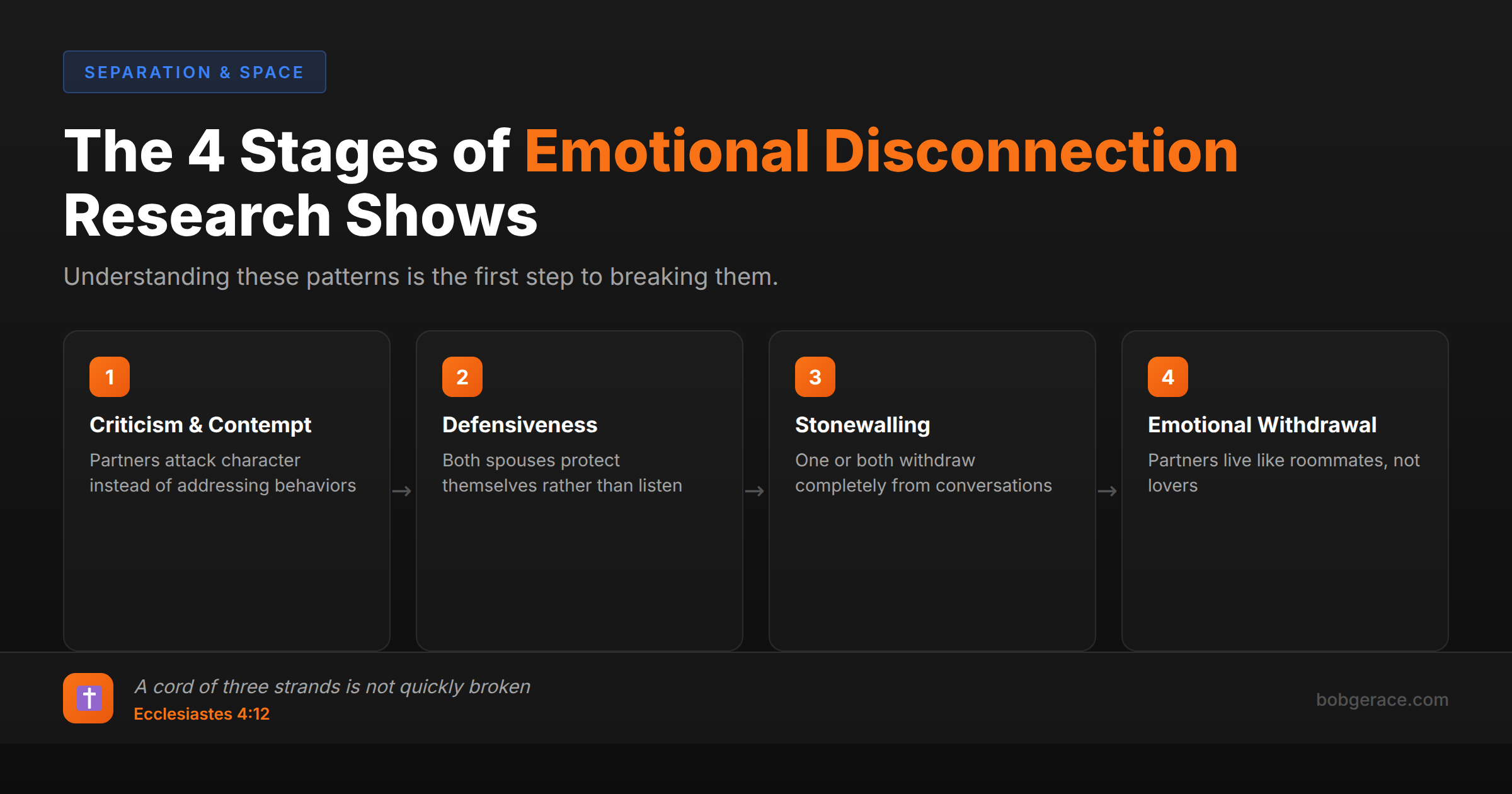
Research consistently shows that emotional disconnection follows predictable patterns in marriages. Studies by Dr. John Gottman and others reveal that disconnection typically begins with criticism and contempt, escalates through defensiveness and stonewalling, and culminates in emotional withdrawal. The research is clear: couples who experience chronic disconnection show measurable changes in stress hormones, communication patterns, and neural responses to their partner. What's encouraging is that research also shows these patterns are reversible. Studies on emotionally focused therapy (EFT) demonstrate 70-73% success rates in helping couples reconnect. The key finding is that disconnection isn't a character flaw—it's a protective response that can be understood and healed with the right approach.
The Full Picture
The research on emotional disconnection is both sobering and hopeful. Dr. John Gottman's longitudinal studies, spanning over 40 years and involving thousands of couples, have mapped the precise trajectory of how marriages move from connection to disconnection.
The Four Horsemen Pattern is well-documented: criticism leads to contempt, which triggers defensiveness, ultimately resulting in stonewalling. But here's what most people miss—disconnection isn't the end stage. Research shows there's actually a fifth stage: emotional numbing, where partners develop what researchers call "parallel lives syndrome."
Studies using neuroimaging reveal that when shown photos of their disconnected spouse, participants show decreased activity in the brain's reward centers—the same areas that light up when viewing strangers. This isn't just "falling out of love"—it's measurable neurological change.
Attachment theory research adds another crucial layer. Adults with secure attachment styles show greater resilience to temporary disconnection, while those with anxious or avoidant styles are more vulnerable to chronic patterns. Dr. Sue Johnson's research on Emotionally Focused Therapy demonstrates that even deeply disconnected couples can rewire these attachment patterns.
The timeline matters too. Research indicates that couples typically experience 6 years of increasing disconnection before seeking help. Those who intervene earlier show significantly better outcomes. Studies also reveal that women typically recognize disconnection 18-24 months before men do, creating additional relationship strain.
Most encouragingly, recovery research shows that couples who successfully reconnect often report stronger marriages than before their disconnection crisis. This "post-traumatic growth" phenomenon suggests that working through disconnection can actually deepen intimacy when approached correctly.
What's Really Happening
From a clinical perspective, emotional disconnection is fundamentally a trauma response—and understanding this changes everything about how we approach recovery.
When couples come to my office describing feeling like "roommates," their nervous systems are actually doing exactly what they're designed to do: protect them from further emotional injury. Research on polyvagal theory shows that chronic relationship stress triggers our autonomic nervous system into protective modes—fight, flight, or freeze.
Here's what's happening neurologically: Repeated negative interactions create what we call "negative sentiment override." The brain begins interpreting even neutral behaviors from your spouse as threats. Brain scans show increased amygdala activation (fear center) and decreased prefrontal cortex activity (rational thinking) when disconnected partners interact.
The research on emotional labor is particularly revealing. Studies show that in disconnected marriages, partners often maintain functional cooperation while experiencing profound emotional isolation. They can discuss schedules, manage households, even maintain physical intimacy, while feeling completely unknown by their spouse.
Attachment injuries play a crucial role. These are moments when one partner fails to respond during a critical time of need—during illness, job loss, family crisis, or major life transitions. Research shows that unresolved attachment injuries create lasting disconnection patterns that persist even when surface-level conflicts are resolved.
The good news is that neuroplasticity research demonstrates our brains can rewire at any age. When couples engage in positive interactions consistently over time, we see measurable changes in neural pathways. The key is understanding that reconnection isn't just about changing behaviors—it's about rewiring nervous systems that have learned to perceive safety in distance rather than closeness.
What Scripture Says
Scripture speaks directly to the patterns of disconnection that research has now documented scientifically. God's design for marriage assumes connection will require intentional effort and spiritual wisdom.
Ecclesiastes 4:12 reminds us, "A cord of three strands is not quickly broken." Research confirms this—marriages with shared spiritual practices show greater resilience to disconnection. When couples pray together, read Scripture together, and worship together, they create neural pathways that support emotional bonding.
1 Peter 3:7 instructs husbands to live with their wives "according to knowledge," which aligns perfectly with attachment research showing that emotional safety requires understanding your spouse's inner world. The verse continues, "showing honor to the woman as the weaker vessel, since they are heirs with you of the grace of life, so that your prayers may not be hindered." Notice the connection—relational disconnection affects our spiritual connection with God.
Ephesians 4:26-27 provides crucial insight: "Be angry and do not sin; do not let the sun go down on your anger, and give no opportunity to the devil." Research on relationship repair shows that couples who address hurts quickly prevent the accumulation of emotional wounds that lead to disconnection. Unresolved anger literally gives the enemy a foothold in marriages.
James 1:19 offers the antidote to Gottman's "Four Horsemen": "Let every person be quick to hear, slow to speak, slow to anger." This isn't just good advice—it's a prescription for nervous system regulation that prevents defensive cycles.
Malachi 2:16 declares God's heart: "For the man who does not love his wife but divorces her, says the Lord, the God of Israel, covers his garment with violence." God sees disconnection and divorce as violence against His design. He's not condemning struggling couples—He's revealing how seriously He takes the covenant bond and His commitment to healing it.
What To Do Right Now
-
1
Track your disconnection pattern - For one week, notice when you feel emotionally distant and what triggers preceded it. Research shows awareness is the first step to changing automatic responses.
-
2
Practice the 6-second rule - When you feel defensive or want to withdraw, count to six. Neurological research shows this is how long it takes for stress hormones to begin subsiding.
-
3
Implement daily check-ins - Spend 10 minutes each day sharing one positive thing and one concern. Studies show this simple practice increases emotional intimacy within 30 days.
-
4
Address attachment injuries - Identify any unresolved hurts from times when your spouse wasn't emotionally available during crisis. Research shows these must be processed for reconnection to occur.
-
5
Create new positive experiences - Plan one novel, enjoyable activity together weekly. Neuroplasticity research shows new experiences together create new neural pathways that support bonding.
-
6
Seek professional guidance - If disconnection has persisted over 18 months, research strongly supports the effectiveness of couples therapy, particularly Emotionally Focused Therapy approaches.
Related Questions
- What is 'emotional disengagement'?
- What's the difference between conflict and disengagement?
- What are Gottman's signs of 'turning away'?
- What is the 'pursuer-distancer' dynamic?
- What is 'flooded' and did she shut down because of it?
- What's the difference between her being withdrawn and being done?
- She won't talk about our problems
- She shuts down when I try to connect
- What is 'accumulated resentment'?
- What does real transformation look like?
Also find Bob on
Subscribe for weekly videos on Christian marriage.
Ready to apply this to your marriage?
Research tells you the pattern. A coach helps you see where you are in it—and what to do next in your specific situation.
Talk to Bob →