What did I learn about love from my parents?
6 min read
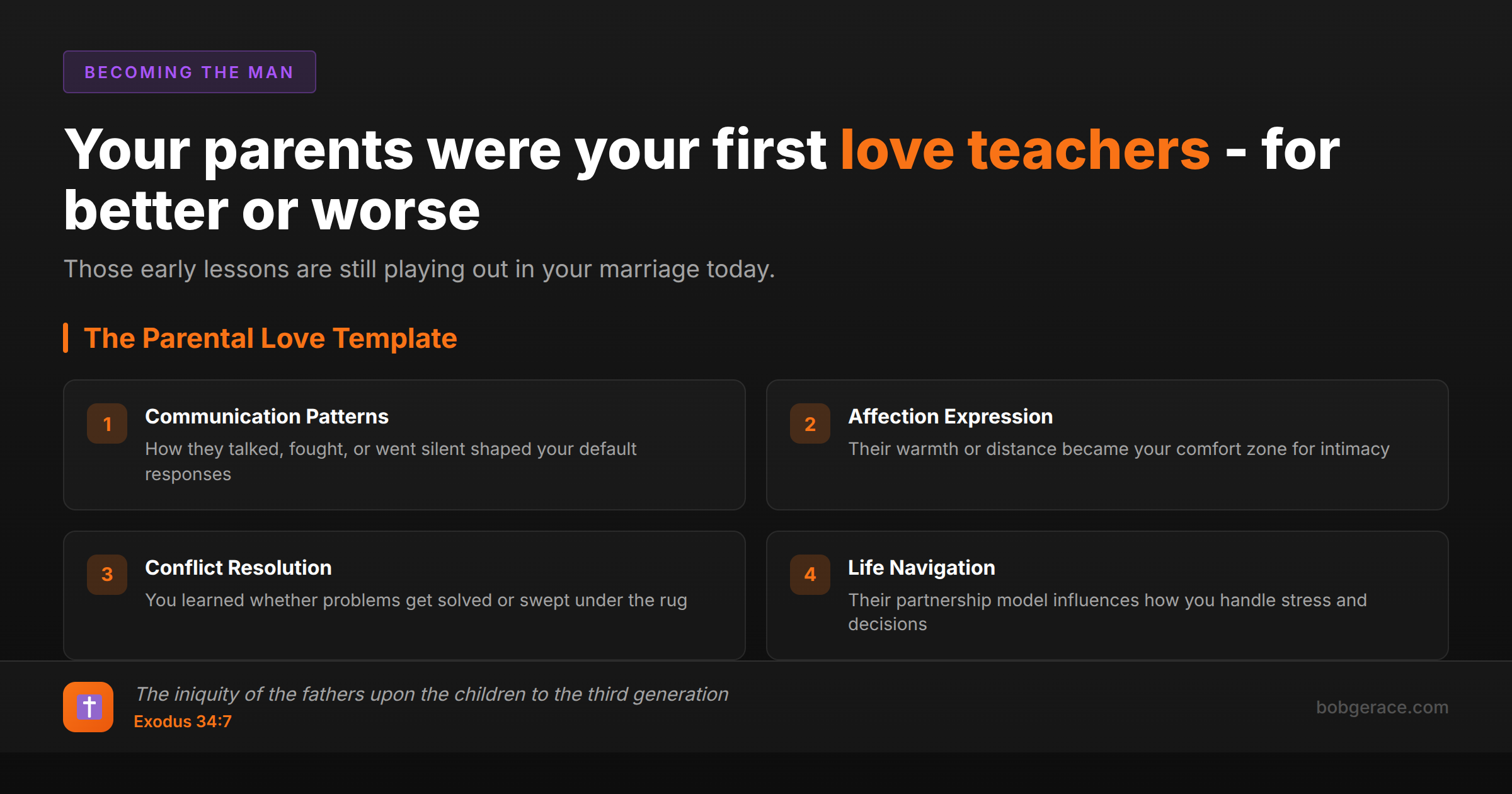
Your parents were your first teachers about love, intimacy, and relationships. Whether they demonstrated healthy connection or struggled with conflict, neglect, or distance, their marriage became your template for what love 'looks like.' You absorbed lessons about how partners communicate, resolve conflict, show affection, and navigate life together - often without realizing it. This isn't about blame or excuses. It's about understanding the automatic patterns you brought into your marriage. Maybe you learned that love means constant fighting, emotional distance, or conditional approval. Maybe you saw beautiful examples of grace and commitment. Either way, these early lessons are still playing out in your relationship today, influencing how you respond to stress, conflict, and intimacy with your spouse.
The Full Picture
Your childhood home was like a laboratory where you conducted thousands of experiments about human connection. You watched how your parents handled disagreement - did they fight loudly, give silent treatment, or work through issues respectfully? You observed how they showed affection - through words, touch, acts of service, or maybe they rarely demonstrated love at all.
The lessons went deeper than you realized. You learned whether it was safe to be vulnerable, whether your needs mattered, and whether love was conditional on performance. If Mom withdrew when angry, you might have learned that conflict threatens connection. If Dad was emotionally unavailable, you might struggle with intimacy today. If they constantly criticized each other, you may have internalized that criticism as normal in relationships.
But here's what's crucial to understand: You didn't just observe these patterns - you developed coping strategies around them. Maybe you became the peacemaker, trying to prevent conflict. Maybe you learned to be invisible to avoid triggering anger. Maybe you became controlling to create the security you didn't feel as a child.
These aren't character flaws - they were survival strategies. A child who mediates their parents' fights isn't weak; they're adapting to their environment. But what helped you survive childhood might be sabotaging your marriage now. The hypervigilance that protected you then might make you defensive with your spouse. The emotional walls that shielded you from disappointment might be blocking intimacy today.
Understanding your attachment history isn't about excusing destructive behavior or staying stuck in the past. It's about recognizing the unconscious patterns driving your responses so you can make conscious choices instead. When you understand why you react certain ways, you can start responding differently.
What's Really Happening
Attachment theory reveals how our earliest relationships create internal working models - unconscious blueprints that guide our expectations and behaviors in intimate relationships. These models operate automatically, below conscious awareness, influencing everything from how we interpret our spouse's actions to how we respond during conflict.
If you experienced secure attachment - consistent, responsive caregiving - you likely developed confidence that relationships are safe and that you're worthy of love. This translates into better communication, emotional regulation, and conflict resolution in marriage. However, if your attachment was insecure - whether due to inconsistent caregiving, emotional neglect, or chaotic family dynamics - you may struggle with trust, intimacy, or emotional stability in your marriage.
Insecure attachment manifests in predictable patterns: anxious attachment leads to fear of abandonment and relationship hypervigilance; avoidant attachment results in emotional distance and discomfort with intimacy; disorganized attachment creates unpredictable responses and difficulty regulating emotions. These aren't permanent sentences - they're starting points for healing.
Neuroplasticity research shows our brains remain changeable throughout life. While early attachment experiences are powerful, they're not deterministic. Through awareness, intentional practice, and often therapeutic intervention, you can develop what we call 'earned secure attachment' - learning to create the safety and connection you may not have experienced in childhood. The key is recognizing these patterns without shame, understanding their protective function, and gradually developing new neural pathways through healthier relational experiences.
What Scripture Says
Scripture acknowledges the profound impact of generational patterns while offering hope for transformation. Exodus 34:7 warns that 'the iniquity of the fathers' can be visited 'upon the children and the children's children, to the third and the fourth generation.' This isn't about divine punishment - it's recognizing how destructive patterns naturally perpetuate through families when left unaddressed.
But God's heart is redemption and restoration. Ezekiel 36:26 promises: 'I will give you a new heart and put a new spirit in you; I will remove from you your heart of stone and give you a heart of flesh.' This transformation is possible because we serve a God who specializes in healing what's been broken and renewing what's been damaged.
2 Corinthians 5:17 declares that 'if anyone is in Christ, the new creation has come: The old has gone, the new is here!' Your identity isn't defined by your parents' failures or your childhood wounds. Through Christ, you can develop new patterns of relating that reflect God's design for marriage.
Ephesians 4:22-24 provides the roadmap: 'You were taught, with regard to your former way of life, to put off your old self... to be made new in the attitude of your minds; and to put on the new self, created to be like God in true righteousness and holiness.' This involves recognizing old patterns, allowing God to renew your thinking, and practicing new behaviors.
Philippians 4:13 reminds us that 'I can do all this through him who gives me strength.' The same power that raised Christ from the dead is available to transform your marriage patterns. Romans 12:2 calls us to 'be transformed by the renewing of your mind' - exactly what happens when we identify unhealthy attachment patterns and replace them with God's design for love and connection.
What To Do Right Now
-
1
Write down three specific patterns you observed in your parents' marriage - both positive and negative examples of how they handled conflict, affection, and daily life together.
-
2
Identify which of these patterns you're currently repeating in your own marriage, asking your spouse for their honest perspective on what they observe.
-
3
Choose one destructive pattern to focus on changing and discuss it openly with your spouse, explaining its origin and asking for their patience as you work to change.
-
4
Develop a specific trigger plan for when this pattern emerges - what will you say or do differently when you notice yourself falling into old responses?
-
5
Practice one new, healthier response this week when faced with a situation that typically triggers your old pattern, even if it feels awkward initially.
-
6
Pray daily for God to heal generational patterns and give you wisdom to create new, godly patterns in your marriage that will bless future generations.
Related Questions
Ready to Break Free From Old Patterns?
Understanding your attachment history is just the beginning. Let's work together to transform these insights into lasting change in your marriage.
Start Healing →