How do childhood attachment wounds show up in marriage?
6 min read
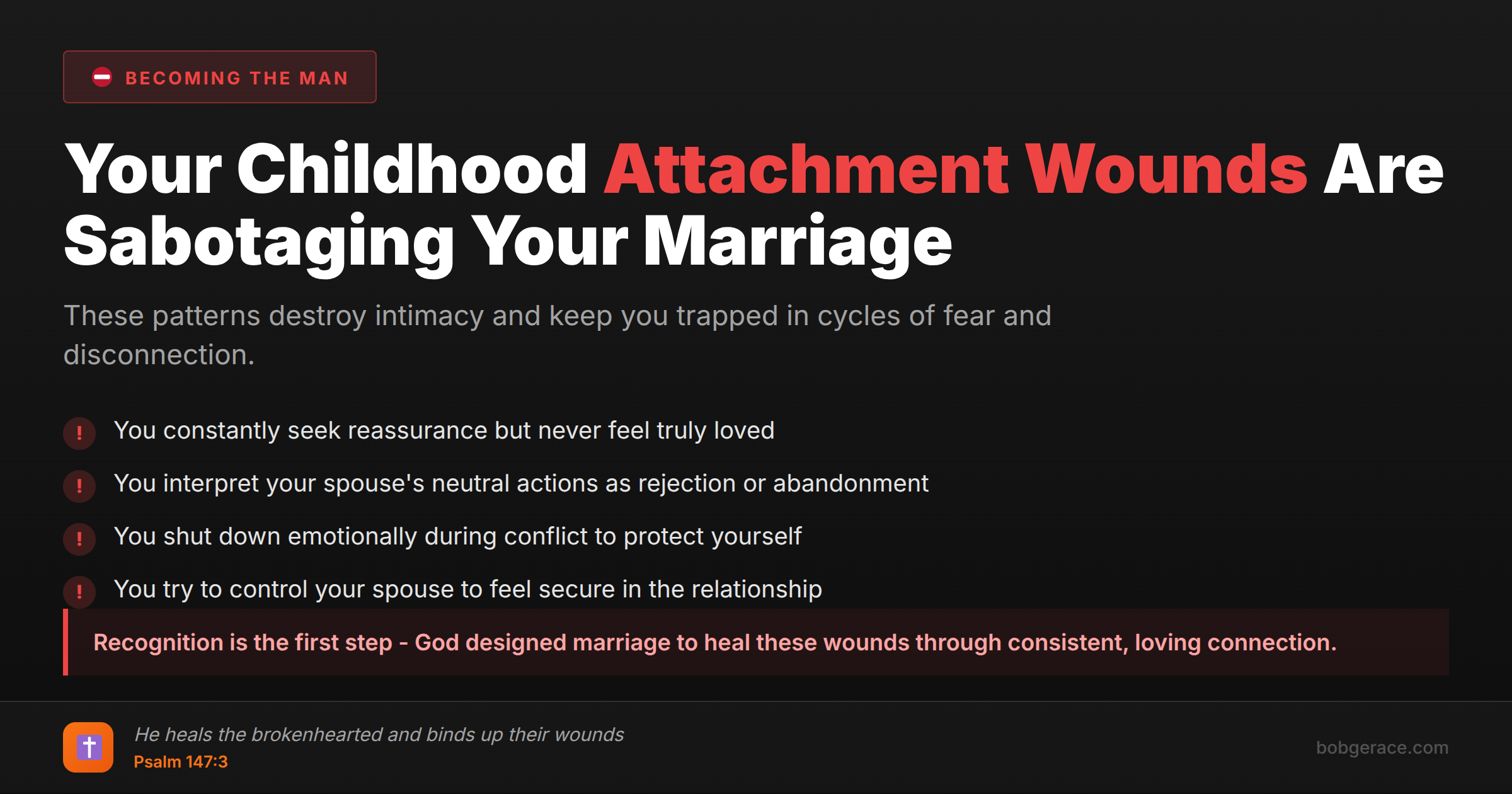
Childhood attachment wounds create predictable patterns in marriage that often sabotage intimacy. If you experienced inconsistent caregiving, abandonment, or emotional neglect as a child, you'll likely struggle with trust, emotional regulation, and connecting deeply with your spouse. These wounds show up as fear of abandonment, difficulty trusting your partner's love, emotional withdrawal when conflict arises, or desperate attempts to control your spouse to feel secure. You might find yourself constantly seeking reassurance, interpreting neutral actions as rejection, or shutting down emotionally to protect yourself from perceived threats. The good news is that recognizing these patterns is the first step toward healing, and God designed marriage as a place where old wounds can be transformed through consistent, loving connection.
The Full Picture
Your childhood attachment experiences literally shaped your brain's wiring for relationships. If your caregivers were consistently available, responsive, and emotionally attuned, you developed secure attachment - the ability to trust, communicate openly, and maintain emotional balance during conflict.
But if your early relationships were marked by inconsistency, emotional unavailability, neglect, or trauma, you developed insecure attachment patterns as survival mechanisms. These aren't character flaws - they're adaptive strategies your young brain created to cope with an unpredictable or unsafe environment.
Anxious attachment develops when caregivers are inconsistent. You learned to become hypervigilant about relationships, constantly scanning for signs of rejection or abandonment. In marriage, this shows up as excessive need for reassurance, jealousy, fear of your spouse leaving, and emotional reactivity during conflicts.
Avoidant attachment forms when caregivers are emotionally distant or rejecting. You learned that depending on others leads to disappointment, so you became self-reliant and emotionally guarded. In marriage, this manifests as difficulty with vulnerability, tendency to minimize problems, withdrawal during conflict, and struggle to express emotional needs.
Disorganized attachment results from traumatic or chaotic early experiences. You simultaneously crave and fear closeness, creating a push-pull dynamic in marriage where you desperately want connection but sabotage it when it becomes available.
These patterns don't disappear at the altar. They're activated most intensely in marriage because your spouse becomes your primary attachment figure - the person your nervous system looks to for safety and security.
What's Really Happening
From a clinical perspective, attachment wounds create what we call 'implicit memories' - emotional and bodily responses that occur below conscious awareness. When your spouse says or does something that unconsciously reminds your nervous system of early wounding, you experience what feels like a current threat, even when your spouse poses no actual danger.
This is why attachment-wounded individuals often have reactions that seem disproportionate to the situation. Your spouse forgets to call, and you feel abandoned. They need space, and you experience rejection. They disagree with you, and you feel unsafe. Your nervous system is responding to past wounding, not present reality.
The key insight is that these responses happen in the limbic brain - your emotional center - which processes information much faster than your prefrontal cortex where logic and reasoning occur. By the time you're consciously aware of your reaction, your nervous system has already flooded with stress hormones and activated fight, flight, or freeze responses.
Healing requires creating new neural pathways through consistent, secure experiences with your spouse. This happens through what we call 'corrective emotional experiences' - moments when your attachment system expects rejection or abandonment, but instead receives safety and attunement. Over time, these positive interactions literally rewire your brain for secure attachment.
The process requires both partners to understand these dynamics and work together to create safety, rather than inadvertently triggering each other's wounds.
What Scripture Says
God understands the profound impact of early wounding on our ability to trust and connect. Scripture acknowledges that 'the fathers have eaten sour grapes, and the children's teeth are set on edge' (Jeremiah 31:29) - recognizing how one generation's wounds affect the next.
Yet God's heart is always toward healing: 'He heals the brokenhearted and binds up their wounds' (Psalm 147:3). Your attachment wounds don't disqualify you from experiencing deep intimacy - they're precisely what God wants to heal through covenant love.
'Perfect love casts out fear' (1 John 4:18) speaks directly to attachment healing. When you experience unconditional love - both from God and your spouse - it gradually dissolves the fear-based patterns that developed in childhood. Your marriage becomes a laboratory for experiencing the kind of love that transforms.
God also calls us to vulnerability in relationships: 'Above all else, guard your heart, for everything you do flows from it' (Proverbs 4:23). This isn't about building walls, but about stewarding your heart wisely - learning to trust again while maintaining healthy boundaries.
'Bear one another's burdens, and so fulfill the law of Christ' (Galatians 6:2) reminds us that healing happens in relationship. Your spouse isn't responsible for healing your wounds, but they can provide a safe space where healing occurs.
Finally, 'He who began a good work in you will carry it on to completion' (Philippians 1:6) offers hope that God is actively working to restore what was broken in your early years through the very relationship that triggers those old wounds most intensely.
What To Do Right Now
-
1
Map your triggers: Identify specific situations with your spouse that create disproportionate emotional reactions, then ask what childhood experience this reminds you of
-
2
Communicate your wounds: Share your attachment history with your spouse, explaining how past experiences affect your present reactions without making them responsible for managing your triggers
-
3
Practice self-soothing: Develop techniques to calm your nervous system when triggered - deep breathing, prayer, or taking a brief break before responding
-
4
Create safety rituals: Establish predictable ways you and your spouse reassure each other, especially during conflict or stress
-
5
Challenge negative interpretations: When you assume the worst about your spouse's motives, pause and ask for clarification rather than reacting from old wounds
-
6
Seek professional help: Consider working with a therapist trained in attachment theory to process childhood trauma and develop healthier relational patterns
Related Questions
- What attachment style did I develop in childhood?
- What attachment injuries did I experience?
- What is 'internal working model' and how do I change mine?
- What did I learn about love from my parents?
- What didn't I receive that I'm still looking for?
- Can adult attachment patterns change?
- What is 'attachment injury' and did I cause one?
- What are 'attachment injuries' and how many did I cause?
- What is 'primal panic' and is that what she's been feeling?
Also find Bob on
Subscribe for weekly videos on Christian marriage.
Your Patterns Need a Human Eye
Attachment wounds don't show up the same way in every marriage. A coach who knows your specific story can see what you can't see alone and help you stop repeating what doesn't work.
Talk to Bob →