What is 'internal working model' and how do I change mine?
6 min read
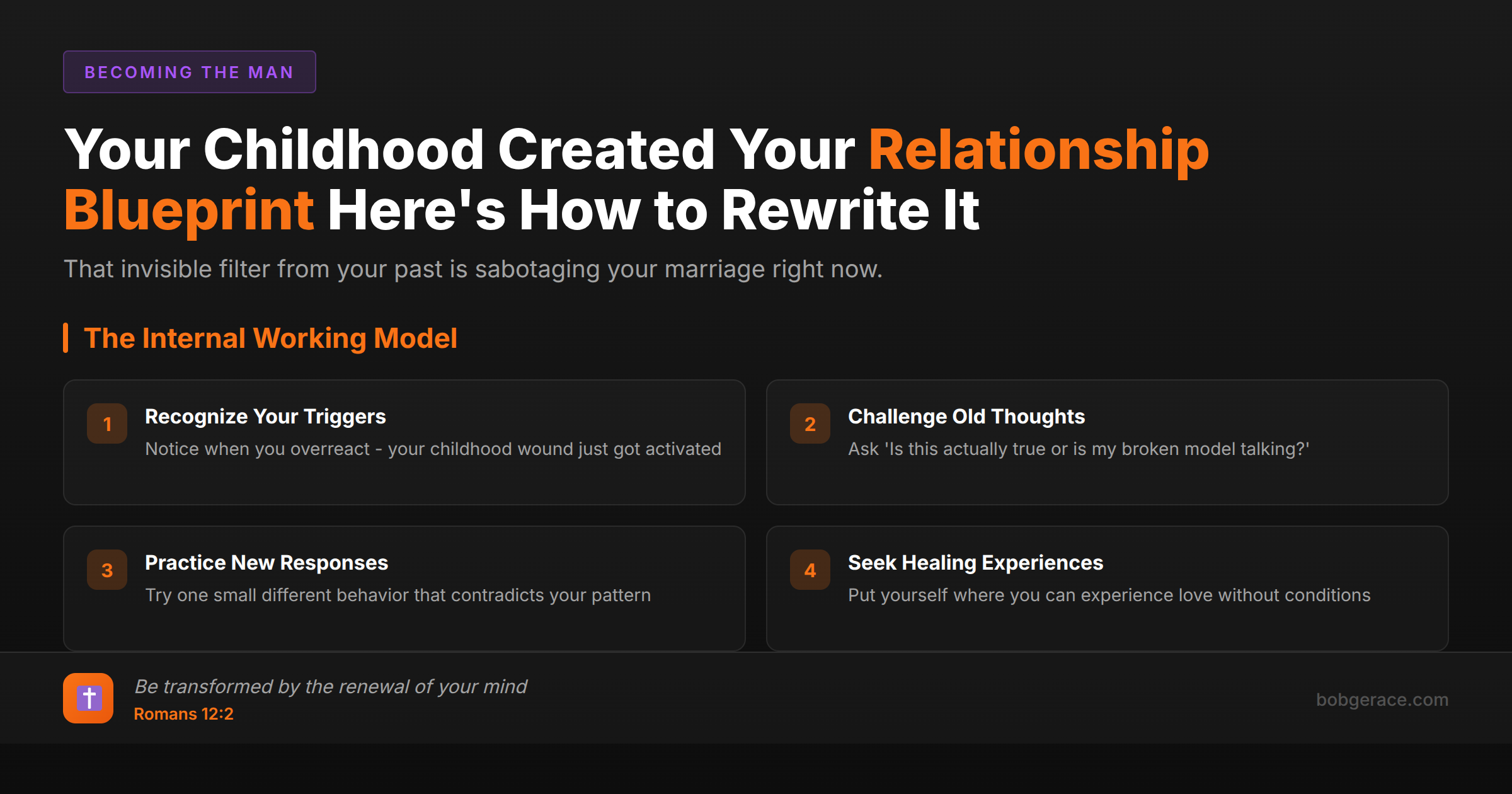
Your internal working model is the unconscious blueprint you formed in childhood about how relationships work—what to expect from others and how loveable you are. It's like having an invisible filter that shapes every interaction with your spouse. If your early experiences taught you that people leave, you might push your spouse away or cling desperately. If you learned love comes with conditions, you might perform constantly or withdraw when imperfect. Changing your internal working model requires intentional rewiring through new experiences. You can't just think your way out—you need repeated positive interactions that contradict your old beliefs. This happens through secure relationships, therapy, and allowing God's truth to transform your core beliefs about yourself and others.
The Full Picture
Think of your internal working model as the operating system running in the background of your marriage. Just like your phone's OS determines how apps function, your internal working model determines how you interpret your spouse's actions, what you expect from them, and how you respond when things get difficult.
Your model was formed early. Between birth and age 5, your brain was frantically trying to figure out: "Am I safe? Am I loved? Can I count on others?" The answers you unconsciously formed became your template for all future relationships.
Maybe your parents were emotionally unavailable, so you learned "people who matter will let you down." Now when your spouse seems distant, you don't just feel hurt—you feel the terror of abandonment. Or perhaps love in your home came with strings attached, so you believe "I'm only valuable when I'm perfect." Now you exhaust yourself trying to be the ideal spouse.
These models operate automatically. You don't consciously decide to interpret your spouse's tired silence as rejection—it just happens. You don't choose to feel panic when they're late coming home—your nervous system reacts based on old programming.
The good news? These models can change. Your brain maintains neuroplasticity throughout life. Through consistent new experiences that contradict old beliefs, you can literally rewire your expectations about relationships. It's not easy—these patterns run deep—but it's absolutely possible with intentional effort and often professional help.
What's Really Happening
Internal working models are essentially encoded predictions your brain makes about relationships based on early attachment experiences. From a neurobiological perspective, these models become part of your implicit memory—they operate below conscious awareness but powerfully influence behavior.
When your internal working model was formed through inconsistent or harmful caregiving, your nervous system learned to expect danger in intimate relationships. This creates what we call "attachment injuries"—deep wounds that get triggered in marriage when situations remind your brain of early threats to connection.
The key to changing these models lies in understanding that they were adaptive strategies that helped you survive childhood, but may now be sabotaging your marriage. Your brain formed these patterns to protect you, so approaching change with self-compassion rather than judgment is crucial.
Transformation happens through "corrective emotional experiences"—repeated interactions that provide evidence contradicting your old beliefs. This might mean learning to stay present during conflict instead of shutting down, or practicing receiving love without performing for it. Professional therapy often provides a safe laboratory for this rewiring process, where you can experience secure attachment with your therapist before transferring those skills to your marriage.
What Scripture Says
Scripture acknowledges that our early experiences shape us profoundly, but it also promises transformation is possible. Romans 12:2 calls us to "be transformed by the renewal of your mind," recognizing that change happens as we replace old thought patterns with God's truth.
2 Corinthians 5:17 reminds us that "if anyone is in Christ, he is a new creation. The old has passed away; behold, the new has come." Your internal working model based on broken human relationships doesn't have to define you—you have a new identity in Christ.
Psalm 139:13-16 reveals that God knew you before you were born and has good plans for you. When your internal working model whispers lies about your worth or lovability, Scripture counters with the truth of your inherent value as God's beloved child.
1 John 4:18 teaches that "perfect love casts out fear." Many destructive internal working models are rooted in fear—fear of abandonment, rejection, or not being enough. As you experience God's perfect love and allow it to flow through your marriage, these fears lose their power.
Isaiah 43:18-19 encourages us: "Remember not the former things, nor consider the things of old. Behold, I am doing a new thing; now it springs forth, do you not perceive it?" God specializes in creating new patterns where old ones have failed.
Transformation requires both divine intervention and human cooperation—God's grace working through intentional effort on your part.
What To Do Right Now
-
1
Identify your triggers - Notice when you react disproportionately to your spouse's behavior and ask what childhood wound might be activated
-
2
Challenge automatic thoughts - When you feel rejected or unloved, pause and ask 'Is this actually true or is my old model talking?'
-
3
Practice new responses - Instead of your default reaction, try one small different behavior that contradicts your old pattern
-
4
Seek corrective experiences - Intentionally put yourself in situations where you can experience security and acceptance
-
5
Consider professional help - A skilled therapist can provide the safe relationship needed to heal deep attachment wounds
-
6
Root yourself in Scripture - Regularly meditate on verses that speak truth about your identity and God's love for you
Related Questions
- What attachment style did I develop in childhood?
- What is 'earned secure' vs. 'earned insecure'?
- What attachment injuries did I experience?
- How do childhood attachment wounds show up in marriage?
- Can adult attachment patterns change?
- What did I learn about love from my parents?
- What is 'attachment injury' and did I cause one?
- What does secure attachment behavior look like in him?
- How would his attachment style shift if he's changing?
- What are 'attachment injuries' and how many did I cause?
Also find Bob on
Subscribe for weekly videos on Christian marriage.
Your Marriage Isn't a Theory Problem
Rewiring your internal working model means doing different things in your actual relationship—with someone who knows your story and can see what you can't. Bob works with guys one-on-one to make this real.
Talk to Bob →