How do I rewire trauma responses?
5 min read
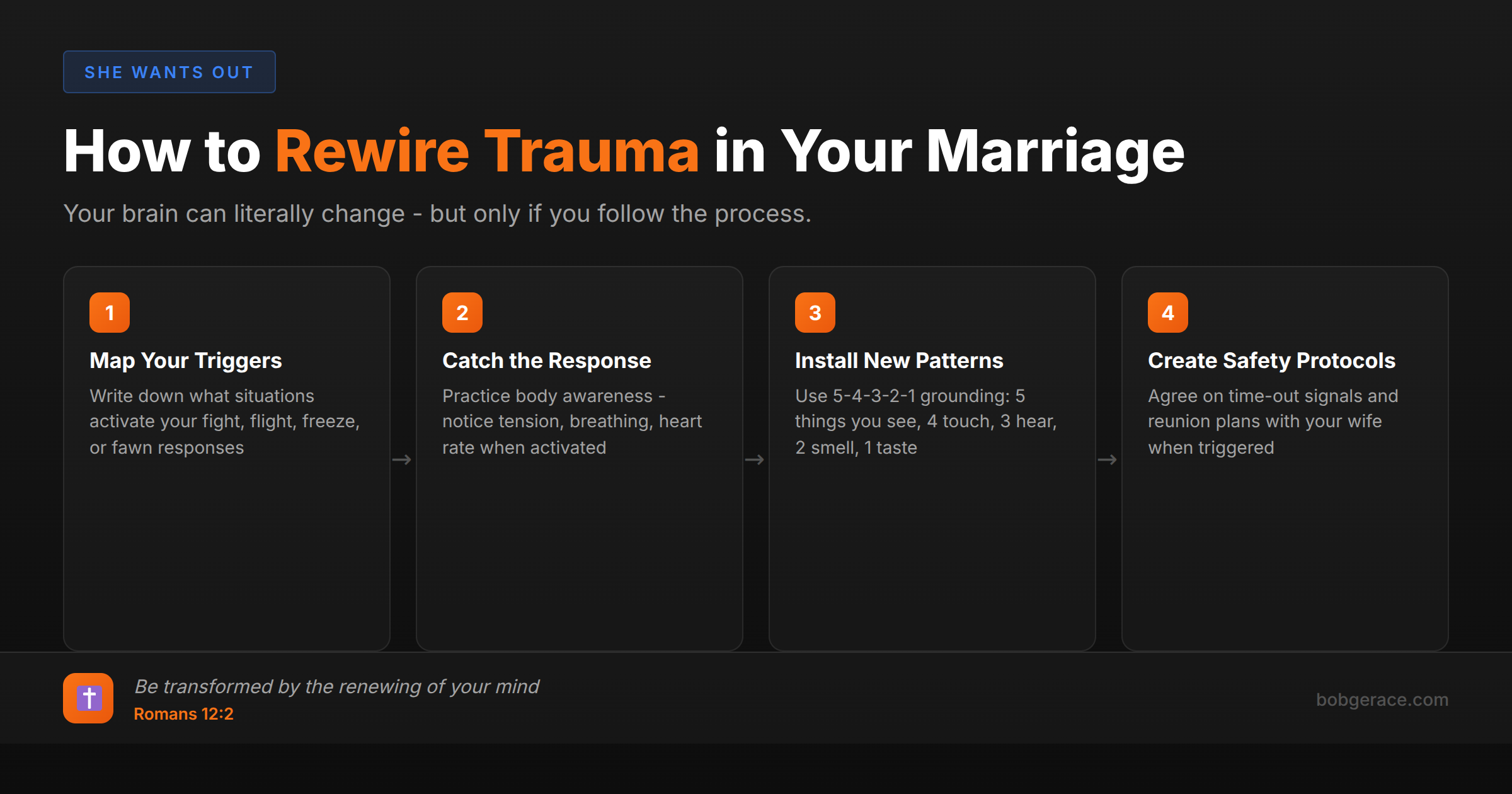
Rewiring trauma responses requires understanding that your brain literally changes through repeated new experiences. The neural pathways that fire during trauma reactions - whether fight, flight, freeze, or fawn - were carved deep by painful experiences, but they're not permanent highways. They're more like walking paths that can be redirected through consistent, intentional practice. The key is catching yourself in the moment when trauma responses activate, then consciously choosing a different response. This isn't about willpower alone - it's about creating new neural networks through practices like grounding techniques, somatic awareness, and cognitive restructuring. Your marriage depends on this work because trauma responses often hijack your ability to connect, communicate, and show up as the husband your wife needs.
The Full Picture
Trauma responses aren't character flaws - they're survival mechanisms gone haywire. When your nervous system perceives threat (real or imagined), it activates ancient protective patterns: fighting (anger, aggression), fleeing (withdrawal, workaholism), freezing (shutdown, numbness), or fawning (people-pleasing, self-abandonment).
In marriage, these responses often misfire. Your wife's frustrated tone triggers your abandonment wound, launching you into defensive anger. Her need for space activates your attachment trauma, causing you to pursue harder. The cruel irony is that the behaviors designed to protect you often push away the person you most want to keep close.
Neuroplasticity is your secret weapon. Your brain remains changeable throughout life. Every time you choose a different response, you strengthen new neural pathways while weakening old ones. But here's what most men get wrong: they try to think their way out of trauma responses.
Trauma lives in the body, not just the mind. Those split-second reactions happen in your limbic system before your rational brain comes online. This is why breathing techniques, progressive muscle relaxation, and body awareness are crucial. You have to work with your nervous system, not against it.
Common mistakes include: expecting instant results, trying to eliminate all emotional responses, working alone when professional help is needed, and focusing only on symptoms while ignoring root causes. The process requires patience, self-compassion, and often therapeutic support to address underlying wounds safely.
What's Really Happening
From a clinical perspective, trauma responses involve dysregulation of the autonomic nervous system, particularly the sympathetic (fight/flight) and dorsal vagal (freeze/collapse) branches. When triggered, the amygdala hijacks rational thought processes, flooding the system with stress hormones like cortisol and adrenaline.
Polyvagal Theory helps us understand that healing happens through co-regulation first, then self-regulation. This is why therapeutic relationships and secure attachments are crucial for rewiring. The nervous system learns safety through repeated experiences of attunement and repair.
Trauma-informed approaches like EMDR, somatic therapy, and Internal Family Systems work because they address the implicit memories stored in subcortical brain regions. These methods bypass the rational mind to work directly with the nervous system's threat detection and safety systems.
Window of tolerance is a key concept - that zone where you can experience emotions without becoming overwhelmed or shutting down. Therapeutic work gradually expands this window through titrated exposure to triggering material while maintaining nervous system regulation.
Neuroplasticity research confirms that consistent practice literally rewires neural networks. Studies show measurable brain changes in trauma survivors who engage in mindfulness practices, therapy, and somatic interventions. The key is repetition over time - single insights rarely create lasting change, but repeated corrective experiences do.
In marriage therapy, we often see trauma responses create negative cycles where each partner's activation triggers the other's. Breaking these cycles requires both individual trauma work and couples interventions that create new experiences of safety and connection.
What Scripture Says
God's design for healing acknowledges both the reality of our wounds and His power to transform us. Romans 12:2 reminds us: 'Do not conform to the pattern of this world, but be transformed by the renewing of your mind.' This 'renewing' (Greek: anakainosis) implies an ongoing process of reconstruction - exactly what neuroplasticity describes scientifically.
Psalm 147:3 declares: 'He heals the brokenhearted and binds up their wounds.' God doesn't minimize trauma or tell us to 'get over it.' He acknowledges our wounds and promises healing. This healing often comes through His people, His word, and the natural processes He built into our brains and bodies.
2 Corinthians 1:3-4 shows us purpose in our pain: 'The Father of compassion and the God of all comfort, who comforts us in all our troubles, so that we can comfort those in any trouble.' Your healing journey equips you to help others, including your wife who may carry her own wounds.
Isaiah 61:3 promises 'beauty instead of ashes, the oil of joy instead of mourning.' This isn't denial of pain but transformation through it. Philippians 1:6 assures us: 'He who began a good work in you will carry it on to completion.' God is committed to your healing process.
James 1:4 teaches patience with the process: 'Let perseverance finish its work so that you may be mature and complete.' Rewiring trauma responses takes time, and God honors that journey. Finally, Galatians 6:2 reminds us to 'carry each other's burdens' - healing often happens in community, not isolation.
What To Do Right Now
-
1
Map your triggers by writing down the specific situations, words, or behaviors that activate your trauma responses this week
-
2
Practice the 5-4-3-2-1 grounding technique daily: name 5 things you see, 4 you can touch, 3 you hear, 2 you smell, 1 you taste
-
3
Install a body awareness pause before reacting - take three deep breaths and scan your body for tension when you feel activated
-
4
Create a trauma response protocol with your wife - agree on a time-out signal and reunion plan when you're triggered
-
5
Begin daily meditation or prayer practice for 10 minutes to strengthen your prefrontal cortex and nervous system regulation
-
6
Schedule consultation with a trauma-informed therapist who uses somatic or EMDR approaches to address root causes professionally
Related Questions
- What is 'white-knuckling' vs. real transformation?
- Why do old patterns come back when I'm triggered?
- What is 'neuroplasticity' and how do I leverage it?
- How long until new behaviors become automatic?
- What role does sleep/exercise/nutrition play in change capacity?
- What are the 'stages of change' and where am I?
- What is 'window of tolerance' and how do I widen mine?
- What does chronic anger do to my nervous system?
- What does trauma recovery look like?
Also find Bob on
Subscribe for weekly videos on Christian marriage.
You Don't Have to Rewire This Alone
A coach who knows your specific story can see what's triggering you, calibrate the work to your marriage, and stay in your corner when the old wiring fires hard.
Talk to Bob →