What are the 'stages of change' and where am I?
5 min read
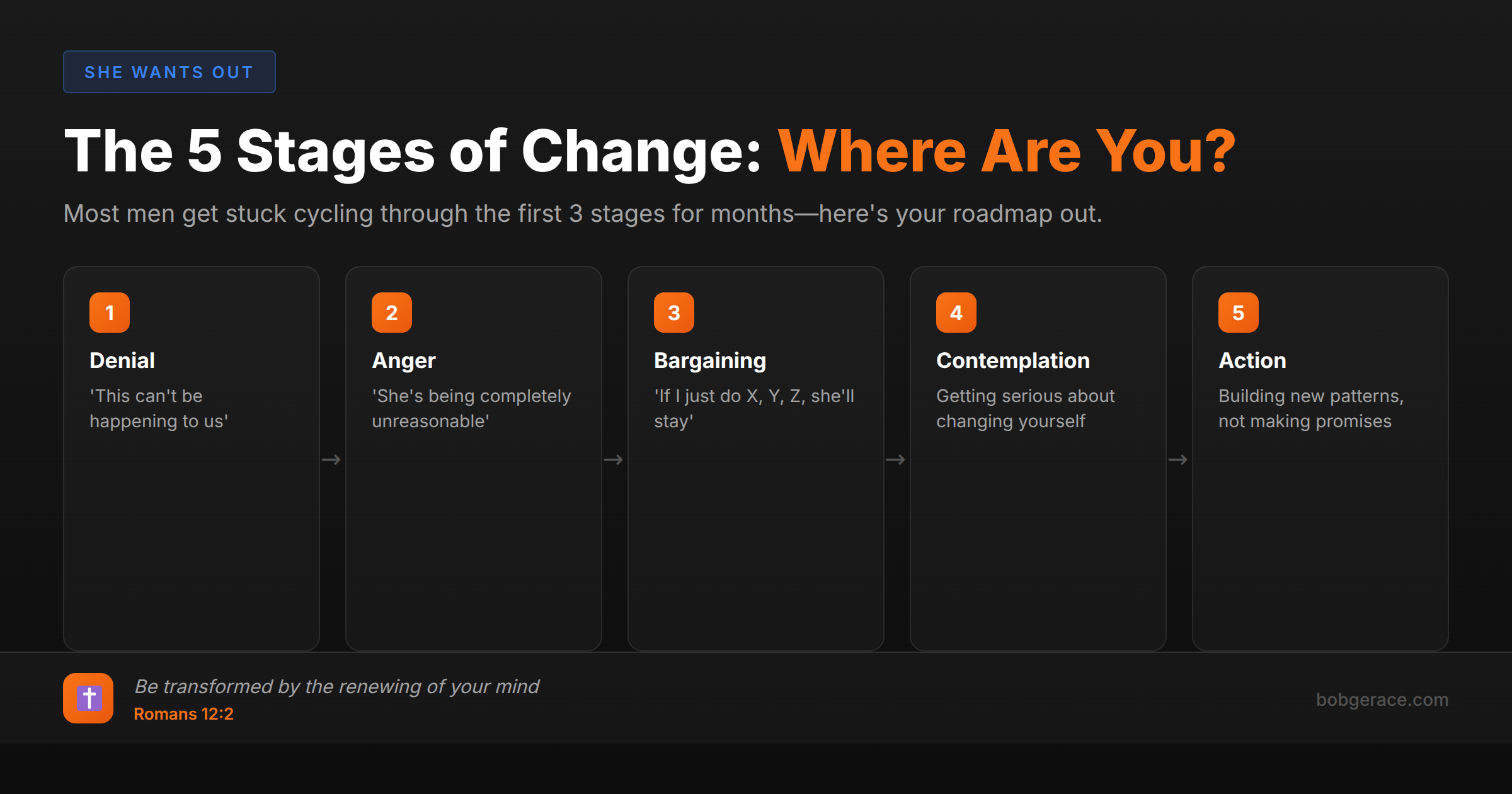
The stages of change aren't just psychology theory—they're your roadmap out of this crisis. You're likely bouncing between denial ('this can't be happening'), anger ('she's being unreasonable'), and bargaining ('if I just do X, Y, Z, she'll stay'). Most men get stuck cycling through these first three stages for months, even years. Here's what you need to know: where you are matters less than moving forward. The stages aren't linear—you'll cycle back, get stuck, and feel like you're making no progress. But understanding this process keeps you from losing hope when change feels impossible. Your wife has been watching you cycle through surface-level changes for too long. Real transformation happens when you hit stage four: contemplation—when you finally get serious about changing yourself, not changing her mind.
The Full Picture
The Transtheoretical Model identifies six stages every person goes through when making significant life changes. In marriage crisis, most men get trapped in the early stages, which is exactly why their wives lose hope.
Stage 1: Pre-contemplation - You don't see the problems she's been pointing out for years. 'She's overreacting.' 'Marriage is supposed to be hard.' You're genuinely confused why she's so unhappy.
Stage 2: Contemplation - Reality hits. You start recognizing the problems but feel overwhelmed. You know change is needed but don't know where to start. This stage can last months if you don't get the right help.
Stage 3: Preparation - You're gathering tools, reading books, maybe starting counseling. You're building readiness but haven't fully committed to the hard work ahead.
Stage 4: Action - This is where real change happens. You're consistently doing new behaviors, having difficult conversations, and making uncomfortable adjustments to how you show up in the marriage.
Stage 5: Maintenance - The new you becomes consistent. Your wife starts seeing sustained change, not just temporary improvements during crisis mode.
Stage 6: Termination - The old patterns are gone. You've become the husband and man you needed to be all along.
The brutal truth: Most men never make it past contemplation. They get comfortable planning to change instead of actually changing. Meanwhile, their wives are watching, waiting, and often planning their exit strategy.
What's Really Happening
The stages of change model reveals why marriage transformation feels so chaotic and unpredictable. Neurologically, your brain is literally rewiring itself, which creates significant internal resistance and cognitive dissonance.
In my practice, I see men get stuck in what I call 'contemplation paralysis'—they become experts at analyzing their problems without taking action. This happens because change threatens your identity and activates your brain's threat detection system. Your nervous system interprets transformation as danger, even when intellectually you know change is necessary.
The relapse cycle is normal but dangerous in marriage. Unlike addiction recovery, you don't have unlimited attempts. Your wife has been watching you cycle through surface changes for years. Each relapse back to old patterns reinforces her belief that real change isn't possible.
Research shows that people typically cycle through the early stages 3-7 times before reaching sustained action. In marriage crisis, this cycling often happens rapidly—sometimes within days or weeks. You might move from denial to bargaining to contemplation and back to denial all in one argument.
The key clinical insight: Your wife isn't just waiting for you to change behaviors; she's waiting to see if you can maintain new patterns under stress. The maintenance stage is where marriages are actually saved, but most men celebrate too early when they reach the action stage, not understanding that consistency over time is what rebuilds trust and emotional safety.
What Scripture Says
Scripture shows us that transformation is God's design for every believer, but it requires cooperation with His process, not shortcuts around it.
Romans 12:2 reminds us: *'Do not conform to the pattern of this world, but be transformed by the renewing of your mind.'* The word 'transformed' here is *metamorphoo*—the same word describing a caterpillar becoming a butterfly. This isn't minor adjustment; it's complete transformation that takes time and surrender.
James 1:4 teaches patience with the process: *'Let perseverance finish its work so that you may be mature and complete, not lacking anything.'* God doesn't skip stages in our development. He works through the process, including the uncomfortable middle stages where you feel stuck.
2 Corinthians 3:18 reveals the gradual nature of change: *'And we all, who with unveiled faces contemplate the Lord's glory, are being transformed into his image with ever-increasing glory.'* Notice 'ever-increasing'—transformation happens incrementally, not overnight.
Philippians 2:12-13 shows our part and God's part: *'Work out your salvation with fear and trembling, for it is God who works in you to will and to act in order to fulfill his good purpose.'* You can't change yourself through willpower alone, but you can't be passive either.
God uses the pressure of marital crisis to accelerate your transformation. Romans 8:28 promises He works all things together for good—including your wife's threats to leave. He's using her words to wake you up to changes you should have made years ago.
What To Do Right Now
-
1
Identify your current stage honestly by asking: 'Am I still defending my old behavior, or am I actively building new patterns?'
-
2
Stop trying to convince your wife you're changing and start documenting specific behavioral changes you're making daily
-
3
Write down three specific behaviors you'll change this week, not promises or intentions but actual observable actions
-
4
Find an accountability partner who will call out your self-deception and hold you to consistent action
-
5
Create a daily review system where you track what stage you operated from that day in key interactions
-
6
Prepare for setbacks by identifying your triggers that pull you back to old stages and planning specific responses
Related Questions
- How do I change when she's not even watching?
- What if I change and she still leaves?
- Why do most change attempts fail?
- How long until new behaviors become automatic?
- What is 'white-knuckling' vs. real transformation?
- Why do old patterns come back when I'm triggered?
- What does real transformation look like?
- How do I break destructive patterns?
- What does sustainable change require?
- What is 'identity-based change'?
Also find Bob on
Subscribe for weekly videos on Christian marriage.
You Don't Have to Figure This Out Alone
A coach who knows your marriage can see where you're stuck and what move comes next. Bob works with men who are tired of cycling through the same patterns without traction.
Talk to Bob →