Why do old patterns come back when I'm triggered?
5 min read
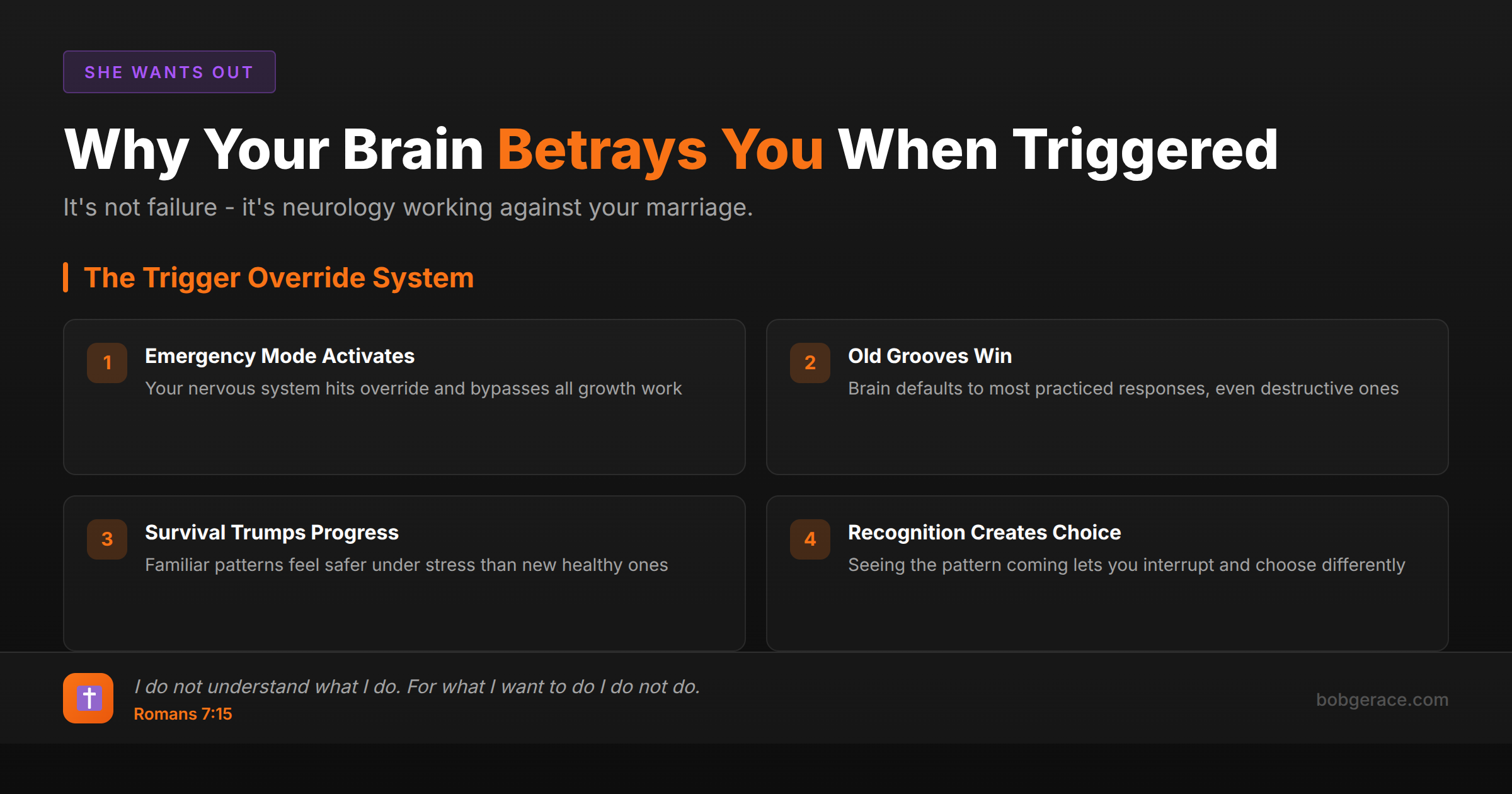
When you're triggered, your brain bypasses all the growth work you've done and defaults to the oldest, most practiced responses - even the destructive ones. It's like your nervous system hits an emergency override button and goes straight to survival mode, using patterns that are deeply grooved from years of repetition. This isn't failure - it's neurology. Your brain is literally designed to revert to familiar patterns under stress because they feel safer, even when they're harmful. The good news? Understanding this process is the first step to interrupting it. You can't change what you don't see coming, but once you recognize the signs of being triggered, you can create new pathways that serve your marriage instead of sabotaging it.
The Full Picture
Think of your brain like a highway system. New behaviors are like back roads - they require conscious navigation and attention. But your old patterns? They're the interstate highways you've traveled thousands of times. When stress hits and you need to get somewhere fast, your brain automatically merges onto that familiar freeway.
This is why you can spend months learning to respond differently to your wife's criticism, only to find yourself defending and counter-attacking the moment she brings up your spending or your mother or whatever your particular trigger is. It's not that you forgot what you learned - it's that your nervous system decided this was an emergency.
Common trigger responses include: • Shutting down and going silent • Getting defensive and explaining why you're right • Counter-attacking with your wife's faults • Leaving the room or the house entirely • Minimizing her concerns or emotions
Here's what most men miss: the trigger isn't really about the current situation. Your wife asking about money might trigger your father's criticism about never being good enough. Her frustration about household tasks might activate childhood feelings of being controlled. The intensity of your reaction is rarely proportional to what's actually happening now.
The pattern works like this: Trigger → Emotional flooding → Nervous system activation → Default to old programming → Relationship damage → Guilt and shame → Promise to do better → Repeat. Breaking this cycle requires interrupting it at multiple points, not just trying harder to be different.
What's Really Happening
From a neurological standpoint, triggers activate what Dan Siegel calls 'flipping your lid' - the prefrontal cortex (rational brain) goes offline while the limbic system (emotional brain) takes control. This process happens in milliseconds, which is why you can feel blindsided by your own reactions.
Research in attachment theory shows that our earliest relationship patterns create neural pathways that become our default programming under stress. If you learned to survive criticism by getting angry or withdrawing, those responses become automatic when you feel emotionally threatened, regardless of the actual level of threat.
The trauma response cycle is particularly relevant here. Many men carry developmental trauma from childhood - not necessarily abuse, but experiences of feeling unseen, criticized, controlled, or emotionally abandoned. When your wife expresses dissatisfaction, it can unconsciously activate these old wounds, causing you to respond as if you're still that hurt child trying to survive.
Polyvagal theory explains why you might cycle through different states when triggered: fight (arguing/defending), flight (leaving/avoiding), or freeze (shutting down/going silent). Your nervous system is trying to regulate itself using strategies that once kept you safe but now damage your closest relationships.
The key insight is that conscious change requires a regulated nervous system. You cannot think your way out of a triggered state - you must first address the physiological arousal before you can access the tools and insights you've learned. This is why breathing techniques, grounding exercises, and taking breaks are so crucial for interrupting old patterns.
What Scripture Says
Scripture acknowledges our tendency to revert to old patterns while offering hope for transformation. Romans 7:15 captures this struggle perfectly: "I do not understand what I do. For what I want to do I do not do, but what I hate I do." Paul understood the frustration of knowing what's right but defaulting to destructive patterns under pressure.
2 Corinthians 5:17 reminds us that "if anyone is in Christ, the new creation has come: The old has gone, the new is here!" But this doesn't mean change happens instantly. The new nature exists alongside old patterns that need to be actively renewed through God's grace and intentional practice.
Romans 12:2 gives us the process: "Do not conform to the pattern of this world, but be transformed by the renewing of your mind." The word 'transformed' (metamorphoo) implies a gradual process, like a caterpillar becoming a butterfly. Old patterns don't disappear overnight - they're replaced through consistent renewal.
Psalm 139:23-24 offers a practical approach: "Search me, God, and know my heart; test me and know my anxious thoughts. See if there is any offensive way in me, and lead me in the way everlasting." This is about inviting God into the process of recognizing triggers before they hijack our responses.
Galatians 5:16 provides the solution: "Walk by the Spirit, and you will not gratify the desires of the flesh." Walking by the Spirit includes creating space for God's wisdom when we feel triggered, rather than immediately reacting from our wounded places.
James 1:19 gives practical instruction: "Everyone should be quick to listen, slow to speak and slow to become angry." This 'slowness' is exactly what gets hijacked when we're triggered - Scripture calls us to create space between stimulus and response.
What To Do Right Now
-
1
Identify your top 3 trigger situations and write them down - be specific about what your wife says or does that consistently causes you to revert to old patterns
-
2
Create physical distance when you feel triggered - tell your wife 'I need 20 minutes to regulate myself so I can respond well to you' and actually take the break
-
3
Practice the 4-7-8 breathing technique daily: inhale for 4, hold for 7, exhale for 8 - this trains your nervous system to regulate under stress
-
4
Develop a pre-trigger ritual when you sense tension building - ask yourself 'What am I feeling in my body right now?' before reacting
-
5
Write out your new desired responses to your trigger situations and practice them when you're calm - rehearse the alternative pathway
-
6
Schedule weekly check-ins with your wife to discuss triggers and patterns when you're both regulated - don't wait for the heat of the moment to address these dynamics
Related Questions
- How do I rewire trauma responses?
- What is 'white-knuckling' vs. real transformation?
- Why do most change attempts fail?
- How long until new behaviors become automatic?
- What are the 'stages of change' and where am I?
- What role does sleep/exercise/nutrition play in change capacity?
- What is 'amygdala hijack' and how do I interrupt it?
- How do I break destructive patterns?
- What are 'neural pathways' and why do patterns persist?
- What is 'window of tolerance' and how do I widen mine?
Also find Bob on
Subscribe for weekly videos on Christian marriage.
You Don't Have to Keep Relapsing Alone
A coach who knows your specific triggers and your marriage can help you build interrupts that work for you—not just theory that collapses when you're flooded.
Talk to Bob →