Why do most change attempts fail?
5 min read
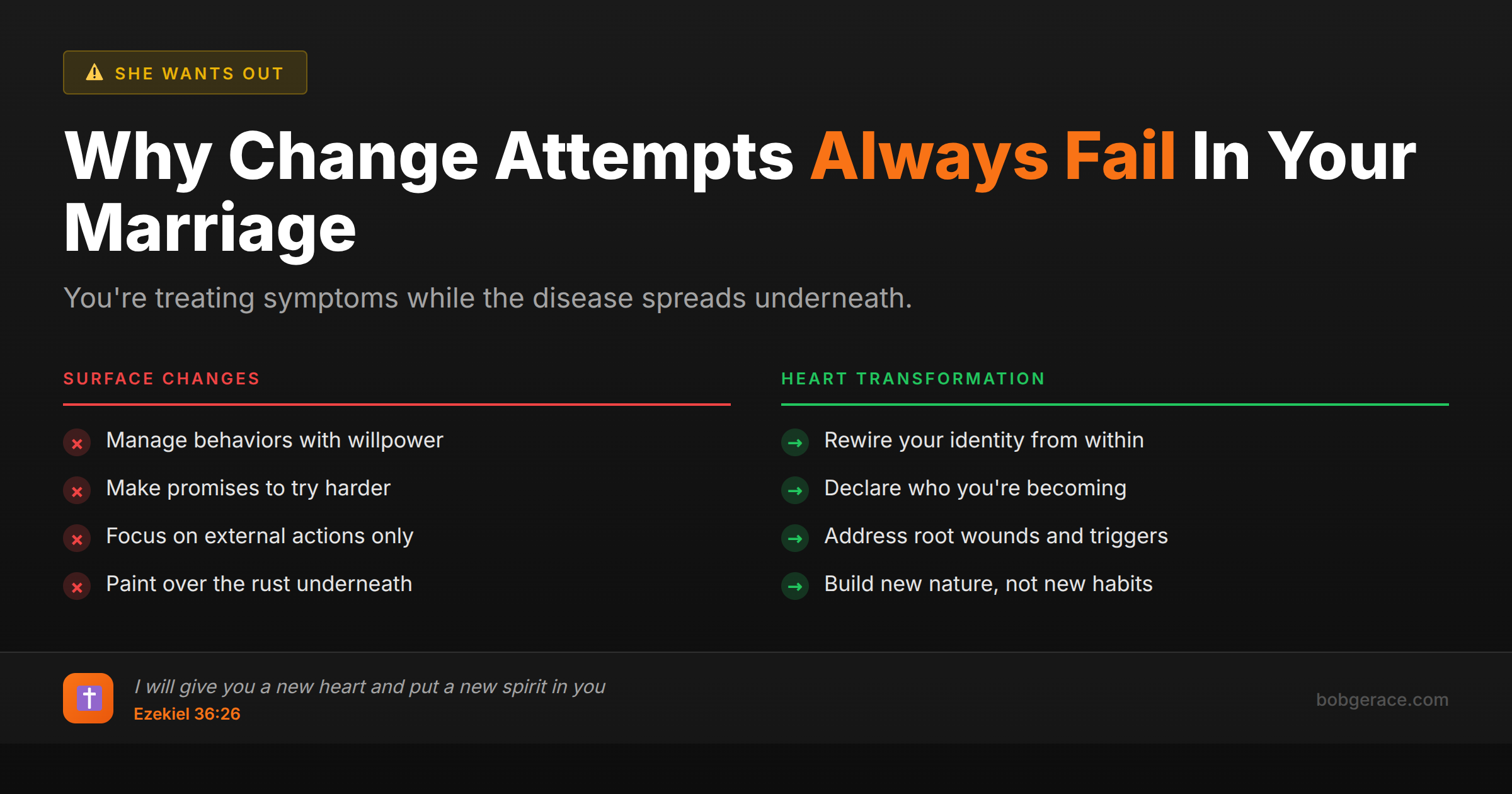
Most change attempts fail because they focus on behavior modification instead of heart transformation. You're trying to manage symptoms while ignoring the root system. It's like painting over rust – looks good temporarily, but the corrosion continues underneath. The brutal truth? Surface-level changes collapse under pressure because they're not anchored to anything deeper than willpower and good intentions. Your wife has watched you make promises before. She's seen the 30-day sprints that fizzled out. Real change requires rewiring at the identity level, not just adjusting your actions.
The Full Picture
The Change Failure Statistics Are Devastating
Research shows that 95% of change attempts fail within the first year. In marriage, the numbers are even worse because there's another person watching, evaluating, and protecting themselves from disappointment.
Here's what typically happens:
• Week 1-2: High motivation, dramatic behavioral changes • Week 3-4: Reality hits, old patterns resurface under stress • Month 2-3: Inconsistency becomes obvious to your spouse • Month 4-6: Complete reversion to old behaviors, often worse than before
The Three Fatal Mistakes
Mistake #1: Focusing on External Compliance You start doing the dishes, saying the right words, showing up differently. But your wife can sense it's performance, not transformation. She's waiting for the other shoe to drop.
Mistake #2: Willpower-Based Change You muscle through new behaviors using discipline and determination. This works until you hit stress, conflict, or fatigue – then the real you shows up.
Mistake #3: Skipping the Identity Work You try to act like a different person without becoming a different person. Your actions don't match your internal operating system, creating unsustainable tension.
The Pressure Cooker Effect Marriage is a pressure cooker that reveals who you really are. Your wife doesn't just want to see you behave differently during calm moments – she needs to know you'll show up differently when the kids are screaming, money is tight, and you're both exhausted.
What's Really Happening
From a psychological perspective, failed change attempts often stem from what we call 'cognitive-behavioral misalignment.' The individual attempts to modify behaviors without addressing the underlying belief systems, emotional patterns, and neural pathways that drive those behaviors.
The Neuroscience of Change Our brains are wired for efficiency, creating automatic response patterns called 'neural highways.' These pathways, formed over years or decades, don't disappear just because we decide to change. Without intentional rewiring through consistent new experiences, the brain defaults to familiar patterns, especially under stress.
Attachment and Safety Concerns When a spouse has experienced repeated disappointment from failed change attempts, their attachment system shifts into protective mode. They develop what researchers call 'learned helplessness' regarding their partner's capacity for genuine transformation. This creates a cycle where the spouse's skepticism actually undermines future change efforts.
The Identity-Behavior Gap Successful change requires what psychologists term 'identity shift' – literally seeing yourself as a different type of person. When someone says 'I'm trying to be more patient' versus 'I am a patient person,' the brain processes these statements completely differently. The first maintains distance from the desired trait; the second integrates it into core identity.
Trauma-Informed Change Many relationship patterns are trauma responses – protective mechanisms developed to navigate past hurt. Surface-level behavioral change cannot address these deep protective systems. Without processing the underlying emotional wounds and developing new safety strategies, old patterns will inevitably resurface when triggered.
What Scripture Says
Scripture reveals that lasting transformation happens from the inside out, not the outside in. God's design for change addresses the heart first, then behaviors naturally follow.
Ezekiel 36:26 promises, 'I will give you a new heart and put a new spirit in you; I will remove from you your heart of stone and give you a heart of flesh.' This isn't about trying harder – it's about receiving a fundamentally different nature.
2 Corinthians 5:17 declares, 'Therefore, if anyone is in Christ, the new creation has come: The old has gone, the new is here!' Notice it doesn't say the old is gradually leaving – it says it's already gone. This is identity-level transformation.
Romans 12:2 instructs us: 'Do not conform to the pattern of this world, but be transformed by the renewing of your mind.' The Greek word for 'transformed' is 'metamorphoo' – the same word used for a caterpillar becoming a butterfly. This is complete restructuring, not surface modification.
Philippians 2:13 reminds us, 'It is God who works in you to will and to act in order to fulfill his good purpose.' Real change isn't powered by your determination – it's powered by God's work within you.
Galatians 2:20 reveals the secret: 'I have been crucified with Christ and I no longer live, but Christ lives in me.' When your identity shifts from 'I'm trying to change' to 'I am changed,' everything shifts.
James 1:8 warns that 'a double-minded person is unstable in all they do.' Half-hearted change attempts create the very instability that destroys trust in marriage.
What To Do Right Now
-
1
Stop making promises and start making identity declarations - write down who you ARE becoming, not what you'll try to do
-
2
Identify your three biggest behavioral triggers and create specific response plans for each one
-
3
Establish daily practices that reinforce your new identity - prayer, reading, reflection, accountability
-
4
Address underlying wounds or traumas that fuel destructive patterns through counseling or intensive work
-
5
Create environmental changes that support your transformation - remove temptations, add accountability, change routines
-
6
Communicate your transformation process to your wife without asking for trust - show her the internal work, not just external changes
Related Questions
- What is 'white-knuckling' vs. real transformation?
- How long until new behaviors become automatic?
- Why do old patterns come back when I'm triggered?
- What are the 'stages of change' and where am I?
- How do I rewire trauma responses?
- What is 'neuroplasticity' and how do I leverage it?
- I keep making the same mistakes
- Why do I repeat patterns I hate?
- How do I break destructive patterns?
- What does sustainable change require?
Also find Bob on
Subscribe for weekly videos on Christian marriage.
Your Marriage Can't Wait for Another Failed Attempt
Bob works with men in active crisis—affairs, separation, divorce papers on the table. He'll diagnose what's actually broken in your specific situation and build the plan that fits your 30-day window.
Talk to Bob →