What does sex mean to her attachment system?
6 min read
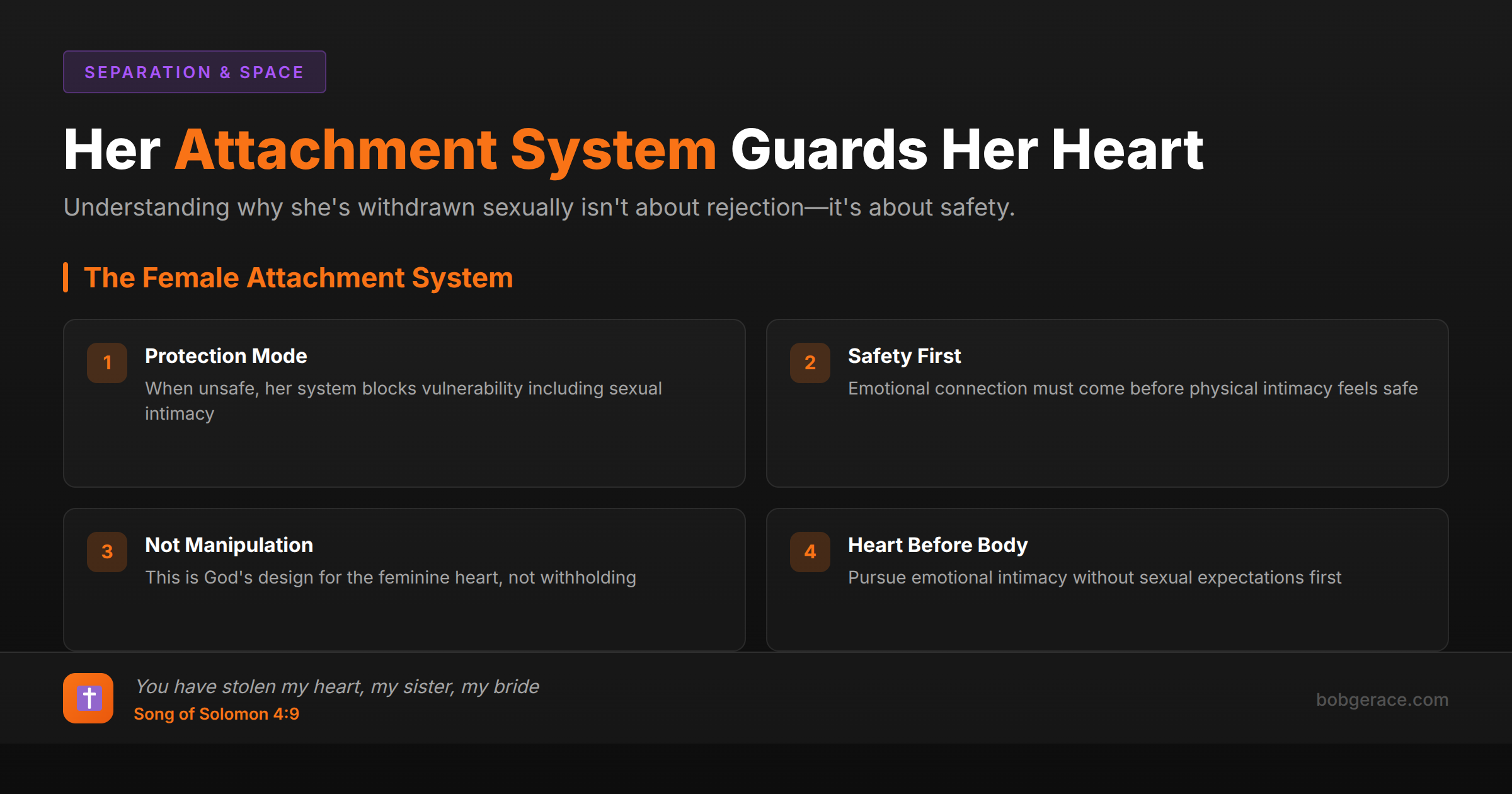
For most women, sex isn't just physical—it's deeply connected to their attachment system, which governs how safe and connected they feel in the relationship. When she's checked out, sex often represents vulnerability she's not ready to offer because her attachment system is in protection mode. She needs emotional safety, trust, and connection before physical intimacy feels safe again. This isn't about withholding or manipulation—it's about how God designed the feminine heart to work. Her attachment system acts like an internal security guard, and right now, it's saying 'not safe' when it comes to the vulnerability that sex requires. Understanding this is the first step toward rebuilding the emotional foundation that makes physical intimacy possible again.
The Full Picture
Here's what most men don't understand: for women, sex is attachment behavior. It's not just about physical pleasure or release—it's about bonding, safety, and emotional connection. When your wife has checked out, her attachment system has essentially gone into protection mode.
Think of her attachment system like a sophisticated security system. It's constantly scanning the relationship environment asking: *Am I safe here? Can I trust him? Will he be there for me? Am I valued beyond what I can give him physically?* When the answers to these questions feel uncertain or negative, the system shuts down access to vulnerability—and sex requires tremendous vulnerability.
This explains why she can seem interested in sex when things are good between you, but completely shut down when there's distance or conflict. It's not that she's using sex as a weapon or trying to punish you. Her nervous system literally won't let her be that vulnerable when she doesn't feel emotionally safe.
For many women, sex without emotional connection feels empty, mechanical, or even invasive. It's like being asked to open your heart when you're not sure the other person will handle it carefully. Her 'no' to sex is often a 'no' to fake intimacy—she's actually protecting the possibility of real intimacy by refusing the counterfeit version.
The good news? Attachment systems can heal. When she starts feeling truly seen, heard, and valued again—when her attachment system gets consistent signals that she's safe with you—physical intimacy often returns naturally. But it has to happen in that order: emotional safety first, then physical intimacy.
What's Really Happening
From a clinical perspective, we're looking at the intersection of attachment theory and sexual intimacy. The attachment system, located primarily in the limbic brain, is designed to keep us connected to those we depend on for survival and emotional regulation. For women especially, sexual intimacy activates this system intensely.
When a woman's attachment system perceives threat—whether from emotional distance, unresolved conflict, or feeling unseen in the relationship—it triggers what we call 'attachment deactivation.' This is a protective mechanism where she unconsciously reduces vulnerability-seeking behaviors, and sexual intimacy is at the top of that list.
Neurologically, arousal and anxiety cannot coexist. If her nervous system is in a state of chronic activation due to attachment insecurity, her body literally cannot access the relaxed, open state necessary for healthy sexual response. This isn't conscious or willful—it's happening at a physiological level.
What we see clinically is that women with secure attachment styles maintain sexual interest even through relationship challenges, while those with insecure attachment (often created by the relationship itself) experience dramatic drops in sexual desire when emotional safety is compromised. The solution isn't better sexual technique or more romance—it's rebuilding the foundation of emotional security that allows her nervous system to relax into intimacy again. This requires consistent, patient work on the husband's part to become a genuinely safe person for her attachment system.
What Scripture Says
Scripture reveals that God designed sexual intimacy to flourish within the context of covenant love and emotional safety. Song of Solomon 4:9 says, *'You have stolen my heart, my sister, my bride; you have stolen my heart with one glance of your eyes.'* Notice the emotional connection and cherishing that precedes physical intimacy.
Ephesians 5:28-29 commands, *'Husbands ought to love their wives as their own bodies. He who loves his wife loves himself. After all, no one ever hated their own body, but they feed and care for their body.'* The word 'care for' here means to cherish tenderly, to warm with tender love—this is the emotional environment where physical intimacy thrives.
1 Peter 3:7 instructs husbands to *'live with your wives in an understanding way, showing honor to the woman as the weaker vessel, since they are heirs with you of the grace of life, so that your prayers may not be hindered.'* Understanding her need for emotional safety isn't weakness—it's how God designed her.
1 Corinthians 7:3-4 speaks of mutual submission in sexual intimacy, but this must be understood within the broader biblical context of sacrificial love, not selfish demand. When a wife feels truly loved and secure, the sexual relationship reflects God's design for oneness.
Proverbs 31:11 describes a husband whose *'heart safely trusts in her'*—but the reverse is equally important. Her heart must safely trust in you before the vulnerability of sexual intimacy feels safe. God's design is beautiful: emotional safety creates the foundation for physical intimacy that brings glory to Him.
What To Do Right Now
-
1
Stop pursuing sex and start pursuing her heart—focus on emotional connection without sexual expectation for the next 30 days
-
2
Learn her primary emotional needs and consistently meet them without keeping score or expecting sexual reciprocation
-
3
Address any behaviors that create emotional unsafety—anger, criticism, dismissiveness, or emotional unavailability
-
4
Practice non-sexual physical affection—hand-holding, gentle touch, cuddling without it leading to sex
-
5
Have honest conversations about what makes her feel safe and valued, then act on what you learn consistently
-
6
Get professional help if you're struggling with anger, addiction, or other issues that compromise her sense of safety
Related Questions
- Why is sex about safety not just desire for women?
- What is 'attachment sex' vs. 'validation sex'?
- Why might she feel used not loved during sex?
- How do I rebuild emotional intimacy first?
- What's the connection between feeling known and wanting sex?
- How do I create conditions for desire without manipulation?
- What is 'attachment injury' and did I cause one?
- What attachment needs was the affair meeting?
- What does emotional attunement look like?
- How do I become a safe emotional presence?
Also find Bob on
Subscribe for weekly videos on Christian marriage.
Your Marriage Isn't a Textbook Case
Understanding attachment theory helps—but your wife's specific history, wounds, and triggers are unique. A coach who knows your story can help you navigate what safety actually looks like in your marriage.
Talk to Bob →