What is 'attachment sex' vs. 'validation sex'?
6 min read
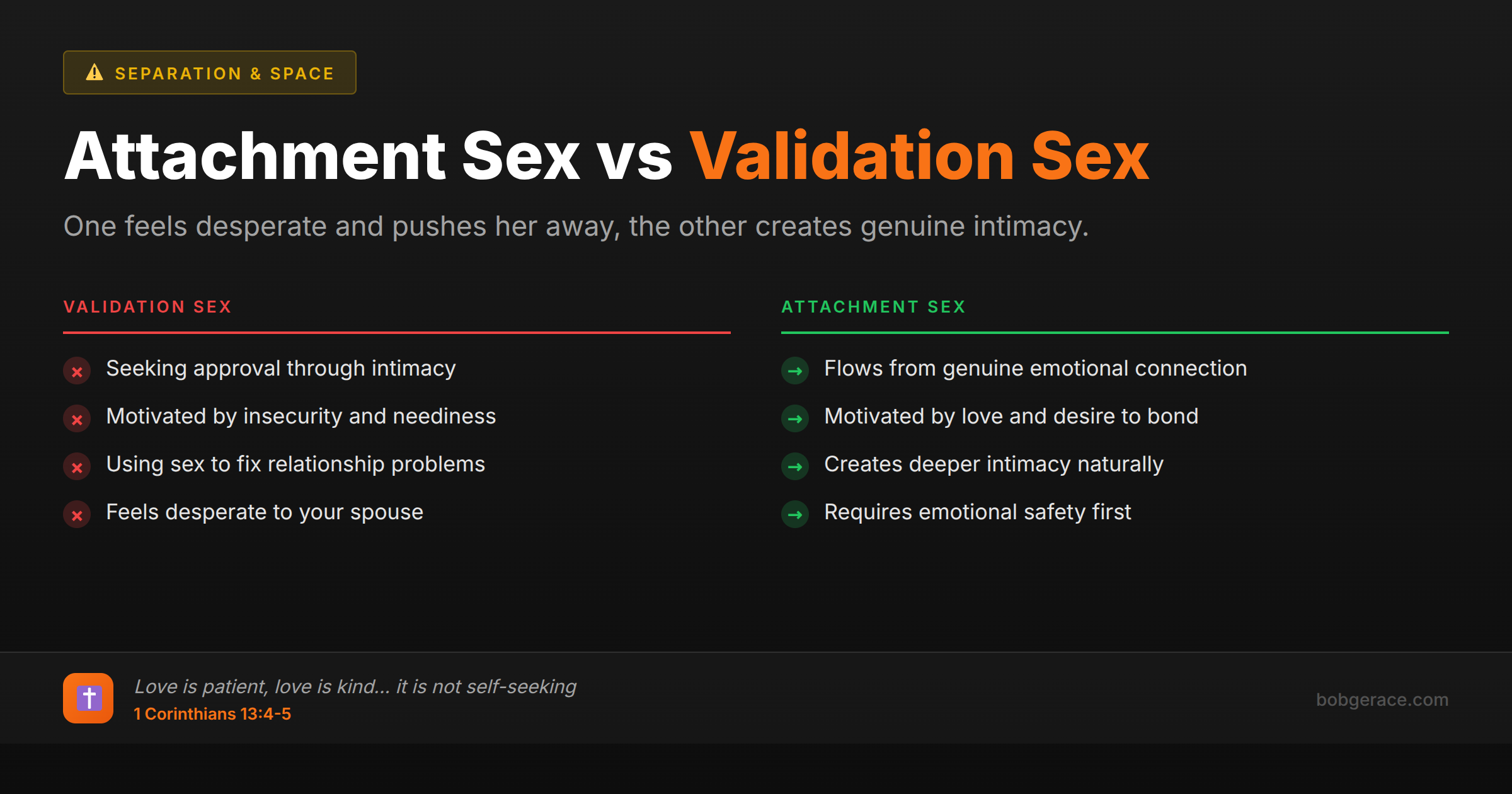
Attachment sex flows from genuine emotional connection and creates deeper intimacy between spouses. It's motivated by love, care, and the desire to bond with your partner. Validation sex, however, is driven by insecurity, the need for approval, or attempts to fix relationship problems through physical intimacy. When your wife has checked out emotionally, you might find yourself seeking validation sex - using physical intimacy to feel wanted, prove your worth, or temporarily ease the pain of disconnection. This approach often backfires because it feels needy and desperate to your spouse, actually pushing them further away. Attachment sex requires emotional safety and connection first, which is exactly what's missing when she's withdrawn from the relationship.
The Full Picture
Understanding the difference between attachment sex and validation sex is crucial when your marriage is struggling, especially when your wife has emotionally checked out.
Attachment sex emerges from a secure emotional bond. It's characterized by: - Genuine desire for connection and intimacy - Focus on giving and receiving pleasure mutually - Natural timing that flows from emotional closeness - Ability to be vulnerable and present with each other - Creates deeper bonding and relationship satisfaction
Validation sex stems from insecurity and unmet emotional needs. It includes: - Using sex to feel wanted, loved, or valued - Attempting to solve relationship problems through physical intimacy - Feeling desperate or needy about sexual frequency - Using sex as a barometer for relationship health - Often feels transactional or manipulative to your spouse
When your wife has checked out, you're likely operating from validation needs. You might think more sex will bring her back, prove your desirability, or temporarily ease the emotional pain. But this approach often creates a negative cycle - the more you pursue sex for validation, the more she feels pressured and withdraws further.
The challenge is that validation sex feels urgent and necessary when you're hurting, but it actually prevents the emotional safety required for genuine intimacy. Your wife can sense when physical intimacy is being used to meet your emotional needs rather than flowing from mutual connection.
What's Really Happening
From a clinical perspective, the distinction between attachment and validation sex reflects different underlying attachment systems and emotional regulation strategies.
Attachment sex activates the bonding system in healthy ways. Both partners feel emotionally regulated, secure, and genuinely drawn to physical connection. This type of intimacy actually strengthens the emotional bond and creates positive feedback loops in the relationship.
Validation sex, however, often stems from anxious attachment patterns and dysregulated emotional states. When men feel disconnected from their wives, they may unconsciously use sexual pursuit as a way to co-regulate their emotions and confirm their worth. This creates what we call 'pursuit-withdraw' dynamics.
Neurologically, when someone feels emotionally unsafe or pressured, their nervous system shifts into protection mode. This makes genuine arousal and connection nearly impossible. Your wife's withdrawal might actually be her nervous system's protective response to sensing your validation needs.
The key insight is that attachment sex requires emotional safety first. When that safety is absent, attempts at physical intimacy often feel threatening rather than connecting. This is why focusing on emotional attunement and reducing pressure often paradoxically improves physical intimacy over time.
Recovering healthy sexual connection requires shifting from validation-seeking to attachment-building behaviors outside the bedroom first.
What Scripture Says
Scripture provides clear guidance about healthy intimacy in marriage, emphasizing mutual care over selfish validation-seeking.
1 Corinthians 13:4-5 reminds us that "Love is patient, love is kind. It does not envy, it does not boast, it is not proud. It does not dishonor others, it is not self-seeking." Validation sex is inherently self-seeking - focused on what we can get rather than what we can give.
Ephesians 5:25 instructs husbands to "love your wives, just as Christ loved the church and gave himself up for her." This sacrificial love creates the emotional safety necessary for attachment sex. Christ didn't love the church to validate His worth - He loved from abundance and security.
1 Corinthians 7:3-4 teaches mutual consideration: "The husband should fulfill his marital duty to his wife, and likewise the wife to her husband." This mutual giving contrasts sharply with validation-seeking, which focuses on getting our needs met.
Song of Solomon 2:7 warns, "Do not arouse or awaken love until it so desires." This verse speaks to timing and natural flow - exactly what's missing in validation sex, which operates from urgency and desperation rather than mutual desire.
Philippians 2:3-4 applies directly: "Do nothing out of selfish ambition or vain conceit. Rather, in humility value others above yourselves, not looking to your own interests but each of you to the interests of the others." Attachment sex flows from this other-centered love.
God designed marital intimacy to flow from secure love, not from attempts to fill emotional voids or prove our worth.
What To Do Right Now
-
1
Stop pursuing sex when you're feeling insecure, rejected, or desperate - this is validation-seeking that will backfire
-
2
Focus on building emotional connection through non-sexual affection, meaningful conversation, and genuine care
-
3
Examine your motives before initiating intimacy - ask yourself if you're seeking connection or validation
-
4
Work on your own emotional regulation and security so you're not dependent on sex for self-worth
-
5
Create emotional safety by reducing pressure and expectations around physical intimacy
-
6
Pray for genuine love and patience, asking God to help you love sacrificially rather than needily
Related Questions
- Why is sex about safety not just desire for women?
- What does sex mean to her attachment system?
- Why might she feel used not loved during sex?
- What's the connection between feeling known and wanting sex?
- How do I rebuild emotional intimacy first?
- What is 'responsive desire' vs. 'spontaneous desire'?
- What is limerence?
- What does 'holding space' actually mean?
Also find Bob on
Subscribe for weekly videos on Christian marriage.
Your Marriage Isn't a Textbook Case
Shifting from validation to attachment in your specific situation—with your history, her current state, where you actually are—requires someone who knows your story. That's what coaching is.
Talk to Bob →