What's the relationship between emotional safety and sexual desire?
6 min read
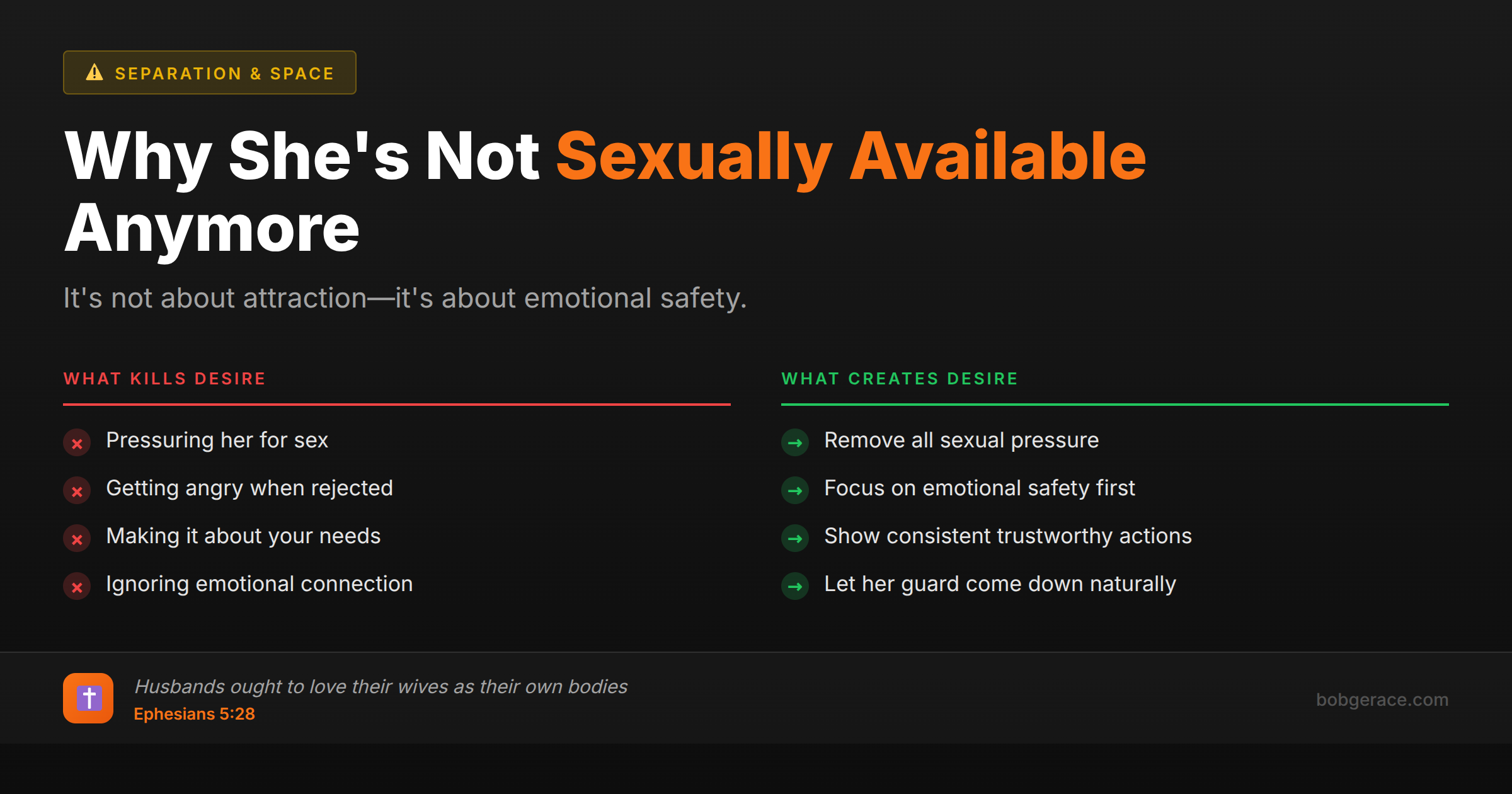
Emotional safety is the foundation of sexual desire in marriage. When your wife doesn't feel emotionally safe with you, her body's natural response is to shut down sexually. This isn't a choice she's making—it's her nervous system protecting her from vulnerability when trust has been damaged. Think of it this way: sexual intimacy requires complete vulnerability. If she can't trust you with her emotions, thoughts, or daily struggles, asking her to be physically vulnerable feels impossible. Her lack of sexual interest isn't about you not being attractive enough—it's about her not feeling safe enough to let her guard down. The good news? Emotional safety can be rebuilt through consistent, trustworthy actions over time.
The Full Picture
Here's what most men don't understand: sexual desire for women is primarily mental and emotional, not physical. While men can often compartmentalize and be physically intimate even when things aren't perfect emotionally, most women can't operate this way.
When your wife has checked out sexually, she's likely checked out emotionally first. Something has damaged her sense of safety with you. Maybe it was:
- Repeated arguments where she felt unheard or dismissed - Times when you reacted poorly to her sharing vulnerable thoughts - Patterns of criticism or contempt in daily interactions - Broken promises or commitments that eroded trust - Feeling like a roommate rather than a cherished wife
Her brain has essentially categorized you as "not safe" for vulnerability. And since sexual intimacy requires the ultimate vulnerability, her desire shuts down as a protective mechanism.
This isn't conscious or intentional. She's not withholding sex to punish you (though it might feel that way). Her nervous system is literally preventing her from wanting to be intimate because it doesn't perceive you as emotionally safe.
The connection between emotional safety and sexual desire is so strong that you can't fake your way around it. You can't be emotionally unsafe Monday through Saturday and expect her to desire you on Sunday night. Emotional safety must be rebuilt first, then sexual desire can naturally follow.
This process takes time—often months, not weeks. But when a woman feels truly safe with her husband again, her natural desire typically returns.
What's Really Happening
From a clinical perspective, we're looking at how the brain processes safety and threat in intimate relationships. The female brain, particularly the limbic system, is highly attuned to emotional safety cues in close relationships.
When a woman perceives emotional threat—criticism, dismissal, anger, or unpredictability from her partner—the amygdala triggers a stress response. Chronic activation of this stress response literally rewires the brain to associate the partner with danger rather than safety.
Neurologically, sexual desire requires the parasympathetic nervous system to be activated—the 'rest and digest' state where we feel calm and safe. When the sympathetic nervous system is chronically activated due to relationship stress, sexual desire is biologically suppressed.
This is why traditional advice like 'just try to be more physical' or 'fake it till you make it' doesn't work. You can't override a neurological safety response with willpower.
What does work is consistent, predictable behavior that signals safety over time. The brain needs to literally rewire its associations with the partner from 'threat' back to 'safety.' This process, called neuroplasticity, takes sustained effort but is absolutely possible.
The key indicators of emotional safety that restore sexual desire include: predictable emotional responses, genuine empathy and validation, consistent follow-through on commitments, and the ability to have conflict without personal attacks or withdrawal.
What Scripture Says
Scripture gives us a beautiful picture of how emotional safety creates the foundation for physical intimacy in marriage. God designed marriage to be the safest place on earth for both spouses.
Ephesians 5:28-29 says, *"In this same way, husbands ought to love their wives as their own bodies. He who loves his wife loves himself. After all, no one ever hated their own body, but they feed and care for their body, just as Christ does the church."* Notice the emphasis on care and nourishment—this is emotional safety in action.
1 Peter 3:7 instructs husbands to *"be considerate as you live with your wives, and treat them with respect as the weaker partner and as heirs with you of the gracious gift of life, so that nothing will hinder your prayers."* When we don't create emotional safety, it literally hinders our relationship with God.
Song of Solomon 2:10-13 shows us desire flourishing in safety: *"My beloved spoke and said to me, 'Arise, my darling, my beautiful one, come with me.'"* This is invitation, not demand—safety, not pressure.
Proverbs 31:11 describes a wife whose *"husband has full confidence in her."* But notice this goes both ways—she must also have full confidence in him for intimacy to flourish.
1 Corinthians 13:4-7 defines love as patient, kind, not easily angered, keeping no record of wrongs. This is the blueprint for emotional safety.
God's design is clear: emotional safety and physical intimacy are meant to work together, each strengthening the other in the covenant of marriage.
What To Do Right Now
-
1
Stop all sexual pressure immediately - Any pressure or expectation right now will only reinforce that you're not safe
-
2
Have an honest conversation - Acknowledge that you recognize the connection is broken and ask what would help her feel safer
-
3
Identify your unsafe behaviors - List specific ways you've been emotionally unsafe (criticism, anger, dismissiveness, broken promises)
-
4
Create predictable safety - Be consistent in your responses, follow through on commitments, and manage your emotions maturely
-
5
Practice genuine empathy - When she shares feelings, respond with validation rather than solutions or defensiveness
-
6
Give it time without scorekeeping - Expect this to take months, not weeks, and don't keep track of progress toward sexual intimacy
Related Questions
- What kills female sexual desire in marriage?
- What is 'responsive desire' vs. 'spontaneous desire'?
- What is 'sexual aversion' and does she have it?
- What conditions need to be in place for desire to return?
- What does sex mean to her attachment system?
- Why is sex about safety not just desire for women?
- How do I become a safe emotional presence?
- What does 'holding space' actually mean?
- What does secure attachment behavior look like in him?
Also find Bob on
Subscribe for weekly videos on Christian marriage.
Rebuilding Safety in Your Marriage
You know what needs to happen. The hard part is doing it consistently when she's still shut down. A coach who knows your specific situation keeps you calibrated through the long middle.
Talk to Bob →