What does research say about sexless marriage recovery?
6 min read
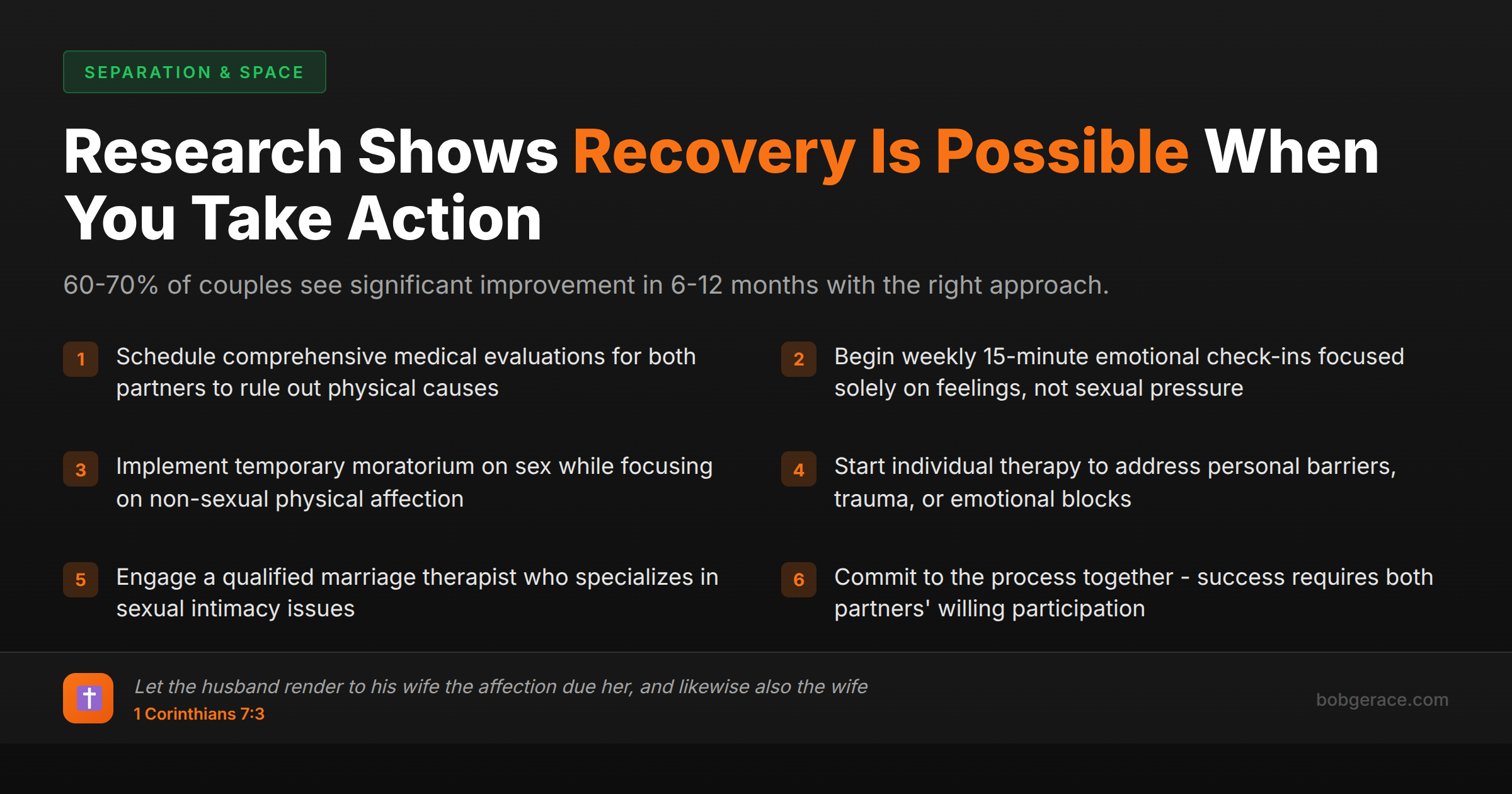
Research on sexless marriage recovery reveals both encouraging and sobering truths. Studies show that approximately 60-70% of couples who actively engage in therapy and commit to the recovery process see significant improvement in their sexual relationship within 6-12 months. However, success heavily depends on both partners' willingness to participate and address underlying issues. The research consistently shows that couples who combine professional guidance with intentional communication and gradual physical reconnection have the highest success rates. Time is a critical factor - the longer a marriage remains sexless without intervention, the more challenging recovery becomes, though it's never impossible with proper commitment.
The Full Picture
The research landscape on sexless marriage recovery paints a complex but hopeful picture. Major longitudinal studies reveal that 15-20% of marriages experience periods of little to no sexual activity, with about half of these recovering naturally over time. However, when marriages remain sexless for more than two years, natural recovery drops to less than 10%.
Clinical intervention dramatically improves these odds. The American Association for Marriage and Family Therapy reports that couples engaging in targeted therapy see recovery rates between 60-75%. The most successful approaches combine cognitive-behavioral techniques, communication training, and gradual physical reconnection exercises.
Key factors predicting successful recovery include: - Both partners acknowledging the problem exists - Willingness to address underlying emotional disconnection - Commitment to professional guidance - Medical evaluation to rule out physical causes - Patience with the gradual rebuilding process
Research consistently shows that couples who focus first on emotional intimacy before physical intimacy have higher success rates. Studies indicate that rushing physical reconnection without addressing underlying trust, communication, or emotional wounds results in relapse in 70% of cases. The most sustainable recoveries happen when couples rebuild their entire intimate connection systematically, often taking 6-18 months for full restoration.
What's Really Happening
From a clinical perspective, sexless marriage recovery follows predictable patterns that we can leverage for success. The research shows us that sexual intimacy rarely dies in isolation - it's typically the final symptom of deeper relational breakdown.
In my practice, I've observed that the couples who recover successfully share three critical characteristics: they're willing to be vulnerable about their pain, they commit to the process even when it's uncomfortable, and they understand that physical intimacy is built on a foundation of emotional safety.
The neuroscience research is particularly revealing. When couples experience prolonged sexual disconnection, their brains literally rewire to associate their partner with rejection rather than desire. This creates a neurological barrier that requires intentional rewiring through positive experiences and emotional reconnection.
What's encouraging is that recent studies show the brain's neuroplasticity allows for this rewiring at any age. However, it requires consistent, positive interactions over time. The couples who succeed understand that recovery isn't just about resuming sexual activity - it's about rebuilding the entire intimate ecosystem of their relationship.
Clinically, we see the highest success rates when both partners address their individual contributions to the disconnection while simultaneously working on their couple dynamics.
What Scripture Says
Scripture provides a framework for understanding sexual intimacy as God's design for marriage, offering both hope and guidance for recovery. "Let the husband render to his wife the affection due her, and likewise also the wife to her husband" (1 Corinthians 7:3). This verse establishes sexual intimacy as a mutual responsibility and gift, not just a desire.
"Therefore what God has joined together, let not man separate" (Mark 10:9). Sexual disconnection is often a form of separation that God desires to heal. The research aligns with biblical truth - restoration is possible when both partners commit to God's design for marriage.
"Be kind to one another, tenderhearted, forgiving one another, even as God in Christ forgave you" (Ephesians 4:32). Recovery requires extending grace for past hurts and disappointments. Research confirms that couples who practice forgiveness have significantly higher recovery rates.
"Husbands, love your wives as Christ loved the church" and "wives, respect your husbands" (Ephesians 5:25, 33). These commands create the emotional safety necessary for physical intimacy to flourish. Studies show that women need emotional connection to desire physical intimacy, while men often need physical connection to feel emotionally safe.
"Let us not grow weary while doing good, for in due season we shall reap if we do not lose heart" (Galatians 6:9). Recovery takes time, and Scripture encourages persistence. Research validates this - couples who persist through the difficult rebuilding phase see lasting transformation.
What To Do Right Now
-
1
Schedule comprehensive medical evaluations for both partners to rule out physical causes affecting libido or sexual function
-
2
Begin weekly 15-minute emotional check-ins focused solely on feelings, not sexual expectations or pressure
-
3
Implement a temporary moratorium on sexual activity while focusing on non-sexual physical affection like hand-holding and hugging
-
4
Start individual therapy to address personal barriers, trauma, or emotional blocks that may be affecting intimacy
-
5
Engage a qualified marriage therapist who specializes in sexual intimacy issues and has a track record of success
-
6
Create a structured rebuilding plan with professional guidance that gradually reintroduces physical intimacy over 3-6 months
Related Questions
- What is 'responsive desire' vs. 'spontaneous desire'?
- What kills female sexual desire in marriage?
- What's the relationship between emotional safety and sexual desire?
- What conditions need to be in place for desire to return?
- What does healing from sexual disconnection look like?
- How do I rebuild emotional intimacy first?
- What are 'attachment injuries' and how many did I cause?
- What does genuine repair look like for old wounds?
- How do I become emotionally intelligent?
- What does emotional attunement look like?
Also find Bob on
Subscribe for weekly videos on Christian marriage.
Research tells you what works. A coach helps you do it.
The stats are real — but your marriage isn't a statistic. A coach who knows your specific situation can help you move from 'sexless' to 'reconnecting' without guessing what applies to you.
Talk to Bob →