What is an 'apology' vs. 'repair' vs. 'attunement'?
6 min read
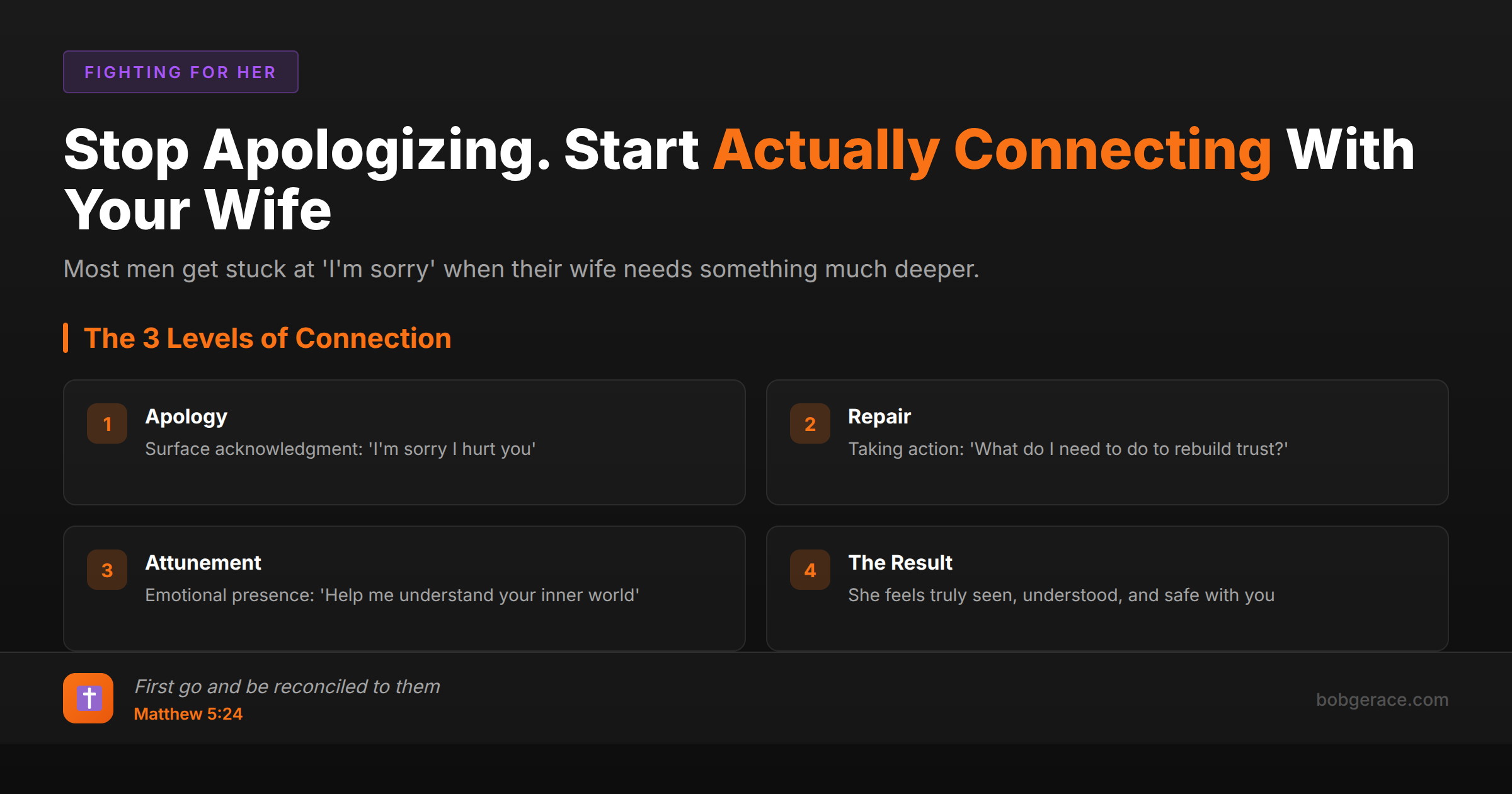
An apology acknowledges wrongdoing and asks for forgiveness. A repair goes deeper—it's taking action to restore trust and connection after damage has occurred. Attunement is the deepest level—it's being emotionally present and responsive to your spouse's inner world, creating safety and intimacy. Most couples get stuck at surface-level apologies when what's really needed is repair work and authentic attunement. When your wife has checked out, she's likely not experiencing true attunement from you—the sense that you truly see, understand, and respond to her emotional needs. Moving from "I'm sorry" to genuine repair and consistent attunement is what rebuilds disconnected marriages.
The Full Picture
Here's what most men don't understand: saying "I'm sorry" isn't enough when your wife has emotionally checked out. You're dealing with three completely different levels of connection, and most couples never get past the first one.
Apology is the surface level—acknowledging you did something wrong and asking for forgiveness. It's necessary but not sufficient. "I'm sorry I forgot our anniversary" addresses the incident but doesn't address the deeper hurt or prevent future disconnection.
Repair goes deeper—it's the work of actually fixing what was broken. True repair involves understanding the impact of your actions, taking responsibility without defensiveness, and making concrete changes to prevent the same hurt from happening again. It's the difference between saying "I'm sorry I hurt you" and "I see how my actions made you feel unimportant, and here's what I'm doing to change."
Attunement is the deepest level—it's being emotionally present and responsive to your spouse's inner world. It's not just about fixing problems after they happen; it's about creating ongoing emotional safety and connection. Attunement means you're tuned into her emotional frequency, responding to her needs before they become crises.
When wives check out, they're usually starving for attunement. They've gotten plenty of surface apologies, maybe even some repair attempts, but they haven't experienced the deep emotional connection that comes from a husband who truly sees and responds to their heart. This is why "I said I was sorry" doesn't work—because what she needs isn't just acknowledgment of wrong, but evidence that you understand her world and are committed to staying emotionally present.
What's Really Happening
From a clinical perspective, these three concepts represent different levels of emotional processing and attachment repair. Apologies engage primarily cognitive processing—acknowledging wrong and seeking forgiveness. This activates the prefrontal cortex but doesn't necessarily regulate the emotional centers of the brain where hurt and disconnection are stored.
Repair work engages both cognitive and emotional systems. It requires the hurt partner to see genuine change and experience renewed safety, which helps regulate their nervous system and rebuild trust. However, repair is still largely reactive—responding to damage after it occurs.
Attunement operates at the deepest neurological level, engaging what we call "co-regulation." When you're truly attuned to your spouse, you're helping regulate their emotional state through your presence and responsiveness. This creates what attachment theorist John Bowlby called a "secure base"—the foundation for all healthy relationships.
Neurologically, attunement activates //blog.bobgerace.com/mirror-method-marriage-transform-limiting-beliefs/:mirror neurons and creates what researchers call "neural coupling"—your brains literally sync up. This is why attuned couples can sense each other's emotions and needs without extensive verbal communication. When this attunement is missing, partners feel isolated even when physically together.
When wives emotionally check out, they're often experiencing what we call "attachment injury"—not just from specific incidents, but from chronic lack of attunement. Their nervous system has adapted to emotional isolation as a protective mechanism. Rebuilding connection requires moving beyond incident-based apologies to creating consistent experiences of being seen, understood, and emotionally held.
What Scripture Says
Scripture beautifully illustrates these three levels of connection, showing us that God's design for relationships goes far beyond surface acknowledgment of wrong.
On Repair Beyond Apology: "Therefore, if you are offering your gift at the altar and there remember that your brother or sister has something against you, leave your gift there in front of the altar. First go and be reconciled to them; then come and offer your gift." (Matthew 5:23-24). Jesus doesn't say just apologize—He says do the work of reconciliation.
On True Attunement: "Rejoice with those who rejoice; mourn with those who mourn" (Romans 12:15). This is the heart of attunement—being emotionally present and responsive to another's inner world, not just their external circumstances.
On Deep Understanding: "Husbands, in the same way be considerate as you live with your wives, and treat them with respect as the weaker partner and as heirs with you of the gracious gift of life" (1 Peter 3:7). The word "considerate" here means "according to knowledge"—truly knowing and understanding your wife's heart.
On God's Model of Attunement: "Before a word is on my tongue you, Lord, know it completely" (Psalm 139:4). God demonstrates perfect attunement—knowing our needs before we even express them. This is the model for marriage.
God doesn't just forgive our sins (apology level) or fix our problems (repair level)—He knows us completely and responds to our deepest needs with perfect love and presence. This is the standard for how we should love our wives. When we operate only at the apology level, we're missing the deeper calling to truly know and care for our spouse's heart the way Christ cares for ours.
What To Do Right Now
-
1
Stop defaulting to "I'm sorry" and start asking "Help me understand how this affected you" when conflict arises
-
2
Practice daily emotional check-ins—ask your wife how she's feeling and really listen without trying to fix or defend
-
3
When you do wrong, follow this sequence: acknowledge the specific behavior, describe its impact on her, take responsibility without excuses, then ask what repair looks like to her
-
4
Study your wife's emotional patterns—when does she feel most connected? Most distant? What are her stress signals?
-
5
Create consistent rituals of connection—daily conversations, weekly dates, monthly deeper talks about your relationship
-
6
Before responding to her emotions, pause and ask yourself: "What is she really needing from me right now?" Then respond to the need, not just the surface issue
Related Questions
Ready to Move Beyond Surface-Level Connection?
Learning the difference between apology, repair, and attunement is just the beginning. Let me help you create the deep emotional connection your marriage needs.
Get Help Now →