What are 'attachment injuries' and how many did I cause?
6 min read
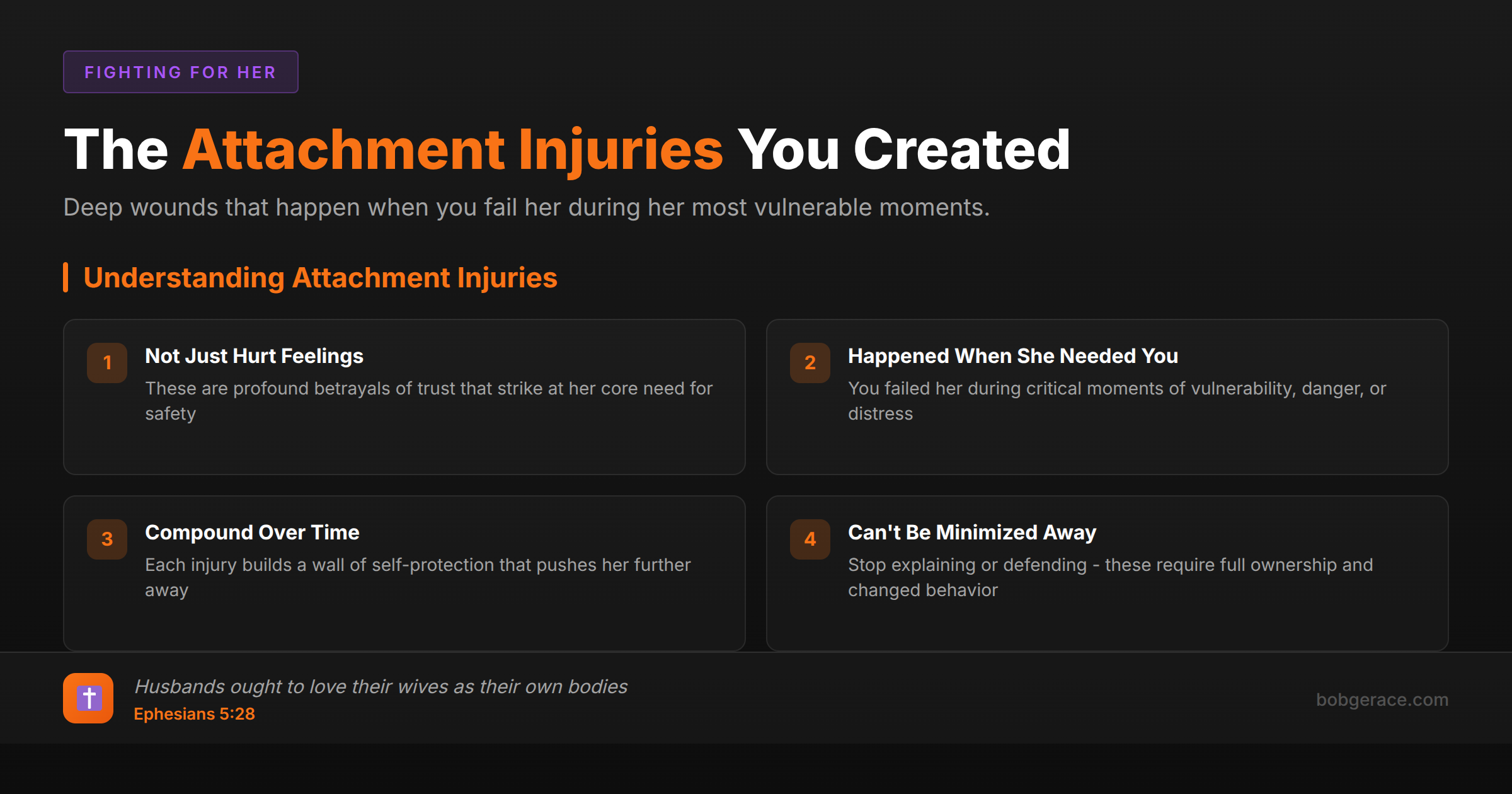
Attachment injuries are deep emotional wounds that damage the fundamental trust and safety in your marriage bond. They occur when your spouse's primary attachment figure - you - fails them during moments of critical need, danger, or vulnerability. Unlike everyday conflicts, these injuries strike at the core of emotional security and create lasting damage to the connection. The hard truth? If your wife has checked out, you've likely caused several significant attachment injuries. These aren't just hurt feelings - they're profound betrayals of trust that happened when she needed you most. The exact number matters less than understanding that each injury has compounded, creating a wall of self-protection that's pushed her away from you emotionally and physically.
The Full Picture
Attachment injuries are the deep cuts that never properly healed in your marriage. They're not the surface-level arguments about dishes or schedules. These are the moments when your wife reached for you in her time of greatest need, and you weren't there - or worse, you became the source of her pain.
Think about it this way: your wife married you believing you would be her safe harbor in life's storms. Attachment injuries happen when that harbor becomes the storm itself. Maybe she came to you devastated about losing a parent, and you minimized her grief. Perhaps she discovered your emotional affair and you blamed her for "driving you to it." Or she miscarried your child and you immediately started talking about "trying again" instead of grieving with her.
These injuries accumulate like compound interest - but in reverse. Each unhealed wound makes her less likely to reach for you the next time. She starts protecting herself instead of connecting with you. What you see as her "checking out" is actually her nervous system's way of surviving in what feels like an unsafe relationship.
The tricky part is that attachment injuries often happen during life's biggest challenges - job loss, family crises, health scares, parenting struggles. These are precisely the moments when couples should be drawing closer, but instead, your responses during these critical times may have driven her further away.
Here's what makes attachment injuries so devastating: they're not just about the specific incident. They shatter her fundamental belief that you're on her team. Once that core trust is broken, everything else becomes suspect. Your attempts at romance feel manipulative. Your apologies sound hollow. Your promises carry no weight.
The question isn't really "how many" injuries you've caused - it's whether you're willing to face the reality that your wife's emotional withdrawal is a direct response to feeling unsafe with you during her most vulnerable moments.
What's Really Happening
From a clinical perspective, attachment injuries represent a fundamental disruption in the secure base that marriage is meant to provide. When we examine couples where one partner has "checked out," we consistently find a pattern of unresolved attachment trauma that has never been properly addressed.
The neuroscience here is crucial to understand. When attachment injuries occur, they activate the same neural pathways as physical trauma. Your wife's brain literally perceives you as a threat to her emotional survival. This isn't dramatic thinking - it's neurobiological reality. Her nervous system has learned that turning to you for comfort often results in more pain, not less.
What's particularly damaging is the timing element. Attachment injuries don't happen during calm moments - they occur during what we call "attachment activation." These are times when your wife's need for connection and safety is heightened: during illness, grief, major life transitions, or crises. When you respond with criticism, dismissal, or emotional unavailability during these crucial moments, you're essentially teaching her nervous system that you're not safe.
The compounding effect creates what we term "negative sentiment override." Her brain begins to interpret even neutral interactions through a lens of threat and disappointment. This is why your attempts to reconnect now feel so futile - you're working against a neurological pattern that's been reinforced over months or years.
Recovery requires more than apologies. It demands what we call "corrective emotional experiences" - consistent, repeated demonstrations that you can be present and attuned during moments of vulnerability. The good news is that attachment patterns can change, but only through sustained, intentional repair work that addresses both the specific injuries and the underlying attachment insecurity they've created.
What Scripture Says
Scripture speaks directly to the responsibility we have as husbands to be sources of safety and strength for our wives, not sources of injury. When we fail in this calling, we're not just damaging our marriages - we're failing to reflect Christ's love for His bride.
Ephesians 5:28-29 reminds us: *"Husbands ought to love their wives as their own bodies. He who loves his wife loves himself. After all, no one ever hated their own body, but they feed and care for their body, just as Christ does the church."* When we cause attachment injuries, we're doing the opposite - we're harming instead of caring, wounding instead of nourishing.
The weight of our responsibility is clear in 1 Peter 3:7: *"Husbands, in the same way be considerate as you live with your wives, and treat them with respect as the weaker partner and as heirs with you of the gracious gift of life, so that nothing will hinder your prayers."* Notice the consequence - our failures in marriage actually hinder our relationship with God.
Proverbs 18:14 captures the devastating nature of attachment injuries: *"The human spirit can endure in sickness, but a crushed spirit who can bear?"* This is exactly what happens when we wound our wives during their most vulnerable moments - we crush their spirits.
But Scripture also offers hope for restoration. Joel 2:25 promises: *"I will repay you for the years the locusts have eaten."* God specializes in restoration, but it requires genuine repentancee and sustained change on our part.
Galatians 6:7-8 warns us: *"Do not be deceived: God cannot be mocked. A man reaps what he sows. Whoever sows to please their flesh, from the flesh will reap destruction; whoever sows to please the Spirit, from the Spirit will reap eternal life."* The attachment injuries you've caused are the harvest of seeds you've sown. But you can begin sowing different seeds today.
The call is clear: "Husbands, love your wives, just as Christ loved the church and gave himself up for her" (Ephesians 5:25). Christ didn't wound His bride - He died for her.
What To Do Right Now
-
1
Stop trying to minimize or explain away past injuries. Make a list of times when your wife was vulnerable and you responded poorly. Don't defend your actions - just acknowledge them.
-
2
Take full responsibility without expecting immediate forgiveness. Say 'I was wrong' without adding 'but you' or 'I was just.' Own your failures completely.
-
3
Start studying her attachment needs instead of your own. Pay attention to when she's stressed, scared, or struggling. These are your opportunities to respond differently.
-
4
Create safety through consistent, small actions. Reliability in daily interactions rebuilds trust faster than grand gestures after you've already failed her.
-
5
Stop defending yourself when she brings up past hurts. Listen, validate her pain, and ask how you can help heal what you've broken.
-
6
Get professional help to break destructive patterns. Attachment injuries require skilled intervention - this isn't something you can fix with good intentions alone.
Related Questions
- She brings up things from years ago
- What is 'accumulated resentment'?
- How does unaddressed hurt compound?
- What does genuine repair look like for old wounds?
- Why does one wound matter more than a hundred good days?
- What is an 'apology' vs. 'repair' vs. 'attunement'?
- What is 'attachment injury' and did I cause one?
- What attachment injuries did I experience?
- How do childhood attachment wounds show up in marriage?
- What attachment injuries lead to this kind of withdrawal?
Also find Bob on
Subscribe for weekly videos on Christian marriage.
Your Marriage Needs a Coach Who Knows Your Story
Attachment injuries stack differently in every marriage. A coach who hears your specific history can see what you can't — and help you stop making it worse while there's still time.
Talk to Bob →