What does she need to hear that I haven't said?
6 min read
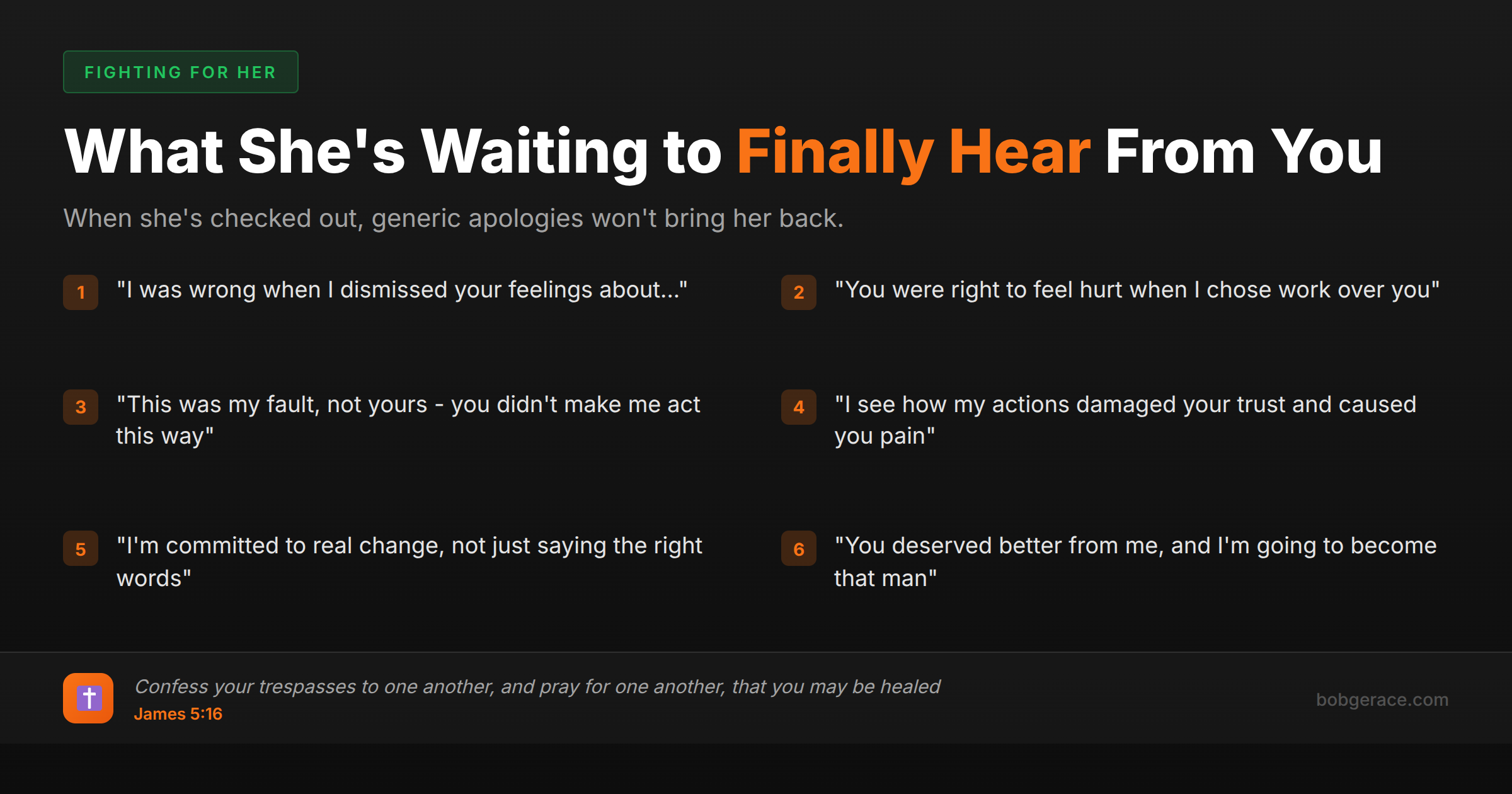
When your wife has checked out, she's often waiting to hear specific acknowledgments you haven't given yet. She needs to hear that you see the pain you've caused, that you understand how your actions (or inactions) affected her, and that you take full responsibility without excuses or deflection. She's not looking for generic apologies - she needs you to demonstrate that you truly understand her experience and the depth of hurt she's carried. Most importantly, she needs to hear that you're committed to real change, not just words, and that you value her enough to do the hard work of becoming the husband she needed all along.
The Full Picture
When a woman checks out emotionally, she's usually been sending signals for months or years that went unheard. Now you're asking what she needs to hear, which tells me you're finally ready to listen - that's actually a huge step forward.
She's not waiting for grand gestures or flowery speeches. She's waiting for you to demonstrate that you finally understand her reality. Think about the conversations where she tried to tell you something was wrong, the times she expressed hurt or frustration, the moments when she needed your support but felt dismissed or minimized.
The words she needs to hear are specific to your relationship, but they usually fall into these categories: acknowledgment of specific hurts you caused, validation of her feelings that you previously dismissed, and ownership of patterns you've denied or minimized. She needs to hear that you see how your selfishness, inattention, or harsh words damaged her trust and made her feel alone in the marriage.
Here's what most men get wrong: they think she wants to hear "I love you" or "I'm sorry" for the hundredth time. But if you've already said those words while continuing the same behaviors, they've lost all meaning. She needs to hear you acknowledge the gap between your words and actions, and she needs to see evidence that you understand why that gap was so devastating to her sense of security and connection in the marriage.
What's Really Happening
When a spouse has emotionally withdrawn, they've typically experienced what we call 'attachment injury' - repeated instances where their attempts to connect were met with dismissal, criticism, or emotional unavailability. The question 'What does she need to hear?' indicates you're recognizing that there's been a communication breakdown at the validation level.
Neurologically, her brain has shifted into protective mode. The emotional centers that once sought connection with you are now focused on self-preservation. She's not being stubborn or vindictive - she's responding to perceived emotional threats in the relationship. The words she needs to hear must address the specific attachment injuries that caused this protective response.
Research shows that effective repair requires three elements: acknowledgment of the specific harm, understanding of the emotional impact, and concrete commitment to behavioral change. Generic apologies activate her threat detection system because they signal that you still don't truly understand what went wrong. She needs to hear you articulate the specific ways your behavior affected her sense of safety and connection.
Most importantly, she needs to hear ownership without defensiveness. When you explain or justify your actions, even partially, her nervous system interprets this as continued threat. The healing words she's waiting for demonstrate complete ownership and understanding of your role in the relationship's deterioration.
What Scripture Says
Scripture gives us clear direction on the kind of communication that heals relationships. James 5:16 tells us to "confess your trespasses to one another, and pray for one another, that you may be healed." Notice it's not just about saying sorry - it's about confessing the specific ways we've wronged each other.
Proverbs 28:13 declares, "He who covers his sins will not prosper, but whoever confesses and forsakes them will have mercy." The words she needs to hear involve uncovering and acknowledging your sins against the marriage, not covering them with excuses or minimization. This requires the humility to admit specific failures without self-protection.
1 Peter 3:7 commands husbands to dwell with their wives "according to knowledge, giving honor to the wife." The phrase "according to knowledge" means you need to understand her specific needs, hurts, and perspective. She needs to hear that you've gained this knowledge - that you finally see and understand her heart.
Matthew 5:23-24 teaches us about reconciliation: "If you bring your gift to the altar, and there remember that your brother has something against you, leave your gift there before the altar, and go your way. First be reconciled to your brother." She needs to hear you acknowledge what she has against you - the specific grievances and hurts - before trying to move forward. This biblical principle of acknowledgment before reconciliation is crucial for healing.
What To Do Right Now
-
1
Write down specific instances where you hurt, dismissed, or failed her - be brutally honest about your role without excuses or justifications
-
2
Acknowledge these specific failures directly: 'I was wrong when I...' followed by the exact behavior and its impact on her
-
3
Validate feelings you previously dismissed: 'You were right to feel hurt/angry/frustrated when I...' - make her emotions valid, not wrong
-
4
Take complete ownership: 'This was my fault, not yours. You didn't cause me to act this way, and you shouldn't have had to deal with it.'
-
5
Address patterns, not just incidents: 'I see now that I have a pattern of... and this has made you feel unsafe/unheard/unloved in our marriage'
-
6
Commit to specific changes with accountability: 'I am going to... and I want you to hold me accountable when I slip back into old patterns'
Related Questions
- What is 'felt understanding' and how do I give it?
- Why didn't my past apologies work?
- What is an 'apology' vs. 'repair' vs. 'attunement'?
- What's the difference between explaining and validating?
- What does genuine repair look like for old wounds?
- She doesn't believe I understand what I did
- How do I not pursue while also not abandoning?
- What does 'taking responsibility' actually look like?
- What does non-defensive response look like?
- How do I express emotion without dumping?
Also find Bob on
Subscribe for weekly videos on Christian marriage.
Not sure what YOUR wife needs to hear?
A coach who knows your story can help you find the words that land—not generic scripts, but what matters in your specific marriage.
Talk to Bob →